


Geopolitical Risks Push Up Oil Prices, U.S.-Iran Confrontation May Escalate, Lebanon-Israel Ceasefire Extension Fails to Ease Geopolitical Premium
TradingKey - Crude oil futures closed sharply higher on Friday, with weekly gains significantly widening. Resurging geopolitical tensions dampened market expectations for a de-escalation agreement between the U.S. and Iran and the lifting of shipping restrictions in the Strait of Hormuz, driving energy prices rapidly upward.
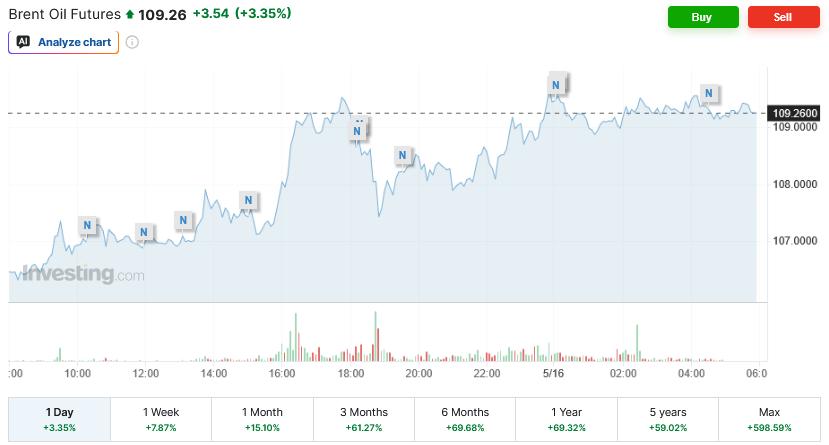
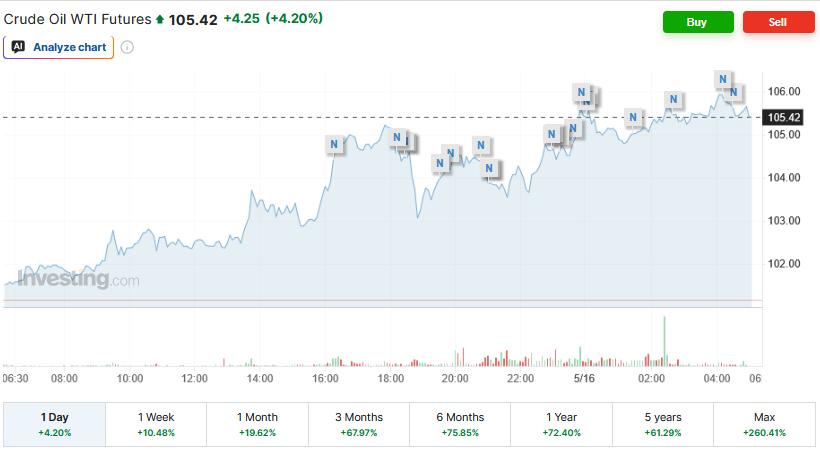
Price data showed that the front-month Brent crude oil futures contract in London closed at $109.26 per barrel, up $3.54 or 3.35% for the day; West Texas Intermediate (WTI) crude futures closed at $105.42 per barrel, up $4.25 or 4.2%.
On a cumulative weekly basis, Brent crude rose 7.84%, while WTI crude surged 10.48%, reflecting the market's continued pricing in of supply disruption risks.
U.S. President Trump stated clearly during an interview on Air Force One on Friday that the current ceasefire arrangement between the U.S. and Iran was reached "at the request of other countries" and that he personally did not originally support it.
He emphasized that Iran's previous negotiation proposal was "unacceptable" and that if it involved the issue of nuclear weapons, he "wouldn't even finish reading the first sentence." Trump also warned that the U.S. has the capability to cripple Iran's critical infrastructure in the short term, including bridges and power grids.
Iranian Foreign Minister Araghchi stated on Friday that Iran has "zero trust" in the U.S. and is only willing to negotiate if the U.S. shows a serious attitude; meanwhile, he said Iran is prepared to return to battle but also hopes to resolve the issue through diplomatic channels.
Analysts at Commerzbank noted, "The tone between the U.S. and Iran has clearly become more confrontational again. While the ceasefire is still holding, hopes for a swift reopening of the Strait of Hormuz have been dashed."
Simultaneously, the U.S. State Department announced that the ceasefire agreement between Israel and Lebanon will be extended by 45 days, bringing some measure of calm to the regional situation.
However, the 48-hour high-level bilateral summit between Trump and China's top leadership in Beijing ultimately failed to reach a concrete plan to end the regional conflict, dashing expectations for a swift resolution to geopolitical tensions and triggering a new round of volatility in global energy markets.
Regarding shipping data, the Iranian Revolutionary Guard Corps (IRGC) disclosed that a total of 30 vessels transited the Strait of Hormuz from Wednesday night through Thursday. Shipping analytics firm Kpler also confirmed that 10 vessels passed through the waterway in the past 24 hours.
Although these figures remain far below the pre-conflict average of 140 vessels per day, they represent a significant recovery from the recent lows of 5 to 7 vessels per day.
PVM analyst Tamas Varga believes that the marginal improvement in vessel traffic affects market sentiment more than it substantively changes the crude oil supply-demand balance.
Global oil inventories are being depleted at a historic pace. The International Energy Agency (IEA) stated in its latest monthly oil report released on the 13th that as tanker transit through the Strait of Hormuz remains restricted, cumulative supply losses from Gulf oil producers have exceeded 1 billion barrels, with forced production shut-ins currently exceeding 14 million barrels per day, constituting an unprecedented supply shock.
Recommended Articles


