


Duke vs. Dominion: Which Dividend-Paying Utility Stock Pays You Better in the Long Run?
Key Points
Like most other utility names, the rise of AI data centers is driving tremendous demand for both companies.
One of these outfits entered this era of data center growth already in a difficult capitalization position.
This same company faces an outstanding growth opportunity, but it's proving expensive to capitalize on. It's not clear when -- or if -- its investments will adequately pay off.
- 10 stocks we like better than Duke Energy ›
Contrary to a common assumption, not all utility stocks are the same. Not only do they offer differing dividend yields, but each also brings different degrees of risk and upside to the table.
And this raises a question: Among the lower-profile names in the business like Duke Energy (NYSE: DUK) and Dominion Energy (NYSE: D), which is the better long-term bet for income-minded investors?
Will AI create the world's first trillionaire? Our team just released a report on the one little-known company, called an "Indispensable Monopoly" providing the critical technology Nvidia and Intel both need. Continue »
The answer might surprise you.

Image source: Getty Images.
On hold 'til further notice
Dominion offers the higher forward-looking dividend yield of 4.2% right now, versus Duke's 3.4%. And for some people, that information alone would be enough to choose one over the other.
As veteran investors can attest, however, there's always more to the story. There's a reason these two seemingly similar utility companies' stocks sport such drastically different dividend yields.
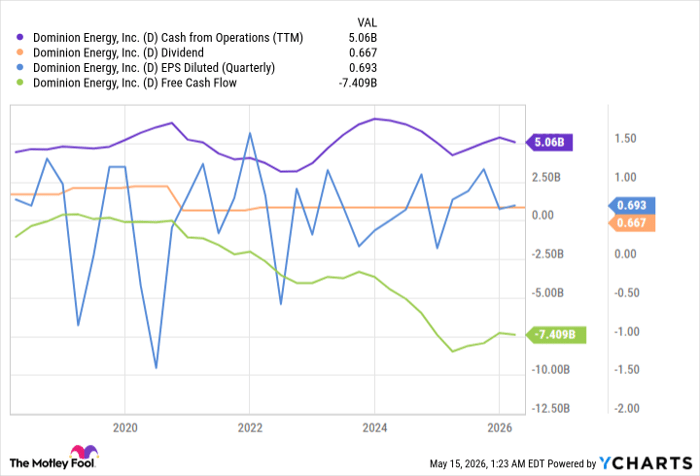
That reason, of course, is each company's rate of dividend growth. Duke Energy's quarterly per-share payout has improved by 29% over the past 10 years, while Dominion's hasn't budged at all since 2022, being restored to a quarterly payment of only $0.6675 per share after a major cut to its dividend during the COVID-19 pandemic.
The decision is understandable. The highly indebted company's been working to improve the health of its balance sheet. As of the end of 2022, the then-$68 billion company's $38.9 billion in long-term debt was costing it on the order of $1 billion worth of interest charges every year, making it difficult -- if not impossible -- to cover a dividend payment and make necessary capital expenditures and work on its balance sheet. It opted to keep dividend payments to a minimum, even if only temporarily (albeit indefinitely).
Dominion Energy's plan isn't exactly working as hoped at the time, though. While revenue is growing as the utility outfit adds production capacity to meet the artificial intelligence (AI) data center industry's ever-growing demand for power, debt is rising. And for that matter, so is the number of outstanding shares.
One thing that's not growing right now? Dominion Energy's per-share profitability and cash flow, making it difficult to even consider starting to raise dividends again in the foreseeable future. The company's dividend payout ratio consistently remains above 90% as well, leaving it little to no fiscal wiggle room.
Data by YCharts.
A bird in the hand...
Never say never. Dominion is certainly geographically positioned to take full advantage of the proliferation of AI data centers. See, it serves northern Virginia, where an incredible 450 data centers are located. The business is there to be won. Whether or not Dominion Energy can meet this demand and simultaneously widen its profit margins anytime soon, however, remains to be seen. And that's the more immediate concern for income investors.
Bottom line? Duke is more likely to better reward newcomers in the long run -- despite its lower dividend yield right now -- simply because there's no telling how long it might take Dominion to start raising its payouts again.
Should you buy stock in Duke Energy right now?
Before you buy stock in Duke Energy, consider this:
The Motley Fool Stock Advisor analyst team just identified what they believe are the 10 best stocks for investors to buy now… and Duke Energy wasn’t one of them. The 10 stocks that made the cut could produce monster returns in the coming years.
Consider when Netflix made this list on December 17, 2004... if you invested $1,000 at the time of our recommendation, you’d have $469,293!* Or when Nvidia made this list on April 15, 2005... if you invested $1,000 at the time of our recommendation, you’d have $1,381,332!*
Now, it’s worth noting Stock Advisor’s total average return is 993% — a market-crushing outperformance compared to 207% for the S&P 500. Don't miss the latest top 10 list, available with Stock Advisor, and join an investing community built by individual investors for individual investors.
See the 10 stocks »
*Stock Advisor returns as of May 16, 2026.
James Brumley has no position in any of the stocks mentioned. The Motley Fool recommends Dominion Energy and Duke Energy. The Motley Fool has a disclosure policy.
Recommended Articles


