


Today’s Market Recap: US Inflation Hits 3-Year Peak as Market Braces for Trump’s China Visit and Fed Leadership Shift
Track the Market Trend
TradingKey - For most investors, the quarterly earnings season represents a critical period. This six-week window, during which the majority of S&P 500 companies disclose their operating results, offers vital insights into the stability of the U.S. corporate landscape and the sustainability of bull and bear markets on Wall Street.
However, a development even more significant than corporate earnings releases has arrived today, carrying the potential to impact the Dow Jones Industrial Average, the S&P 500, and the Nasdaq Composite .
The April CPI figures arrived higher than anticipated at an annual rate of 3.8%, propelled by a spike in gasoline prices. This data pushed 10-year Treasury yields to a one-year peak of 4.46%. The Nasdaq has faced the most significant pressure: Intel (INTC), Qualcomm (QCOM), and Micron (MU) have each declined by 4% or more, while the S&P 500 and the Dow remain relatively flat.
Regarding individual equities, Boeing (BA) saw a decline amid concerns over trade and the 737 MAX. Meanwhile, Teva Pharmaceutical Industries (TEVA) experienced a sharp drop after being named alongside other firms in a price-fixing lawsuit.
Market Headline
The White House has released a list of 16 American business leaders set to accompany President Trump on his state visit to China. According to several U.S. media outlets cited by CCTV, the delegation includes representatives from the technology, finance, aviation, and agriculture sectors. Key figures in the technology sector include Elon Musk of Tesla (TSLA), Tim Cook of Apple (AAPL), and executives from semiconductor giants Qualcomm (QCOM) and Micron Technology (MU). The financial sector is represented by leaders from Wall Street firms such as Citigroup (C), Goldman Sachs (GS), and Blackstone (BX). Additionally, Boeing (BA) and Cargill represent the aviation and agriculture industries, respectively.
U.S. inflation figures for April came in unexpectedly high, with the CPI rising 3.8% year-over-year to reach a three-year peak, while the core CPI increased to 2.8%. The impact of the conflict in Iran is permeating the pricing system through rising costs in energy, airfare, and transportation. Furthermore, memory chip costs are experiencing uncontrolled surges due to the intensifying "AI race." Technical factors also influenced the data, as the Bureau of Labor Statistics (BLS) implemented a one-time correction for distortions in rent and housing data caused by last October's government shutdown.
A U.S. appeals court has paused a ruling that opposed Trump’s 10% global tariff, allowing the levies to remain in effect. The U.S. Court of Appeals for the Federal Circuit issued an administrative stay, maintaining the tariffs' validity during the appeal process; importers must continue payments as usual. This follows a previous ruling by the U.S. Court of International Trade that declared the policy invalid. The Trump administration argued that an immediate voiding of the tariffs would undermine the President's economic agenda and disrupt ongoing foreign trade negotiations.
The U.S. Senate confirmed Kevin Warsh as a member of the Federal Reserve Board of Governors on Tuesday for a 14-year term, clearing the path for him to succeed Jerome Powell as Chair. The Senate has also initiated the confirmation process for Warsh’s four-year term as Fed Chair, with a vote potentially occurring as early as Wednesday. Jerome Powell’s term as Chair is set to expire this Friday.
A proposal for an "AI Citizen Dividend" in South Korea caused the stock market to plunge as much as 5% before officials clarified the plan. The Kospi index dropped 5.1% intraday following the Presidential Office's suggestion, though sentiment stabilized after clarifications that funding would come from "excess tax revenue" rather than a windfall tax on corporations. However, amid surging profits at giants like Samsung Electronics (005930) and union demands for profit-sharing, the redistribution of wealth in the AI era has emerged as a significant policy risk, increasing volatility pressure on the highly concentrated Korean market.
OpenAI is investing $4 billion to aggressively pursue the Front-end Deployment Engineering (FDE) market. By establishing a dedicated deployment company and acquiring the consultancy firm Tomoro, OpenAI is shifting the AI competition from model parameters to enterprise implementation. As demand for traditional software engineers has plummeted by 70%, the need for FDEs — who work on-site to integrate AI solutions for clients — has surged by nearly 1,000%, making them the most sought-after talent in the next phase of AI development.
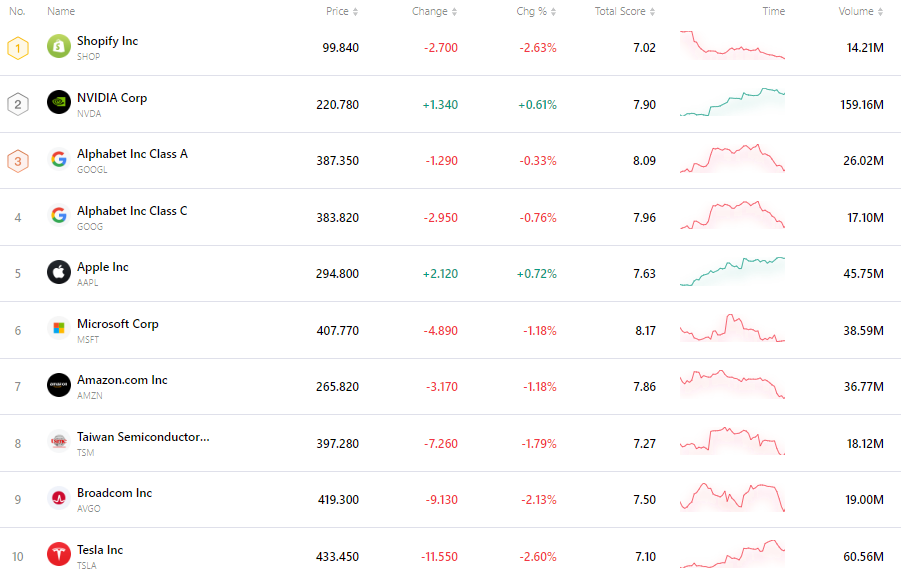
Top 10 Most Traded Stocks
The chart below lists the ten most actively traded stocks in the market last Friday. Bolstered by massive trading volume and exceptional liquidity, these assets have become key benchmarks for tracking global market dynamics.
Recommended Articles


