


Circle Revenue Hits Record High; Stock Soars Nearly 16%, Clarity Act to Be Key to Returning to Peak
TradingKey - Circle reported record Q1 revenue, driving the stock to a near two-month high; however, its future development is inextricably linked to the CLARITY Act.
On May 11, Eastern Time, the leading stablecoin stock Circle ( CRCL) released its fiscal Q1 2026 earnings report. The stock price dipped briefly before surging 15.91% to close at $131.76, hitting a high since March 17. Can Circle's stock continue to rise and break through this resistance level?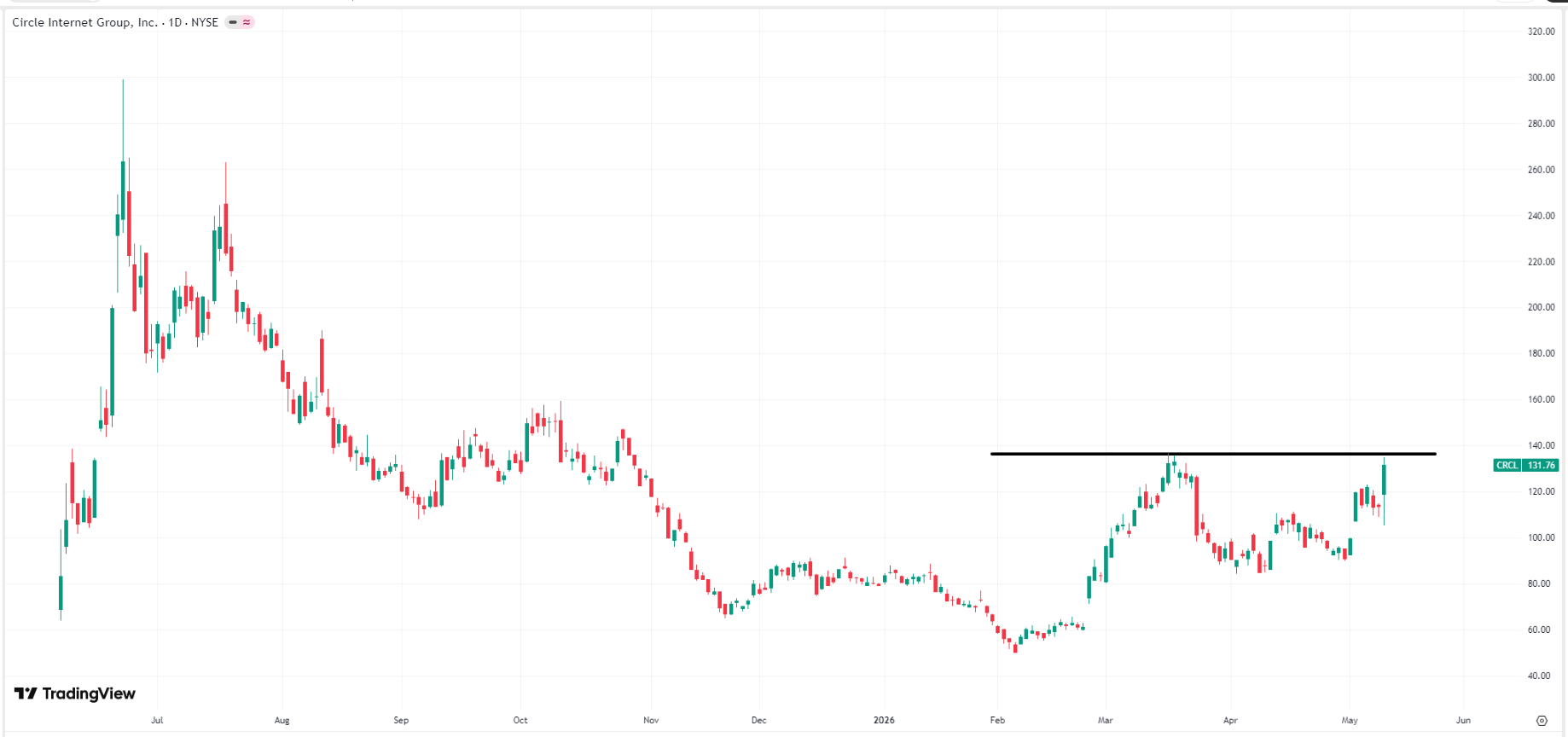 Circle stock price chart, source: TradingView
According to the released financial data, Circle's total Q1 revenue grew 20% year-over-year to $694 million, a record high. However, substantial stock-based compensation expenses following its listing and heavy R&D investment caused operating expenses to surge 76%, sharply eroding its net profit.
Although Circle's net profit was only $55 million, down 15% year-over-year, its GAAP earnings per share (EPS) of $0.21 was significantly higher than the market expectation of $0.15, acting as a key catalyst for the stock's strength. Furthermore, Circle has two strategic highlights supporting its stock price: the ARC ecosystem token presale and the Circle Agent Stack.
The Circle Agent Stack is a financial infrastructure suite designed specifically for AI agents, primarily consisting of two components: (1) Agent Wallets: enabling AI bots to autonomously hold and manage funds; (2) Nanopayments: supporting ultra-low amount (as low as $0.000001) machine-to-machine (M2M) high-frequency payments. During service provision, Circle can charge a nominal transaction fee or fixed service fee for each micropayment between AI agents, diversifying its revenue and reducing reliance on interest income from USD reserves.
Circle completed the presale of ARC tokens, attracting top institutions such as a16z Crypto, BlackRock ( BLK) and Apollo, raising $222 million. This not only provided direct funding but also secured endorsements from these giants for the ARC protocol. As USDC serves as the pricing and settlement unit for the protocol, it is bound to drive USDC long-term growth in circulating supply.
Although Circle is accelerating the expansion of USDC use cases, regulatory compliance issues remain unresolved and are highly dependent on the CLARITY Act. If the act is passed, Circle can implement its strategic plans to promote USDC circulation and trading, driving higher revenue to support its stock price and even challenge its historical high of $300. However, if the bill is rejected, the very survival of USDC could become problematic.
Recommended Articles


