


Ripple Price Forecast: XRP sellers tighten grip as network growth slows
- XRP losses persist for the fifth consecutive day, testing support at $1.37 on Tuesday.
- The XRP Ledger sees a sharp decline in the number of addresses joining the network amid reduced speculative interest.
- Mild inflows into XRP spot ETFs fail to boost sentiment amid fragile momentum indicators.
Ripple (XRP) is trading above $1.37, struggling to find a solid footing at the time of writing on Tuesday amid a broad crypto market drawdown. The persistent decline marks the fifth consecutive day of sellers tightening their grip, leaving XRP vulnerable.
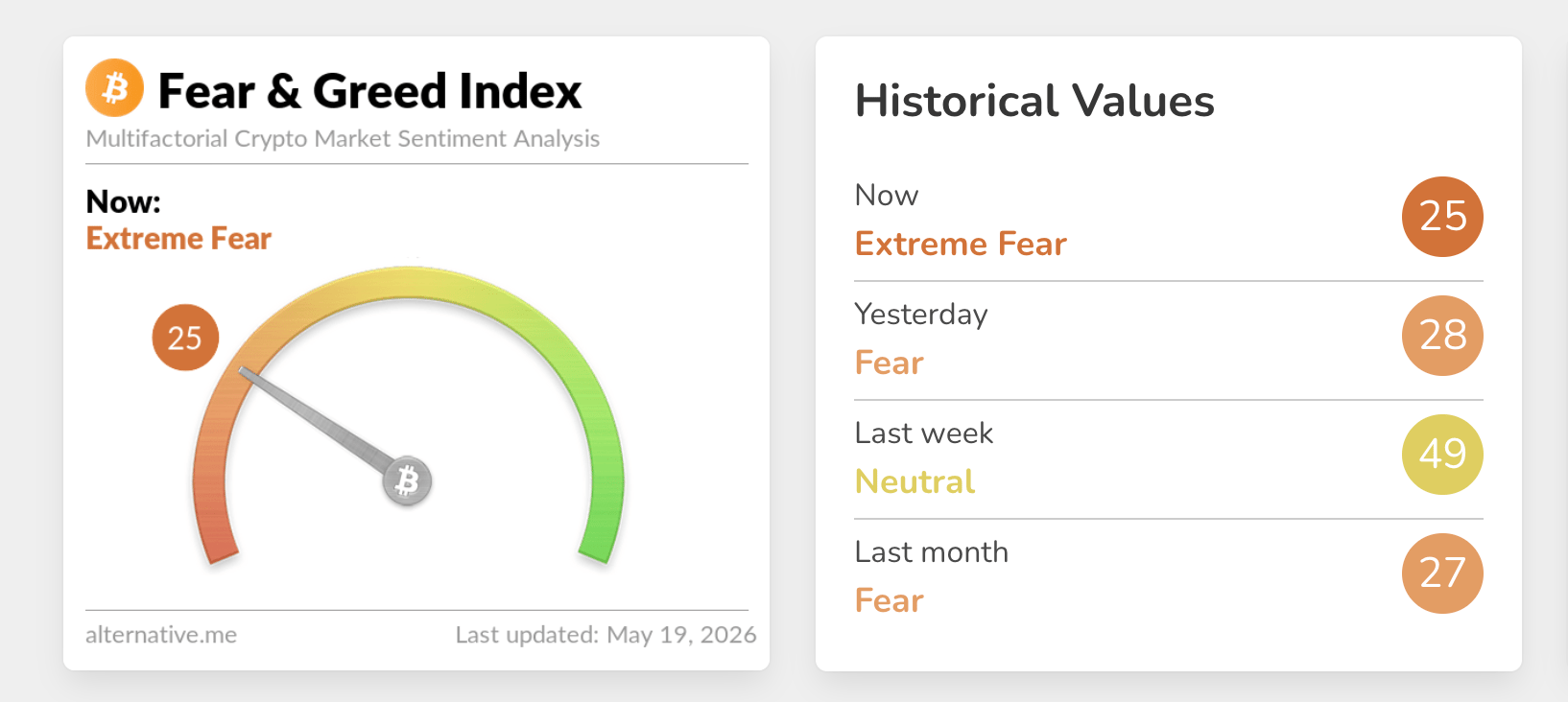
Risk appetite is generally cooling, as evidenced by the crypto Fear & Greed Index, which measures market sentiment, falling to 25 in the Extreme Fear territory on Tuesday, down from 28 the previous day and 49 last week.
XRP network growth cools amid modest ETF inflows
The XRP Ledger (XRPL) continues to face declining adoption, with fewer new users joining the protocol. According to Santiment data, newly created addresses on the network dropped sharply near 780 on Tuesday, from roughly 2,600 the previous day.
Such a decline is an early signal of fading user adoption, interest and demand for the XRP. Fewer users on the blockchain could mean low network activity or speculative inflows needed to reinforce a steady bullish outlook, shifting the edge toward defensive positioning until growth metrics stabilize or reverse.
 [14-1779192389273.06.24, 19 May, 2026].png)
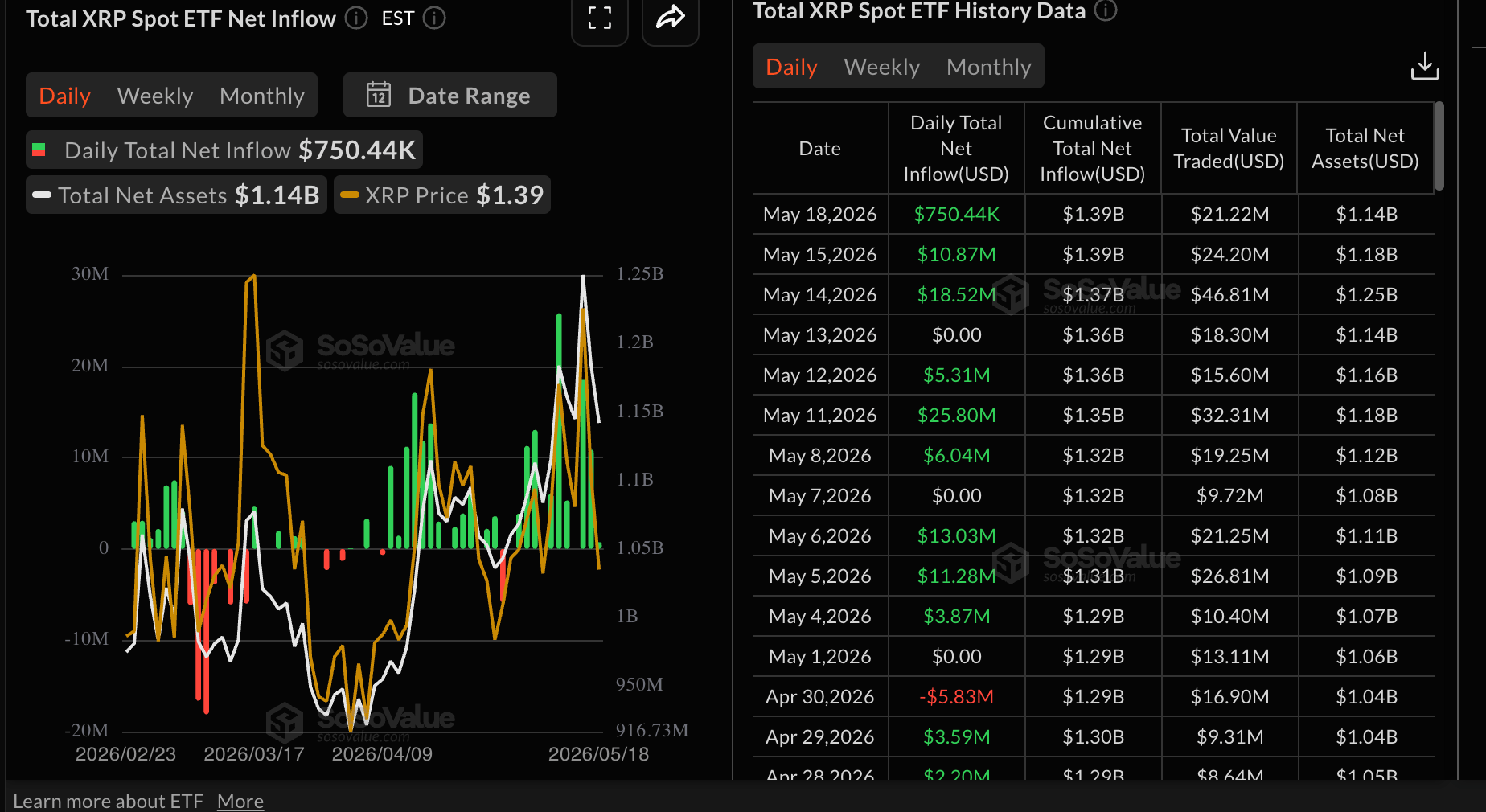
XRP spot Exchange-Traded Funds (ETFs) mirror the protocol’s weakness and loss of appetite, as inflows plunged a mere $750,000 on Monday, from nearly $11 million on Friday. Although cumulative inflows steadied at $1.39 billion, net assets under management narrowed to $1.14 billion from $1.18 billion over the same period.
Sustaining inflows into the ETFs could help stabilize sentiment and raise the odds of a recovery. However, if institutions sense uncertainty and pull their funds, declines could accelerate.
Price analysis: XRP slides as pressure builds
XRP trades above $1.37, extending its retreat below a dense cap of moving averages and a recently broken ascending trendline, which keeps the near-term bias bearish. Momentum indicators reinforce the downside tilt, with the Relative Strength Index (RSI) slipping to about 43 on the daily chart and the Moving Average Convergence Divergence (MACD) histogram turning negative below the zero line, even as the Money Flow Index (MFI) stabilizes near 50, hinting at balanced but fragile flows.
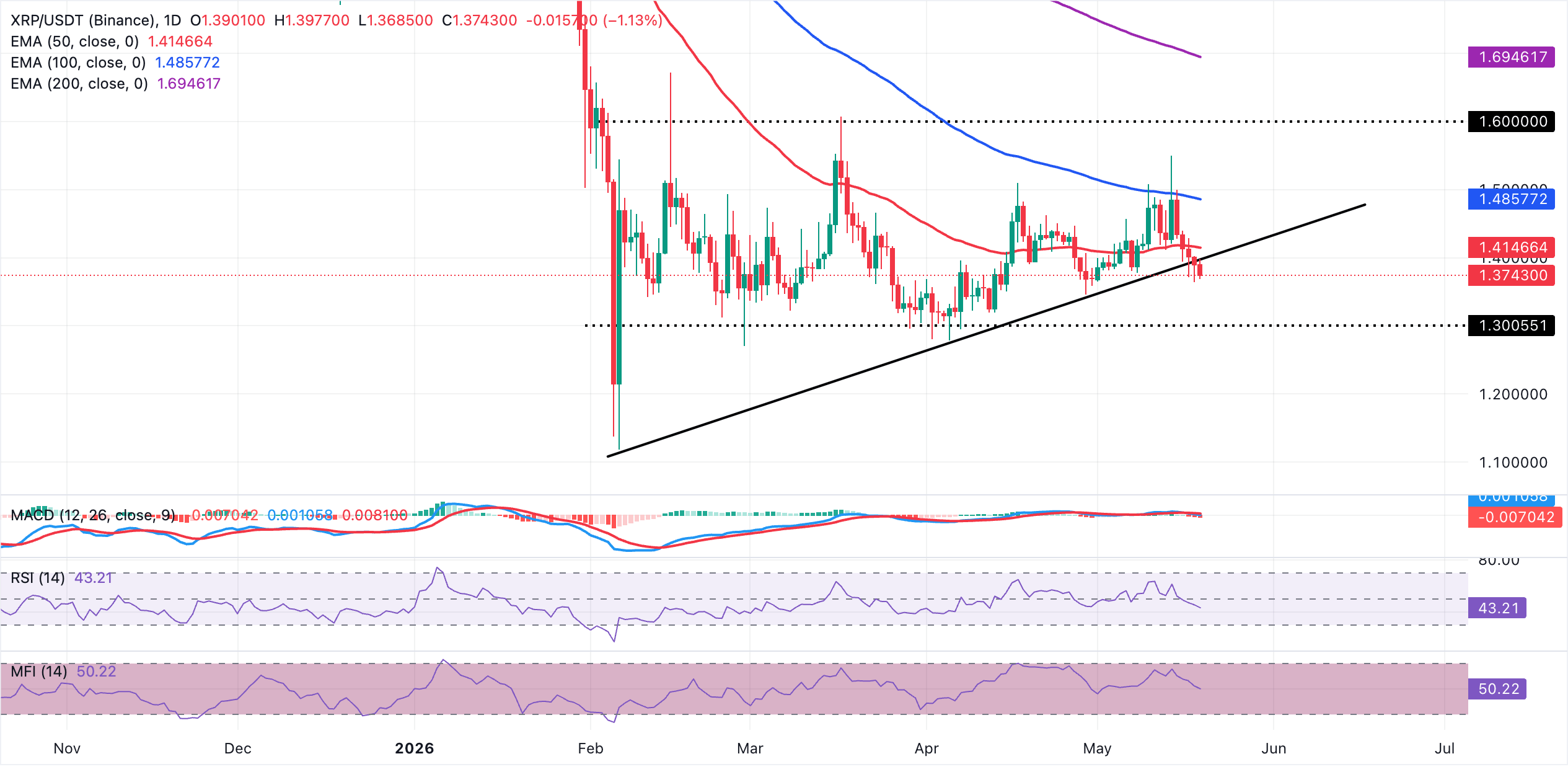
On the topside, initial resistance lies at the ascending trendline break near $1.40, followed by the 50-day Exponential Moving Average (EMA) at $1.41, which would need to be overcome to ease immediate selling pressure. Above that barrier, the 100-day EMA at $1.49 marks the next supply area ahead of the more distant 200-day EMA around $1.69, which frames the broader downbeat structure.
If the sell-off continues, XRP could drop to retest a short-term support at $1.35, with extended pressure likely to expose a deeper demand level at $1.30.
(The technical analysis of this story was written with the help of an AI tool.)
Crypto ETF FAQs
An Exchange-Traded Fund (ETF) is an investment vehicle or an index that tracks the price of an underlying asset. ETFs can not only track a single asset, but a group of assets and sectors. For example, a Bitcoin ETF tracks Bitcoin’s price. ETF is a tool used by investors to gain exposure to a certain asset.
Yes. The first Bitcoin futures ETF in the US was approved by the US Securities & Exchange Commission in October 2021. A total of seven Bitcoin futures ETFs have been approved, with more than 20 still waiting for the regulator’s permission. The SEC says that the cryptocurrency industry is new and subject to manipulation, which is why it has been delaying crypto-related futures ETFs for the last few years.
Yes. The SEC approved in January 2024 the listing and trading of several Bitcoin spot Exchange-Traded Funds, opening the door to institutional capital and mainstream investors to trade the main crypto currency. The decision was hailed by the industry as a game changer.
The main advantage of crypto ETFs is the possibility of gaining exposure to a cryptocurrency without ownership, reducing the risk and cost of holding the asset. Other pros are a lower learning curve and higher security for investors since ETFs take charge of securing the underlying asset holdings. As for the main drawbacks, the main one is that as an investor you can’t have direct ownership of the asset, or, as they say in crypto, “not your keys, not your coins.” Other disadvantages are higher costs associated with holding crypto since ETFs charge fees for active management. Finally, even though investing in ETFs reduces the risk of holding an asset, price swings in the underlying cryptocurrency are likely to be reflected in the investment vehicle too.
Recommended Articles


