


Gold back to $5,400? Here’s why Goldman Sachs still sees bullish potential ahead
- Goldman Sachs maintains its bullish target for Gold at $5,400 by year-end.
- Central bank purchases are expected to increase, supporting Gold prices.
- Gold’s short-term outlook remains weak as higher yields globally weigh on investors’ appetite for the precious metal.
Central banks are expected to increase their Gold purchases in 2026, analysts at Goldman Sachs say, supporting a much-needed boost to the precious metal toward the end of the year.
Central bank buying is expected to average 60 tonnes a month on average this year, more than the 12-month moving average of 50 tonnes seen in March, analysts Lina Thomas and Daan Struyven said in a note dated May 15, Bloomberg reports.
Central bank buying is considered one of the main factors supporting the Gold price, which reached an all-time high of around $5,600 per troy ounce at the end of January. “There’s a strong underlying interest in Gold, and recent geopolitical developments are likely to reinforce diversification,” the analysts said, citing an in-house survey.
Given the boost from institutional demand, the analysts maintained Gold’s price target by year-end at $5,400, close to its record high. The precious metal currently trades at around $4,500, weighed down by soaring global bond yields as inflation expectations continue to climb.
-1779110349021.png)
Despite the upbeat forecast, Goldman Sachs was more cautious when analyzing the near-term outlook for the metal. Gold is “a natural source of cash if private investors face liquidity needs — for example, if equity markets sell off amid higher rates and weaker growth expectations,” the analysts said.
Some central banks are already stepping up their purchases. According to data from the World Gold Council (WGC), the People’s Bank of China (PBoC) has purchased 8 tonnes in April, the highest level since December 2024. Gold now accounts for approximately 9% of China's overall foreign exchange reserves.
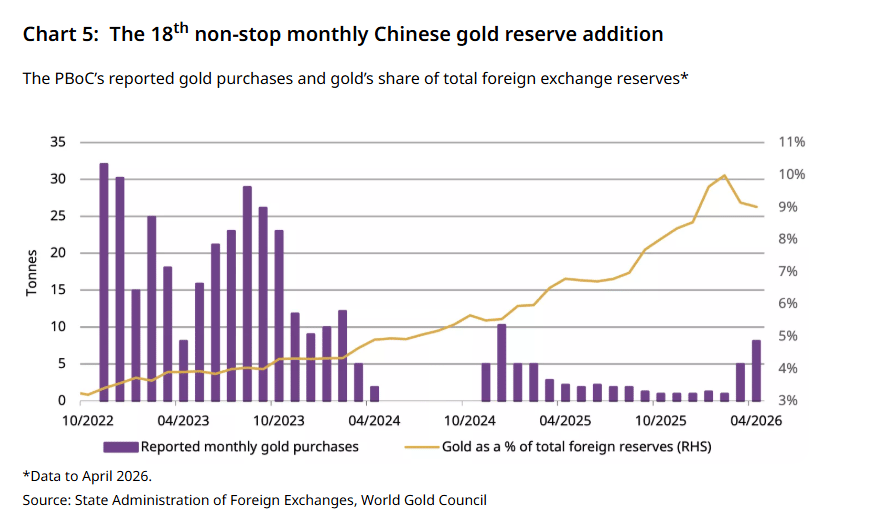
In the first quarter, data from the WGC shows that global central banks bought 244 tonnes of Gold, a 3% increase compared with the same period a year earlier, despite a visible uptick in selling activity from certain countries during the quarter.
“Our view remains that investment and central bank demand will be supported by ongoing geopolitical risk, with further investment impetus from elevated inflation and persistent high gold prices,” the WGC said.
Gold FAQs
Gold has played a key role in human’s history as it has been widely used as a store of value and medium of exchange. Currently, apart from its shine and usage for jewelry, the precious metal is widely seen as a safe-haven asset, meaning that it is considered a good investment during turbulent times. Gold is also widely seen as a hedge against inflation and against depreciating currencies as it doesn’t rely on any specific issuer or government.
Central banks are the biggest Gold holders. In their aim to support their currencies in turbulent times, central banks tend to diversify their reserves and buy Gold to improve the perceived strength of the economy and the currency. High Gold reserves can be a source of trust for a country’s solvency. Central banks added 1,136 tonnes of Gold worth around $70 billion to their reserves in 2022, according to data from the World Gold Council. This is the highest yearly purchase since records began. Central banks from emerging economies such as China, India and Turkey are quickly increasing their Gold reserves.
Gold has an inverse correlation with the US Dollar and US Treasuries, which are both major reserve and safe-haven assets. When the Dollar depreciates, Gold tends to rise, enabling investors and central banks to diversify their assets in turbulent times. Gold is also inversely correlated with risk assets. A rally in the stock market tends to weaken Gold price, while sell-offs in riskier markets tend to favor the precious metal.
The price can move due to a wide range of factors. Geopolitical instability or fears of a deep recession can quickly make Gold price escalate due to its safe-haven status. As a yield-less asset, Gold tends to rise with lower interest rates, while higher cost of money usually weighs down on the yellow metal. Still, most moves depend on how the US Dollar (USD) behaves as the asset is priced in dollars (XAU/USD). A strong Dollar tends to keep the price of Gold controlled, whereas a weaker Dollar is likely to push Gold prices up.
Recommended Articles


