


EUR/USD Price Forecast: 1.1600 support holds as bearish momentum lingers
- EUR/USD rebounds modestly as softer US Treasury yields limit further upside in the US Dollar.
- Eurozone inflation remains above the ECB’s 2% target, reinforcing expectations of a June rate hike.
- Technically, EUR/USD remains under bearish pressure below the 50-day and 100-day SMAs, with sellers still controlling the near-term trend.
EUR/USD stages a modest rebound on Wednesday as a pullback in US Treasury yields limits further upside in the US Dollar (USD), while the Euro (EUR) draws support from the latest Eurozone inflation data, which strengthened expectations that the European Central Bank (ECB) could raise interest rates sooner than previously anticipated.
At the time of writing, the pair is trading around 1.1632 after hitting an intraday low near 1.1582, its weakest level since April 7. Meanwhile, the US Dollar Index (DXY), which tracks the Greenback against a basket of six major currencies, consolidates around 99.36 near six-week highs.
Data released by Eurostat showed inflation remained above the ECB's 2% target for a second consecutive month. The Harmonized Index of Consumer Prices (HICP) rose to 3.0% YoY in April from 2.6% in March, driven largely by higher energy prices, while Core HICP eased slightly to 2.2% YoY from 2.3% previously.
Reuters reported on Wednesday, citing sources, that the case for an ECB rate hike in June is now “nearly sealed” as the inflation outlook moves toward the “adverse scenario.”
According to a BHH Market View report, markets are currently pricing in an 86% probability of a 25-basis-point ECB rate hike to 2.25% at the June 11 meeting. However, the report noted that rate hikes in a low-growth, high-inflation environment are not outright bullish for the Euro, though they could help cushion the downside.
At the same time, hawkish Federal Reserve (Fed) expectations and ongoing uncertainty surrounding the US-Iran negotiations continue to keep the US Dollar supported, limiting stronger upside attempts in EUR/USD. From a technical perspective, bearish momentum also suggests sellers remain in control in the near term.
Technical Analysis:
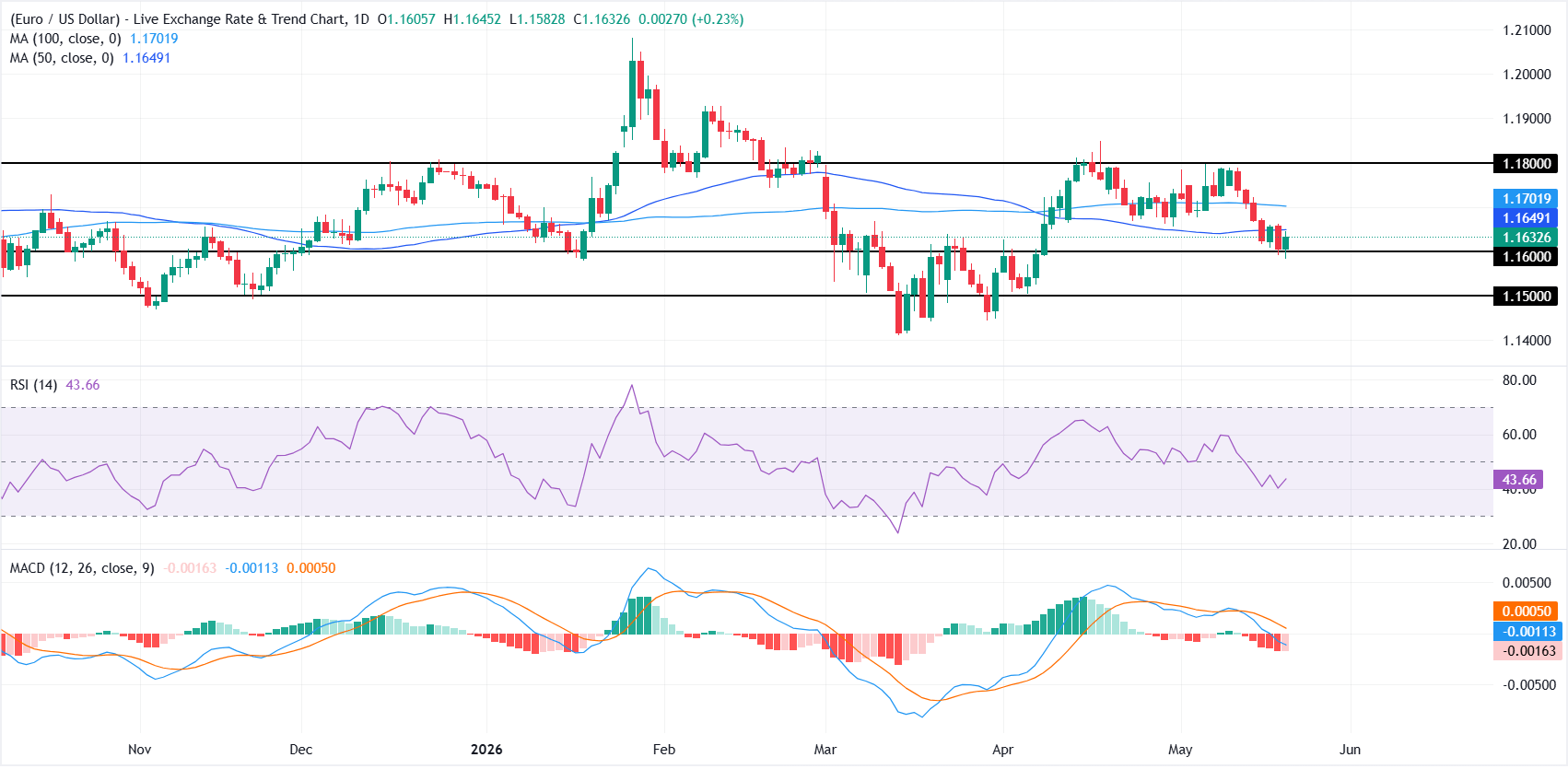
On the daily chart, EUR/USD keeps a bearish bias as it holds below both the 50-day Simple Moving Average (SMA) and the 100-day SMA. The pair is drifting just above a nearby horizontal floor at 1.1600, while the Relative Strength Index (RSI) is around 43 and a negative Moving Average Convergence Divergence (MACD) line with a slightly negative histogram hints that downside momentum remains in place, albeit without extreme conditions.
On the topside, immediate resistance is seen at the 50-day SMA near 1.1649, followed by the 100-day SMA around 1.1701 and the horizontal barrier at 1.1800, which together form a broader supply band. On the downside, initial support comes at 1.1600, with a break exposing the next horizontal level near 1.1500, where buyers would likely attempt to slow the decline.
(The technical analysis of this story was written with the help of an AI tool.)
ECB FAQs
The European Central Bank (ECB) in Frankfurt, Germany, is the reserve bank for the Eurozone. The ECB sets interest rates and manages monetary policy for the region. The ECB primary mandate is to maintain price stability, which means keeping inflation at around 2%. Its primary tool for achieving this is by raising or lowering interest rates. Relatively high interest rates will usually result in a stronger Euro and vice versa. The ECB Governing Council makes monetary policy decisions at meetings held eight times a year. Decisions are made by heads of the Eurozone national banks and six permanent members, including the President of the ECB, Christine Lagarde.
In extreme situations, the European Central Bank can enact a policy tool called Quantitative Easing. QE is the process by which the ECB prints Euros and uses them to buy assets – usually government or corporate bonds – from banks and other financial institutions. QE usually results in a weaker Euro. QE is a last resort when simply lowering interest rates is unlikely to achieve the objective of price stability. The ECB used it during the Great Financial Crisis in 2009-11, in 2015 when inflation remained stubbornly low, as well as during the covid pandemic.
Quantitative tightening (QT) is the reverse of QE. It is undertaken after QE when an economic recovery is underway and inflation starts rising. Whilst in QE the European Central Bank (ECB) purchases government and corporate bonds from financial institutions to provide them with liquidity, in QT the ECB stops buying more bonds, and stops reinvesting the principal maturing on the bonds it already holds. It is usually positive (or bullish) for the Euro.
Recommended Articles


