


Morgan Stanley Stock (MS) Moved Up by 3.38% on May 20: What Investors Need To Know
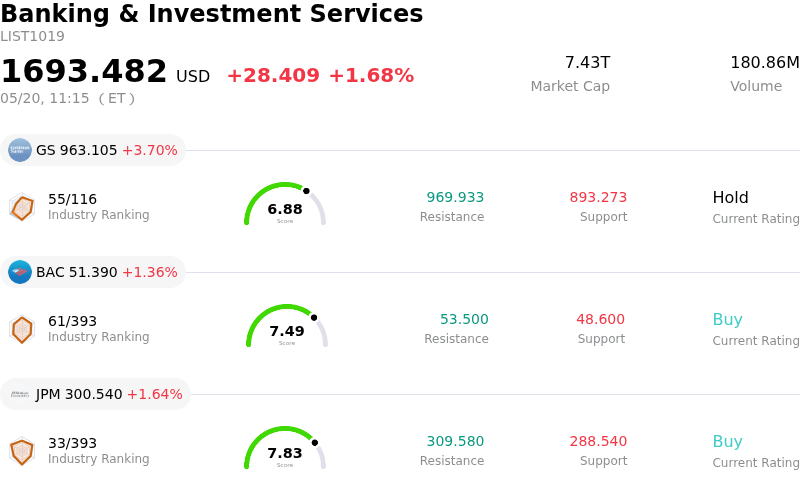
Morgan Stanley (MS) moved up by 3.38%. The Banking & Investment Services sector is up by 1.68%. The company outperformed the industry. Top 3 stocks by turnover in the sector: Goldman Sachs Group Inc (GS) up 3.70%; Bank of America Corp (BAC) up 1.36%; JPMorgan Chase & Co (JPM) up 1.64%.
What is driving Morgan Stanley (MS)’s stock price up today?
Morgan Stanley's stock experienced upward movement, likely driven by a combination of positive analyst sentiment, strong recent financial performance, and an optimistic outlook for key business segments.
A significant catalyst appears to be recent analyst upgrades and increased price targets. CICC Research, for instance, raised its price target for Morgan Stanley and reiterated an "outperform" rating on Tuesday, May 19, 2026. This followed similar positive adjustments from other major firms, including Citigroup, Dbs Bank, and Wells Fargo & Company in the preceding weeks. Additionally, Erste Group Bank upgraded the stock from a "hold" to a "buy" rating in late April. These revised forecasts collectively signal confidence in the company's future prospects.
The positive sentiment is further bolstered by the company's robust first-quarter 2026 earnings, reported on April 15, 2026. Morgan Stanley significantly surpassed analyst expectations for both earnings per share and revenue, with its quarterly revenue showing a notable year-over-year increase. The firm reported record net revenues and pre-tax income, alongside a strong return on tangible common equity, highlighting strong execution across its institutional securities and wealth management divisions. The wealth management segment, in particular, demonstrated considerable momentum with substantial net new assets.
Beyond recent financials, Morgan Stanley's involvement in the highly anticipated SpaceX initial public offering (IPO) as a lead underwriter is generating positive market attention. The formal publication of SpaceX's prospectus, expected around May 20, marks a significant event for the investment banking sector. Morgan Stanley management and research have also expressed a constructive outlook on the broader market, particularly emphasizing the positive impact of AI-driven capital expenditures on U.S. equities and projecting accelerated global mergers and acquisitions (M&A) activity throughout 2026. This optimistic view, coupled with favorable industry predictions from Deloitte regarding AI's potential to unlock new revenue streams for financial services, contributes to a positive environment for Morgan Stanley's stock.
Technical Analysis of Morgan Stanley (MS)
Technically, Morgan Stanley (MS) shows a MACD (12,26,9) value of [4.18], indicating a neutral signal. The RSI at 53.43 suggests neutral condition and the Williams %R at -62.86 suggests oversold condition. Please monitor closely.
Fundamental Analysis of Morgan Stanley (MS)
Morgan Stanley (MS) is in the Banking & Investment Services industry. Its latest annual revenue is $114.74B, ranking 3 in the industry. The net profit is $16.25B, ranking 2 in the industry. Company Profile
Over the past month, multiple analysts have rated the company as Buy, with an average price target of $203.42, a high of $230.00, and a low of $145.00.
More details about Morgan Stanley (MS)
Company Specific Risks:
- Ongoing multi-agency regulatory investigations into Morgan Stanley's anti-money laundering (AML) controls within its wealth management division present a material financial and reputational risk due to potential fines and mandated operational overhauls.
- Identified weaknesses in the firm's internal AML framework, including delayed activation of essential risk tools for certain client segments like E*Trade and insufficient enhanced due diligence on high-risk accounts, increase the exposure to financial crime liabilities and further enforcement actions.
- Morgan Stanley's own analysts have highlighted a macroeconomic fragility, warning that worsening energy volatility or sustained higher oil prices could unsettle markets and trigger a recession, posing a significant risk to the firm's institutional and wealth management businesses.
Recommended Articles


