


Will Ethereum Ever Hit $5,000?
Key Points
Ethereum is the world's most popular platform for developing decentralized applications.
Ether is the native cryptocurrency in the Ethereum ecosystem, and it's used to pay fees whenever decentralized apps are activated.
Ether should become more valuable as the Ethereum network expands, but activity appears to be stagnating.
- 10 stocks we like better than Ethereum ›
Ethereum is the world's largest platform for developing decentralized applications, which are increasingly popular in industries like finance and gaming. Ether (CRYPTO: ETH) is the native cryptocurrency in the Ethereum ecosystem, where it helps facilitate everything from fee payments to money transfers.
Ether set a new all-time high of $4,954 per coin last year, but it has since plummeted by more than 50% and trades at just $2,339 as of March 17. Investors have trimmed their exposure to speculative, high-risk assets like cryptocurrencies during the past six months in favor of safe assets like gold, amid heightened economic uncertainty and geopolitical turmoil.
Will AI create the world's first trillionaire? Our team just released a report on the one little-known company, called an "Indispensable Monopoly" providing the critical technology Nvidia and Intel both need. Continue »
But Ether has experienced sharper sell-offs in the past, and it recovered to deliver spectacular gains on each occasion. Could this downturn be a buying opportunity ahead of a potential run to the $5,000 milestone?

Image source: Getty Images.
The leading destination for decentralized applications
Decentralized apps are designed to function without the need for human intervention, so every user receives equal treatment based on a concrete set of rules. These rules are governed by slivers of computer code called smart contracts, which live on the Ethereum blockchain and typically can't be changed, ensuring no person or company can manipulate an app's core functions.
Whenever someone uses a decentralized app, they activate smart contracts which trigger fees (often called gas) payable in Ether. Gas covers the cost of the computing power required to complete a requested action. It also compensates the people who validate transactions on the blockchain, which keeps the network secure.
Ethereum boasts a perfect 100% uptime during the past 10 years, which is a key reason it's the most trusted ecosystem among developers. Rather than hosting the network in a centralized data center, which is a common strategy in the digital age, Ethereum is hosted on thousands of nodes (computers) spread all over the world. This crowdsourced approach keeps the Ethereum network online, even if some nodes suffer an outage.
Developers have created thousands of decentralized apps on Ethereum so far, but most of them have fringe use cases, and very few have achieved widespread adoption. Uniswap is one of the most successful examples. It's a decentralized exchange where users can swap their cryptocurrencies for other cryptocurrencies, and it uses smart contracts to handle everything from pricing to order execution.
Users can connect their existing crypto wallets to Uniswap without signing up or making an account, so it bypasses a lot of the red tape that creates friction on centralized exchanges like Coinbase. Uniswap is built to succeed in a world where speed and convenience are top priorities for consumers, and it has already processed a whopping $3 trillion in volume since it was established in 2018. This is proof that decentralized apps can succeed at scale.
Will Ether reach $5,000 per coin?
The $5,000 milestone is merely symbolic for Ether investors. It isn't an impenetrable barrier, and the fact that it hasn't been crossed yet is probably due more to sheer bad luck than anything else. Most cryptocurrencies -- even those with legitimate use cases like Ether -- tend to fluctuate based on the whims of speculative investors, which makes them very hard to predict and value.
In theory, Ether should rise in value over the long term if the Ethereum ecosystem continues to expand. More developers and more users would result in more fees, thus increasing the organic demand for Ether. Unfortunately, the number of Ethereum daily active addresses (which is a measure of network activity) seems to have declined during the past few months.
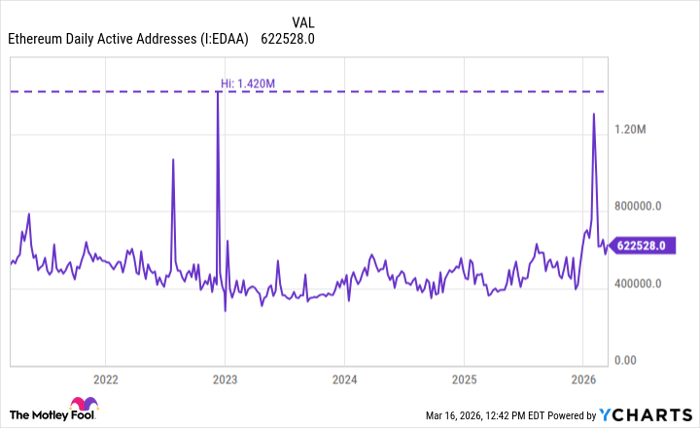
Ethereum Daily Active Addresses data by YCharts.
That's probably bad news for investors who are hoping to see Ether sail past the $5,000 milestone in the near future. However, it might be a mere formality over the longer term, because some Wall Street analysts are forecasting significant gains in the coming years.
One of the Street's top stock market analysts, Tom Lee of Fundstrat Global Advisors, currently serves as chairman of the world's largest Ethereum treasury company, BitMine Immersion Technologies. It owns 4.6 million Ether coins worth $10.5 billion, which represents 3.8% of the total circulating supply.
Lee believes decentralized apps will transform entire industries like financial services, which he says could catapult Ether to $62,000 per coin by 2035. This sounds plausible considering how much potential there is in the decentralized finance segment, but developers will have to create apps that are truly useful outside the crypto universe in order to unlock that kind of upside in Ether.
Should you buy stock in Ethereum right now?
Before you buy stock in Ethereum, consider this:
The Motley Fool Stock Advisor analyst team just identified what they believe are the 10 best stocks for investors to buy now… and Ethereum wasn’t one of them. The 10 stocks that made the cut could produce monster returns in the coming years.
Consider when Netflix made this list on December 17, 2004... if you invested $1,000 at the time of our recommendation, you’d have $510,710!* Or when Nvidia made this list on April 15, 2005... if you invested $1,000 at the time of our recommendation, you’d have $1,105,949!*
Now, it’s worth noting Stock Advisor’s total average return is 927% — a market-crushing outperformance compared to 186% for the S&P 500. Don't miss the latest top 10 list, available with Stock Advisor, and join an investing community built by individual investors for individual investors.
See the 10 stocks »
*Stock Advisor returns as of March 20, 2026.
Anthony Di Pizio has no position in any of the stocks mentioned. The Motley Fool has positions in and recommends Ethereum. The Motley Fool recommends Coinbase Global. The Motley Fool has a disclosure policy.
Recommended Articles


