


Fed Chair Jerome Powell Just Said the Quiet Part Out Loud -- and These 8 Words Are Roiling Wall Street
Key Points
FOMC interest rate decisions are among the most anticipated announcements on Wall Street.
Although the U.S. economy is chugging along and consumer spending remains resilient, inflation is a wildcard that can upend the Fed's existing monetary policy.
A historically divided FOMC is further complicating matters for an expensive stock market.
- 10 stocks we like better than S&P 500 Index ›
Few announcements put investors on the edge of their seats quite like interest rate decisions from the Federal Reserve. Federal Open Market Committee (FOMC) meetings occur about every six weeks and shape U.S. monetary policy.
While the Fed is often viewed as the bedrock of Wall Street and a calming force for equities, eight words from Fed Chair Jerome Powell following the FOMC's March 18 meeting may have spoiled the party for the Dow Jones Industrial Average (DJINDICES: ^DJI), S&P 500 (SNPINDEX: ^GSPC), and Nasdaq Composite (NASDAQINDEX: ^IXIC).
Will AI create the world's first trillionaire? Our team just released a report on the one little-known company, called an "Indispensable Monopoly" providing the critical technology Nvidia and Intel both need. Continue »
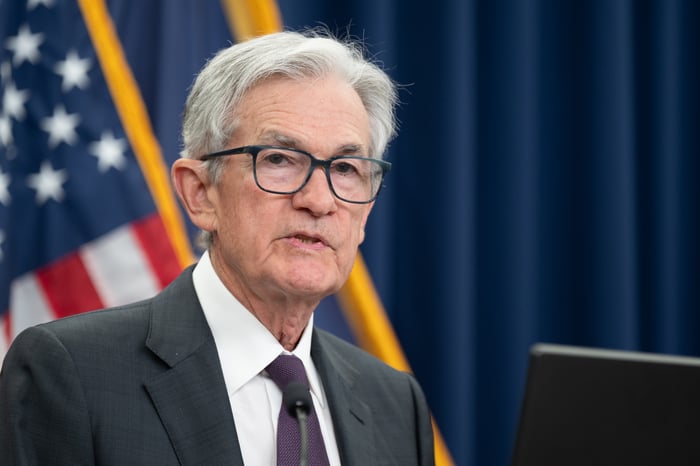
Fed Chair Jerome Powell delivering remarks. Image source: Official Federal Reserve Photo.
Jerome Powell just said the quiet part out loud
In many respects, the FOMC's March 2026 meeting went according to plan. The FOMC voted 11-1 to keep the federal funds target rate unchanged at 3.50% to 3.75%, which was the expectation for investors heading into the meeting. Powell's statements also pointed to steady economic growth and "resilient" consumer spending.
But in Fed Chair Powell's opening statement at the FOMC press conference, he uttered eight words that ultimately roiled Wall Street and its major stock indexes. In response to U.S. and Israeli military actions against Iran and the subsequent skyrocketing of crude oil prices, Powell proclaimed, "higher energy prices will push up overall inflation."
While Jerome Powell and the other members of the FOMC have vowed to adhere to the dual mandate of stabilizing prices and maximizing employment, his statement places the spotlight on inflation being a very real concern in the wake of the Iran war.
The odds of a rate hike over the next three months is now higher than the odds of a cut. A month ago, no one would have believed this. pic.twitter.com/a9K0cTXJS1
-- Ryan Detrick, CMT (@RyanDetrick) March 17, 2026
Although the Fed's dot plot -- a projection from Fed officials of where interest rates will end each of the next three years -- continues to project one quarter-point rate cut in 2026 and one more in 2027, the uncertainty caused by a historic energy supply chain shock can completely upend the Fed's rate-easing cycle. In fact, the Federal Reserve Bank of Atlanta now assigns higher odds to an interest rate hike, rather than a rate cut, over the next three months.
A monetary policy shift could be devastating for the stock market
The stock market entered 2026 at its second-priciest valuation in history, dating back to 1871. Although the rise of artificial intelligence (AI) is a reason equities are pricey, it's not the only one. Investors have also been pricing in several rate cuts for 2026. If those don't come to fruition (which looks highly unlikely given what's going on in the Middle East), sustaining existing premium valuations may prove impossible.
To complicate matters for the Dow Jones Industrial Average, S&P 500, and Nasdaq Composite, Jerome Powell's term ends in less than two months, and the FOMC is more fractured than it's been in a long time.
Anna is correct below when she says:
-- Jim Bianco (@biancoresearch) September 17, 2025
"I have not seen a meeting with so much contradictions."
---
This meeting was a mess.
See the labels in the dot plot below.
One member of the FOMC thinks the Fed is going to HIKE rates this year. One (Stephen Miran) thinks it is going to cut... https://t.co/TRUQmD5I2E pic.twitter.com/qPlJGL57ln
Including the March 2026 meeting, each of the last six FOMC meetings has featured at least one dissenting opinion. In October and December, we witnessed dissents in opposite directions (at least one member favoring no reduction, while another pushed for a more aggressive 50-basis-point cut to the federal funds target rate). There have only been three FOMC meetings with opposite dissents in the last 36 years, and two have occurred since late October.
A monetary policy shift is beginning to feel inevitable in the wake of a historic oil price shock -- and that could prove devastating to an expensive stock market.
Should you buy stock in S&P 500 Index right now?
Before you buy stock in S&P 500 Index, consider this:
The Motley Fool Stock Advisor analyst team just identified what they believe are the 10 best stocks for investors to buy now… and S&P 500 Index wasn’t one of them. The 10 stocks that made the cut could produce monster returns in the coming years.
Consider when Netflix made this list on December 17, 2004... if you invested $1,000 at the time of our recommendation, you’d have $508,877!* Or when Nvidia made this list on April 15, 2005... if you invested $1,000 at the time of our recommendation, you’d have $1,115,328!*
Now, it’s worth noting Stock Advisor’s total average return is 936% — a market-crushing outperformance compared to 189% for the S&P 500. Don't miss the latest top 10 list, available with Stock Advisor, and join an investing community built by individual investors for individual investors.
See the 10 stocks »
*Stock Advisor returns as of March 18, 2026.
Sean Williams has no position in any of the stocks mentioned. The Motley Fool has no position in any of the stocks mentioned. The Motley Fool has a disclosure policy.
Recommended Articles


