


1 Tech ETF to Buy Hand Over Fist -- and 1 to Avoid
Key Points
RoundHill Magnificent Seven ETF is expensive, highly concentrated, and has a worrying investment approach.
Vanguard Information and Technology ETF is cheap, diversified, and purposefully boring.
- 10 stocks we like better than Vanguard Information Technology ETF ›
All too often, Wall Street gets sucked into what amounts to investment fads. One of the biggest in history was the so-called Nifty Fifty, a collection of large companies whose stocks investors believed would only go up. Eventually, they fell, to the chagrin of those who got caught up in the hysteria.
Today, there's the Magnificent Seven, which exchange-traded fund (ETF) RoundHill Magnificent Seven ETF (NYSEMKT: MAGS) tracks. Before you get caught up in this modern investment fad, consider the risks. And maybe buy an ETF like Vanguard Information and Technology ETF (NYSEMKT: VGT) instead. Here's what you need to know.
Will AI create the world's first trillionaire? Our team just released a report on the one little-known company, called an "Indispensable Monopoly" providing the critical technology Nvidia and Intel both need. Continue »
The Magnificent Seven is a bad idea
The magnificent seven is simply a list of strongly performing technology stocks. Essentially, investor sentiment is what's driving this list. When investor sentiment changes, as often happens on Wall Street, these magnificent stocks could quickly turn into market dogs. Buying an ETF based entirely on investor sentiment is not a great long-term investment plan. That's particularly true in the technology sector, where new innovation is constant.

Image source: Getty Images.
And the fact that there are only seven stocks in RoundHill Magnificent Seven ETF makes the risk that much higher. Sure, the concentration has helped on the way up, but it will hurt if, more likely when, these seven stocks are no longer market darlings. To add insult to injury, the expense ratio is a high 0.29%, which seems odd given how little work should be required to manage such a small portfolio.
Diversify and sleep well at night
Vanguard Information and Technology ETF is at the opposite extreme in almost every way. For example, it owns more than 300 stocks and has an expense ratio of just 0.09%. It may not have performed as well as RoundHill Magnificent Seven ETF, but focusing on low costs and diversification is a tried-and-true approach to investing.
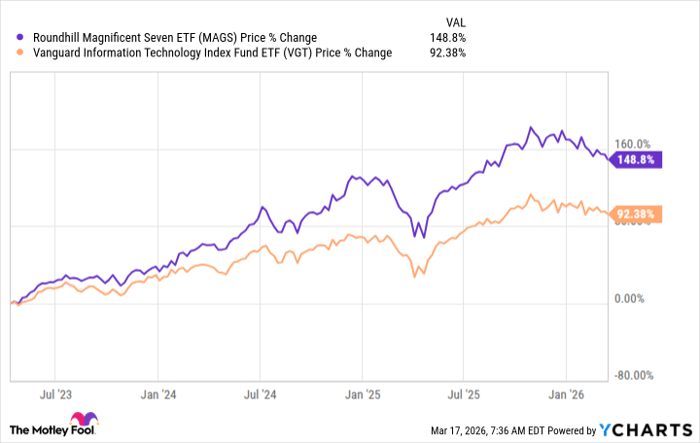
MAGS data by YCharts
That said, Vanguard Information and Technology ETF is market-cap weighted, so the largest companies have the greatest impact on performance. The magnificent seven are important to its performance, too. However, exposure to another 300 or so stocks beyond that short list will allow you to benefit when other tech companies become market darlings. And the diversification will soften the blow when the magnificent seven falter, just like the Nifty Fifty eventually did before them.
Be careful when you follow an investment fad
Vanguard Information and Technology ETF is built to help you build wealth over time. RoundHill Magnificent Seven ETF is built so people can invest directly in a Wall Street fad. Most investors looking for tech exposure should go with the Vanguard ETF and the tried-and-true methods that have reliably built sustainable wealth over time.
Should you buy stock in Vanguard Information Technology ETF right now?
Before you buy stock in Vanguard Information Technology ETF, consider this:
The Motley Fool Stock Advisor analyst team just identified what they believe are the 10 best stocks for investors to buy now… and Vanguard Information Technology ETF wasn’t one of them. The 10 stocks that made the cut could produce monster returns in the coming years.
Consider when Netflix made this list on December 17, 2004... if you invested $1,000 at the time of our recommendation, you’d have $508,877!* Or when Nvidia made this list on April 15, 2005... if you invested $1,000 at the time of our recommendation, you’d have $1,115,328!*
Now, it’s worth noting Stock Advisor’s total average return is 936% — a market-crushing outperformance compared to 189% for the S&P 500. Don't miss the latest top 10 list, available with Stock Advisor, and join an investing community built by individual investors for individual investors.
See the 10 stocks »
*Stock Advisor returns as of March 18, 2026.
Reuben Gregg Brewer has no position in any of the stocks mentioned. The Motley Fool has no position in any of the stocks mentioned. The Motley Fool has a disclosure policy.
Recommended Articles


