


If Oil Prices Keep Climbing, These 3 ETFs Could Be Big Winners
Key Points
The conflict in Iran resulted in unprecedented volatility in the oil market.
Crude oil future contracts soared well above $100 per barrel in the immediate aftermath before easing back.
These three oil ETFs offer different exposure to crude oil prices.
- 10 stocks we like better than United States Oil Fund ›
The conflict in Iran has created unprecedented volatility in oil prices. Future contract prices on West Texas Intermediate (WTI) crude oil, which had been trading around $65 per barrel at the end of February, soared to nearly $120 on March 9 before settling back down to around $85 at the close. Even the current price, however, is the highest since late 2023.
But the volatility may not be over. President Donald Trump has indicated that the conflict will be "ended soon," but activity in the region carries on for now. If access to the Strait of Hormuz for oil freighters and cargo vessels remains restricted, it's certainly possible we could see $100 oil again.
Will AI create the world's first trillionaire? Our team just released a report on the one little-known company, called an "Indispensable Monopoly" providing the critical technology Nvidia and Intel both need. Continue »
If you're interested in investing in oil, there are three primary exchange-traded funds (ETFs) that could be used. Each provides different exposure to the oil market, so which one to choose depends largely on how much volatility you're willing to stomach.

Image source: Getty Images.
1. United States Oil Fund
The United States Oil Fund (NYSEMKT: USO) is the most commonly used ETF for oil exposure and is pretty straightforward. It invests primarily in the nearest-to-expiration future contracts on WTI crude oil and rolls forward to the next contract when the current one expires.
The nearest-to-expiration contract tends to be the more volatile one since it's more directly impacted by current events. During the COVID meltdown in oil prices, this fund altered its strategy slightly to allow for investing in the next three months' contracts to manage volatility. Currently, it's back to using just the front-month contract and remains the best way to gain exposure to current oil prices.
2. United States 12 Month Oil Fund
The United States 12 Month Oil Fund (NYSEMKT: USL) is designed to offer a more risk-managed version of the above fund. As the name suggests, it equally weights its investments across the next 12 monthly contracts. Because of the diversification factor, it has historically experienced about 25% less volatility than the United States Oil Fund.
That strategy paid off in 2020 when energy prices crashed. The United States Oil Fund fell more than 80% from peak to valley, but this fund declined "only" by 60%.
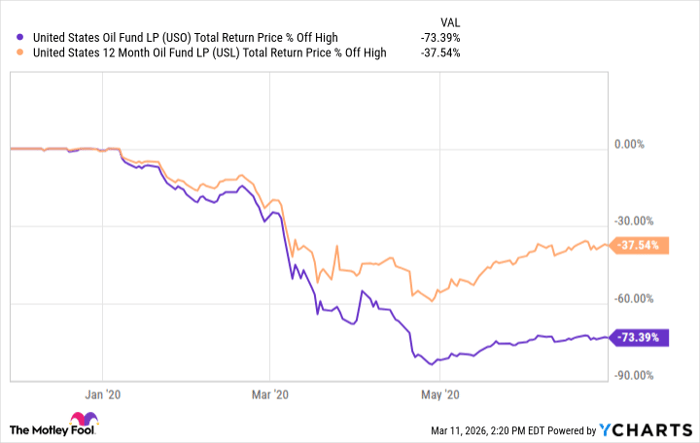
USO Total Return Price data by YCharts
3. ProShares Ultra Bloomberg Crude Oil Fund
If you really want to take a big swing on changes in oil prices, the ProShares Ultra Bloomberg Crude Oil Fund (NYSEMKT: UCO) offers 2x daily exposure to the Bloomberg Commodity Balanced WTI Crude Oil Index.
It should be pointed out that this fund is only designed for very short-term holding periods, such as just a few days at most, and generally isn't appropriate for most retail investors. The high volatility associated with crude oil prices tends to do more damage than good for leveraged products. This fund is no exception.
Should you buy stock in United States Oil Fund right now?
Before you buy stock in United States Oil Fund, consider this:
The Motley Fool Stock Advisor analyst team just identified what they believe are the 10 best stocks for investors to buy now… and United States Oil Fund wasn’t one of them. The 10 stocks that made the cut could produce monster returns in the coming years.
Consider when Netflix made this list on December 17, 2004... if you invested $1,000 at the time of our recommendation, you’d have $514,000!* Or when Nvidia made this list on April 15, 2005... if you invested $1,000 at the time of our recommendation, you’d have $1,105,029!*
Now, it’s worth noting Stock Advisor’s total average return is 930% — a market-crushing outperformance compared to 187% for the S&P 500. Don't miss the latest top 10 list, available with Stock Advisor, and join an investing community built by individual investors for individual investors.
See the 10 stocks »
*Stock Advisor returns as of March 16, 2026.
David Dierking has no position in any of the stocks mentioned. The Motley Fool has no position in any of the stocks mentioned. The Motley Fool has a disclosure policy.
Recommended Articles


