


Prediction: Oil Prices Stay Elevated in 2026 -- and Volatility Will Follow
Key Points
Hostilities in the Middle East don't look to be coming to an end anytime soon.
Stabilized oil markets may require an unlikely peaceful power transition in Iran.
- These 10 stocks could mint the next wave of millionaires ›
It's difficult to say with any certainty how the ongoing war in the Middle East will end, or more importantly, exactly when that will happen. Yet those are critical questions for financial markets, as the war and the resulting spike in oil prices are driving market volatility to dangerously high levels.
The CBOE Volatility Index, also known as the stock market's fear gauge, recently exceeded 29 and remains near 25, above the threshold of 20 that indicates rising investor fear and volatility (above 30 is panic mode). And CNN's well-known "Fear & Greed Index" is now hovering at the intersection of "Fear" and "Extreme Fear."
Will AI create the world's first trillionaire? Our team just released a report on the one little-known company, called an "Indispensable Monopoly" providing the critical technology Nvidia and Intel both need. Continue »
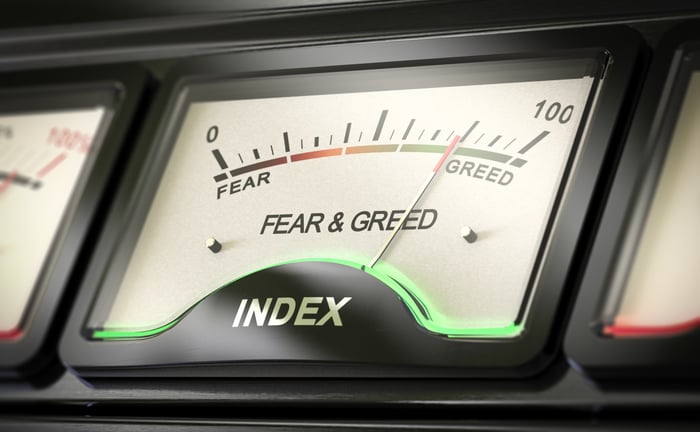
Image source: Getty Images.
As I write this on March 11, there seems to be little indication that the hostilities between the U.S, Israel, and Iran will cease any time soon, despite repeated reassurances from President Donald Trump that the war will wrap up "very soon." And it's telling that Trump's words about a near-term end of the war come amid other messages on the timeline from both Defense Secretary Pete Hegseth and Secretary of State Marco Rubio.
Oil prices have fluctuated wildly in recent days due to the war and more specifically, to Iran's ability to bring shipping traffic through the Strait of Hormuz -- through which travels a fifth of the world's oil exports -- to a standstill. Over the weekend of March 7-8, the price of Brent crude, the international benchmark, spiked to $120 a barrel. That was up from about $71 before the war started, though it has since settled back to around $92.
Policy actions to counter price spikes are limited
To be sure, policy makers outside of Iran are taking measures to try to calm shaky oil markets. On March 11, the 32 member states of the International Energy Agency (IEA) said they will release 400 barrels of oil from their emergency stocks, which would be the largest such release in history.
Yet despite that unprecedented action, the price of oil rose on Wednesday, probably because Trump announced the possibility of additional U.S strikes on Iran despite his recent claims that the war is winding down. In addition, some oil industry analysts are saying that the IEA plan will provide only temporary relief to high oil prices and volatile markets, perhaps a month's worth.
Making predictions about when oil prices will fall back to pre-war levels and financial markets will calm is difficult in such circumstances. But it's worth noting that lower oil prices in the near term and less-volatile markets will likely depend not just on an end to hostilities in the Middle East, but also a peaceful transition to a new government in Iran.
And that seems unlikely right now. More likely is a chaotic environment with various groups fighting for power and infighting between Iran's various ethnic groups. JPMorgan Chase notes that since 1979, the year of the Iranian revolution, there have been eight notable instances of regime change in medium- to large-scale oil-producing nations, each with significant implications for global oil prices and supply dynamics. And further destabilization of Iran could lead to significantly higher oil prices sustained over extended periods, and thus more volatility.
I see that as about the likeliest forecast possible right now. Still, investors should stay the course, as the stock market has endured similar situations before and eventually recovered. Those looking for more safety in their portfolios should consider consumer staples, healthcare, and utilities stocks, which tend to outperform in down markets.
Where to invest $1,000 right now
When our analyst team has a stock tip, it can pay to listen. After all, Stock Advisor’s total average return is 930%* — a market-crushing outperformance compared to 187% for the S&P 500.
They just revealed what they believe are the 10 best stocks for investors to buy right now, available when you join Stock Advisor.
See the stocks »
*Stock Advisor returns as of March 15, 2026.
The Motley Fool has a disclosure policy.
Recommended Articles


