


If President Trump Successfully Raises the Global Tariff Rate to 15%, These Stocks Could Take a Hit
Key Points
Manufacturers that rely on imported materials may be very affected by tariffs.
Some automakers have felt the effect of tariffs strongly.
Still, some companies will by minimally affected by tariffs -- of 10%, 15%, or 25%.
- These 10 stocks could mint the next wave of millionaires ›
Some presidents love peanuts or jelly beans, and others love hiking in national parks or golfing. Our current resident in the White House, President Donald Trump, loves golfing -- and tariffs. Our Motley Fool Research report on Tariffs and Trade is keeping track of the tariff and trade action from the Trump administration.
For example, in February, after the Supreme Court disallowed many of the extreme tariffs he had imposed, he struck back with a global tariff of 10% -- and then followed that with a threat to hike it to 15%.
Will AI create the world's first trillionaire? Our team just released a report on the one little-known company, called an "Indispensable Monopoly" providing the critical technology Nvidia and Intel both need. Continue »
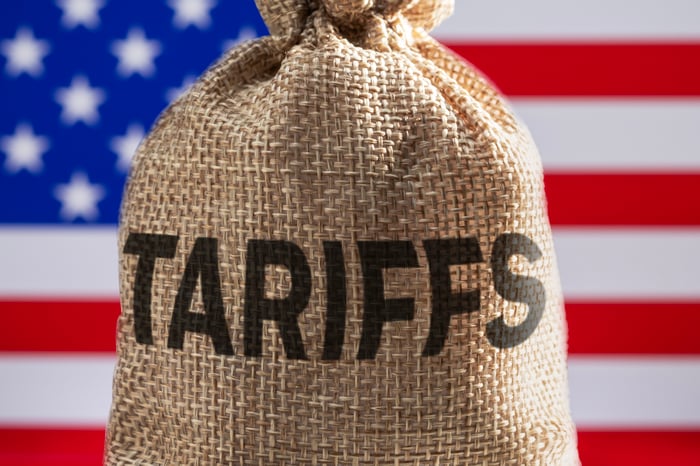
Image source: Getty Images.
How tariffs work
President Trump has repeatedly stated that foreign countries pay the tariffs, but that's not how it works. A tariff is a tax on an import -- and it's paid by importers, not foreign countries.
Not so long ago, the U.S. had a 2.5% tariff on many imported passenger vehicles. So the American importer of a $25,000 vehicle would pay $625 -- which would go to the U.S. Treasury and would likely end up factored into the price the car buyer pays.
More recently, the tariff on many imported cars and trucks has been 25%, on top of that 2.5%, and light trucks imported from some countries face a 50% tariff. As you might imagine, this level of tariff, and even 10% and 15% tariffs, forces some decisions and changes.
A 25% tariff on a $25,000 imported vehicle would result in a $6,250 tax paid by the importer. If the vehicle cost, say, $40,000, the tariff would amount to $10,000. Thus, carmakers exporting such vehicles may see demand fall off sharply if car prices are rising briskly to offset tariffs paid by importers. After all, importers are not going to simply hand over millions and billions in tariffs -- those costs will eventually (or quickly) work their way down to the consumer in the form of higher prices.
This all may sound terrible, but, used strategically, some tariffs can do some good. They are primarily designed to eventually strengthen domestic manufacturing and help create jobs in key sectors as they help domestic businesses by increasing the cost of goods imported from foreign competitors. However, in the short run, this can also shrink economic output and lead to lower wages and higher inflation. Trade wars between countries, featuring escalating tariffs, can also be counterproductive.
What does it mean for investors?
All this means that investors should pay particular attention to companies in sectors such as industrials, where manufacturers that import raw materials and other items may face much steeper prices. Volkswagen, for example, is seeing its profits fall as it lays off thousands. Chocolate giant Hershey has warned of higher prices due to higher cocoa costs, which can depress its performance. Caterpillar has offered similar warnings -- with tariffs costing it billions, while it works to offset those costs with cost-cutting.
Note, too, that plenty of companies are far less affected by tariffs. Real estate investment trust (REIT) Realty Income, for example, makes its money by owning a lot of real estate and leasing it out. Financial companies process transactions electronically, without imports, and domestic retailers may see limited effects.
Still, there may be an overall negative effect on the stock market at some point, so it's smart to keep up with developments.
Where to invest $1,000 right now
When our analyst team has a stock tip, it can pay to listen. After all, Stock Advisor’s total average return is 930%* — a market-crushing outperformance compared to 187% for the S&P 500.
They just revealed what they believe are the 10 best stocks for investors to buy right now, available when you join Stock Advisor.
See the stocks »
*Stock Advisor returns as of March 15, 2026.
Selena Maranjian has positions in Realty Income. The Motley Fool has positions in and recommends Caterpillar, Hershey, and Realty Income. The Motley Fool has a disclosure policy.
Recommended Articles


