


SPY Has Survived Every Geopolitical Shock of the Last 30 Years. This One Is Unlikely to Be the Exception.
Key Points
Already vulnerable to inflated valuations stemming from the rapid rise of AI stocks, fresh conflict in the Middle East makes the market feel even more vulnerable.
There’s little about the current geopolitical landscape that’s not been seen and survived before.
Trying to navigate your investments is the wrong move. Just being patient will pay off the most in the long run.
- 10 stocks we like better than SPDR S&P 500 ETF Trust ›
If recent headlines have you worried about your investments, you're not alone. And you're not crazy. Although we're not yet in the sort of recession that leads to a bear market, it's not difficult to believe any escalation of the current conflict in the Middle East could cause one. And this time, given political tensions already in place all over the rest of the world, the stakes seem more permanent.
Just be careful of jumping to such a sweeping conclusion.
Will AI create the world's first trillionaire? Our team just released a report on the one little-known company, called an "Indispensable Monopoly" providing the critical technology Nvidia and Intel both need. Continue »
See, as dire as matters may feel right now, we've seen this (and worse) before. The market not only survived all of these shocks, but the S&P 500 (SNPINDEX: ^GSPC) and the exchange-traded funds (ETFs) like the SPDR S&P 500 ETF Trust (NYSEMKT: SPY) and the Vanguard S&P 500 ETF (NYSEMKT: VOO) meant to mirror the index each recovered to reach new record highs after each one of them. This time isn't likely to be any different.

Image source: Getty Images.
Nothing we haven't seen and survived before
But "this time is different?" There may be some truth to the statement in terms of the reason for the disruption. It's the same broad assessment that's been given to most of the planet's previous societal shocks, however. The world's response is always ultimately the same. That is, most everyone just wants to get back to business ... figuratively as well as literally.
And the long-term data bears this out. As The Motley Fool's own research into the matter highlights, since 1980, the United States has suffered six recessions, while the Centre for Economic Research counts a total of four global recessions (with some obvious overlap). During this same 46-year stretch, we've also been through eight bear markets, which mostly -- although not perfectly -- coincided with these recessions.
Yet, since 1980, the S&P 500 has still managed to gain more than 6,300%. And that's not counting any dividends paid in the meantime.
Then there's the long list of global events that felt terrifying at the time, but have practically been forgotten without their feared long-term toll ever being taken. These include 2011's meltdown of a nuclear reactor in Fukushima, Japan, 1990's Gulf War, North Korea test-launching several long-range missiles back in 2017, a SARS outbreak in 2003, Greece's 2015 debt crisis that was supposed to drag most of Europe down with it, 2020's COVID-19 pandemic, and 2001's 9/11 terrorist attacks, just to name a few. All were terrifying at the time, stoking fears that the world would never be the same again. But capitalism found its way back just like it always does.
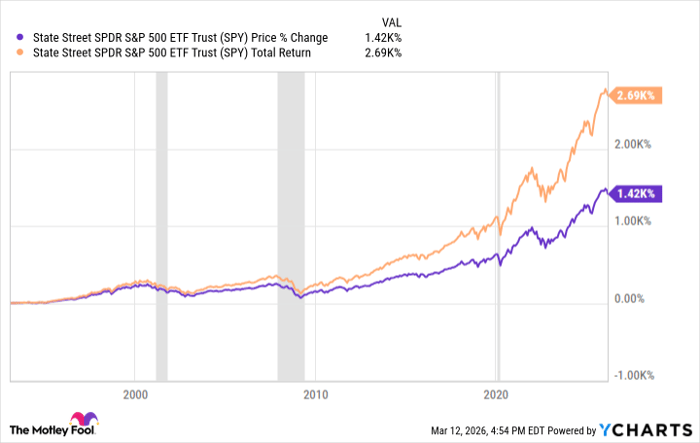
Data by YCharts. Grey bars indicate recessions.
If you are an investor, just breathe
None of this is to suggest you should simply ignore what's happening in the Middle East at this time. It can and likely will impact your portfolio for at least a short while. In fact, the conflict in the Middle East has already disrupted oil supply chains, pushing gasoline prices measurably higher.
Just don't lose perspective on what's really happening there and elsewhere in the world. Even if things get worse for the economy and the stock market before they get better again, history consistently says things eventually get back to what investors would consider normal.
And for what it's worth, whether you own VOO or SPY or a bunch of individual stocks, trying to figure out where the exact bottom is going to be poses more risk than it's worth. Just being patient is far more likely to pay off in the end.
Should you buy stock in SPDR S&P 500 ETF Trust right now?
Before you buy stock in SPDR S&P 500 ETF Trust, consider this:
The Motley Fool Stock Advisor analyst team just identified what they believe are the 10 best stocks for investors to buy now… and SPDR S&P 500 ETF Trust wasn’t one of them. The 10 stocks that made the cut could produce monster returns in the coming years.
Consider when Netflix made this list on December 17, 2004... if you invested $1,000 at the time of our recommendation, you’d have $511,735!* Or when Nvidia made this list on April 15, 2005... if you invested $1,000 at the time of our recommendation, you’d have $1,140,464!*
Now, it’s worth noting Stock Advisor’s total average return is 946% — a market-crushing outperformance compared to 191% for the S&P 500. Don't miss the latest top 10 list, available with Stock Advisor, and join an investing community built by individual investors for individual investors.
See the 10 stocks »
*Stock Advisor returns as of March 13, 2026.
James Brumley has no position in any of the stocks mentioned. The Motley Fool has positions in and recommends Vanguard S&P 500 ETF. The Motley Fool has a disclosure policy.
Recommended Articles


