


Apple Just Made a Power Move to Gain Market Share
Key Points
Apple introduced a host of new products at its spring event this week.
One of the big surprises was the surprisingly affordable price of its entry-level iPhone 17e, which was the same price as last year.
As some component prices skyrocket, Apple is likely leveraging price to gain market share.
- 10 stocks we like better than Apple ›
When it comes to the smartphone market, Apple (NASDAQ: AAPL) has long been the biggest winner. Even when the company didn't have the largest market share, it long commanded the largest share of the profits. The final gem in the company's crown came in 2025, when the iPhone became the year's top seller, accounting for 20% of the market, according to Counterpoint Research. The company is also the market leader in several other product categories.
Apple has long been known for its premium (read: high-priced) products that cater to the high end of the market, noted for their simplicity of design, superior technology, and ease of use. However, Apple is taking a different approach in 2026. In the face of memory shortages and high component prices, the company held the line on its lowest-priced iPhone, suggesting that Apple is determined to take market share from struggling competitors.
Will AI create the world's first trillionaire? Our team just released a report on the one little-known company, called an "Indispensable Monopoly" providing the critical technology Nvidia and Intel both need. Continue »
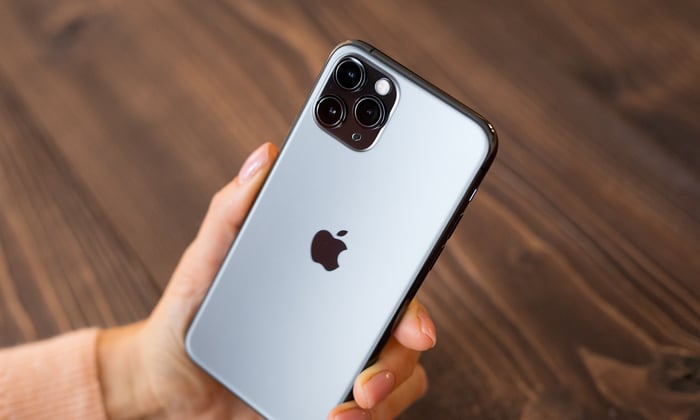
Image source: Getty Images.
More for less
At Apple's big spring event this week, the company introduced several entry-level products that turned heads for being surprisingly affordable, at least by Apple standards. The headliner was the iPhone 17e, which features double the starting storage capacity at 256 GB. Yet the device came with a starting price of $599 -- the same as last year's iPhone 16e -- despite greater capabilities and higher input costs.
This was a surprising move by Apple, as the cost of memory and storage chips has skyrocketed this year, driven higher by the rising adoption of artificial intelligence (AI), which has fueled unprecedented demand for servers and data centers. Memory chips in smartphones play a crucial role in running apps, while storage is needed for photos, videos, and other files stored on the devices.
There are likely two factors at play here. First, Apple's supply chain prowess is well documented, and the company has historically inked multi-year agreements with suppliers to secure capacity and manage price fluctuations over longer periods of time. Second, the company also has a history of keeping lower-end product prices stable while raising prices on its higher-end products to absorb higher input costs without losing market share. That said, CEO Tim Cook made clear that component prices would begin to weigh on margins in future quarters.
The price of the iPhone 17e will make Apple much more competitive in foreign markets that have historically offered cheaper alternatives. In China, for example, Apple has lost market share in recent years, ceding ground to lower-priced offerings from rivals such as Vivo, Huawei, and Xiaomi. However, soaring memory and storage prices will likely force competitors to raise prices, giving Apple an opening. That opportunity is even more pronounced given Apple's 24-month payment plans offered to customers in China. This advantage will translate to other price-sensitive markets as well.
Over the long term, this will be good news for Apple shareholders. Devices like the iPhone are just the beginning of customer relationships with Apple, as many users branch out to other devices and augment their purchases with ancillary products, services, and apps. Furthermore, once customers are locked into the Apple ecosystem, they are less likely to defect.
The stock has struggled over the past year, as investors have grown wary of Apple's growth prospects. However, this helps to illustrate that the runway ahead is long for the iPhone maker. And at 28 times next year's expected sales, Apple stock is attractively priced.
Should you buy stock in Apple right now?
Before you buy stock in Apple, consider this:
The Motley Fool Stock Advisor analyst team just identified what they believe are the 10 best stocks for investors to buy now… and Apple wasn’t one of them. The 10 stocks that made the cut could produce monster returns in the coming years.
Consider when Netflix made this list on December 17, 2004... if you invested $1,000 at the time of our recommendation, you’d have $526,889!* Or when Nvidia made this list on April 15, 2005... if you invested $1,000 at the time of our recommendation, you’d have $1,103,743!*
Now, it’s worth noting Stock Advisor’s total average return is 947% — a market-crushing outperformance compared to 192% for the S&P 500. Don't miss the latest top 10 list, available with Stock Advisor, and join an investing community built by individual investors for individual investors.
See the 10 stocks »
*Stock Advisor returns as of March 4, 2026.
Danny Vena, CPA has positions in Apple. The Motley Fool has positions in and recommends Apple. The Motley Fool recommends Xiaomi. The Motley Fool has a disclosure policy.
Recommended Articles


