


Will Gold Prices Fall Below $5,000 in 2026?
TradingKey - Although Gold (XAUUSD) is a traditional safe-haven asset, it has continued to weaken since the outbreak of the U.S.-Iran conflict, which has left many investors puzzled. In fact, the previous outbreak of the Russia-Ukraine conflict also triggered a similar trend in gold.
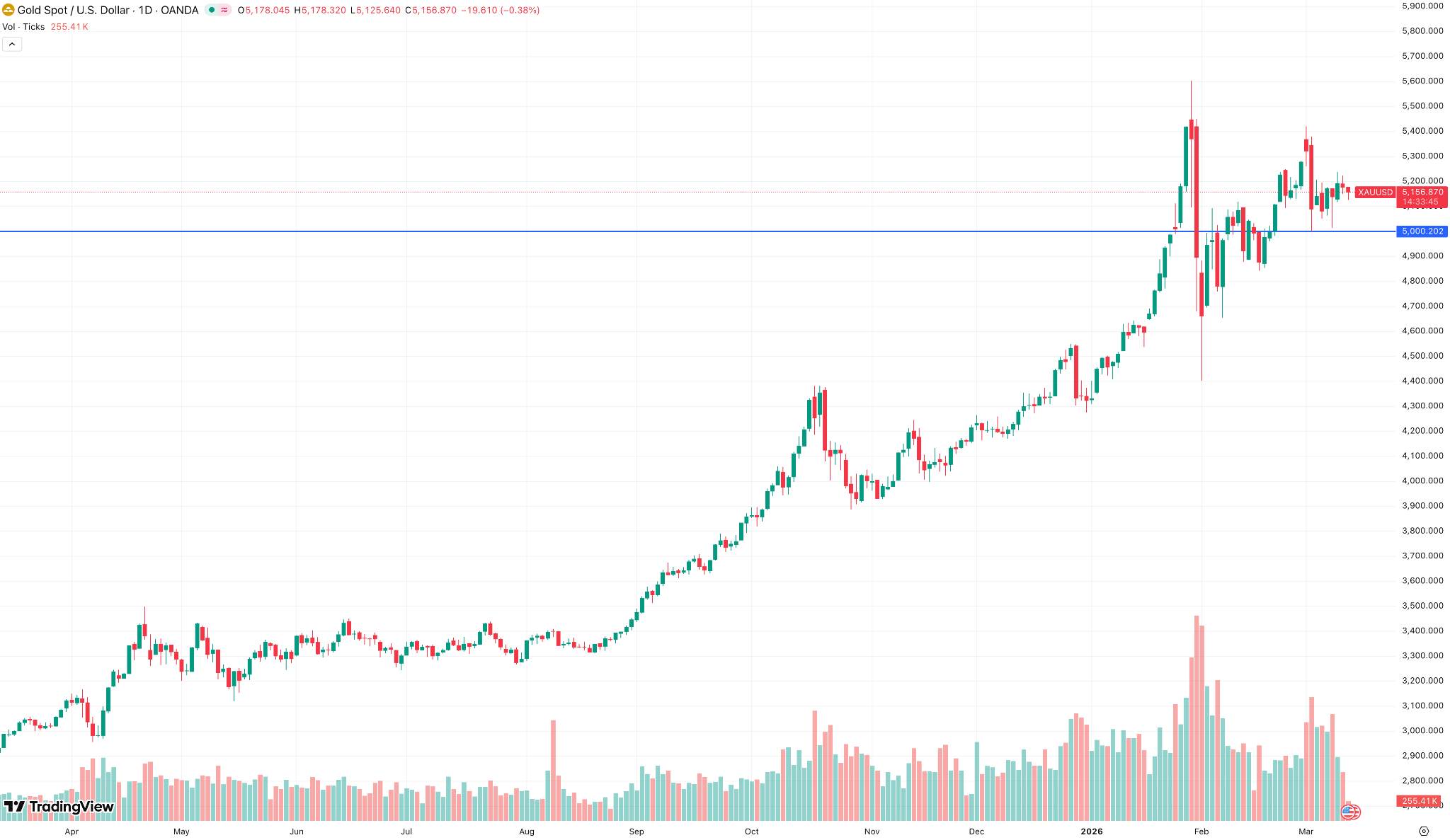
[Gold Trend Overview, Source: TradingView]
Against this backdrop, the market has begun to re-examine a question: Is the safe-haven logic for gold changing in the current macroeconomic environment?
Why is gold not rising despite the U.S.-Iran conflict?
First, it is important to understand that gold prices in global markets are typically denominated in U.S. dollars, so their movement often exhibits a degree of negative correlation with the U.S. Dollar Index. Against the backdrop of escalating geopolitical conflicts, gold is usually seen as a classic safe-haven asset, so the market generally expects gold prices to rise as risk increases. However, in the recent U.S.-Iran conflict, the performance of gold prices has been relatively restrained.
Under stable market conditions, when the dollar strengthens, dollar-denominated gold becomes more expensive for holders of other currencies, thereby dampening demand and limiting the upside for gold prices. However, in certain extreme cases, such as the early stages of a conflict outbreak when safe-haven sentiment surges, capital may flow into both the dollar and gold simultaneously, potentially causing the U.S. Dollar Index and gold prices to rise in tandem for a short period.
But this periodic resonance is often difficult to sustain. As the market gradually digests geopolitical risks, the suppressing effect of a strong dollar on gold prices begins to emerge. On one hand, the U.S. dollar itself holds global reserve currency status and possesses immense liquidity; during risk events, institutional investors often prioritize allocations to U.S. dollar assets, such as U.S. Treasuries or cash-equivalent assets.
In contrast, although gold possesses safe-haven attributes, its liquidity and capacity to absorb capital still struggle to match the U.S. dollar asset system in the short term. Therefore, against the backdrop of geopolitical conflicts, some safe-haven capital will ultimately concentrate in U.S. dollar assets.
Secondly, the U.S. interest rate environment is also a key variable affecting gold trends. Gold itself does not generate interest yield; when U.S. real interest rates remain high, the opportunity cost of holding gold rises, thereby weakening its appeal. If the market believes that geopolitical conflicts will not significantly alter the Federal Reserve's interest rate path or even weaken expectations for rate cuts, then capital is more likely to continue flowing into high-yield U.S. dollar assets rather than increasing gold positions.
Meanwhile, market expectations regarding the sustainability of the conflict also influence gold's performance. Most market institutions expect that the U.S.-Iran war will not last for a prolonged period. Analysts believe that skyrocketing oil prices resulting from the war could place immense pressure on the U.S. economy, which would be detrimental to the political sustainability of the Trump administration.
If investors believe the conflict has a limited scope and short duration, with minimal impact on global energy supplies or economic growth, then safe-haven demand is unlikely to continue rising. Instead, risk assets remain favored by capital, and gold prices often pull back under the push of short-term funds.
Will gold prices fall below the $5,000 mark?
From the perspective of long-term macroeconomic trends, structural demand for gold still exists.
From a market pricing perspective, $5,000 has become a major psychological threshold for the current gold market. If the dollar continues to strengthen and maintains high real interest rates, gold may still face near-term correction pressure. Some institutions believe that if safe-haven demand cools periodically, gold prices could potentially test key support levels.
Since 2022, global central banks have increased their gold holdings by nearly 1,000 tons annually. With rising global asset volatility and increased geopolitical risks, some countries are reducing their dependence on U.S. dollar assets by increasing gold reserves, which provides long-term support for gold prices.
At the same time, potential risks within the financial system are also drawing market attention, particularly the rapidly expanding private credit market. This market has grown from about $40 billion in 2000 to nearly $2 trillion today.
Rakesh Ganapathy, CEO of Unicus Research, noted that most private credit assets operate outside the traditional regulatory system. A large number of these loans lack credit ratings, and their asset pricing often relies on internal valuations rather than public market prices, resulting in low overall transparency.
If credit risks are exposed in a concentrated manner in the future, the global financial system could face new credit pressures, and such systemic risks typically revive safe-haven demand for gold.
In the short term, if the U.S.-Iran conflict is prolonged and drives up global energy prices, inflationary pressures could resurface. In this case, central banks may maintain a more cautious stance on interest rate policy, thereby keeping real interest rates high, which could instead exert some pressure on gold.
In other words, the continuation of war does not necessarily mean a sustained rise in safe-haven demand. In certain macro scenarios, conflict may instead impose periodic constraints on gold's rise by driving up inflation and interest rate expectations.
From a market pricing perspective, $5,000 has become a major psychological threshold for the current gold market. If the dollar continues to strengthen and maintains high real interest rates, gold may still face near-term correction pressure. Some institutions believe that if safe-haven demand cools periodically, gold prices could potentially test key support levels.
Recommended Articles


