


USD/INR corrects at open on hopes of Strait of Hormuz reopening
- The Indian Rupee gains ground against the US Dollar after a four-day winning streak; its outlook remains grim.
- US President Trump expresses confidence that a few nations are ready for joint operations to open the Strait of Hormuz.
- FIIs have remained net sellers on all trading days so far in March.
The Indian Rupee (INR) snaps four-day winning streak against the US Dollar (USD) on Monday. The USD/INR pair opens lower to near 92.80 as the US Dollar’s rally hits a pause amid speculation that the Strait of Hormuz could reopen soon.
As of writing, the US Dollar Index (DXY), which tracks the Greenback’s value against six major currencies, trades 0.3% lower to near 100.20. The USD Index corrects after posting a fresh over nine-month high of 100.55 on Friday. The US Dollar has outperformed in the past few weeks amid rising oil prices, given that the United States (US) is a net exporter of oil.
Trump calls on nations to intervene to reopen Strait of Hormuz
The speculation for the reopening of the Strait of Hormuz, a channel through which 20% of global oil is supplied, which is closed as part of retaliation by Tehran against joint attacks by the US and Israel on Iran, has come into the picture as President Donald Trump has claimed that he is getting a good response from other countries for intervention.
“Many Countries, especially those who are affected by Iran’s attempted closure of the Hormuz Strait, will be sending War Ships, in conjunction with the United States of America, to keep the Strait open and safe,” Trump said in a post on Truth.Social adding, “Hopefully China, France, Japan, South Korea, the UK, and others, that are affected by this artificial constraint, will send Ships to the area so that the Hormuz Strait will no longer be a threat by a Nation.”
There seems to be a limited impact of Trump’s attempts to reopen Hormuz on the oil price, which has surrendered its opening gains.
Given that India is one of the largest importers of oil in the world, a higher oil price is an unfavorable situation for the Indian Rupee.
Meanwhile, Iran has allowed passage to Indian ships from the Strait of Hormuz, which has diminished oil and Liquefied Petroleum Gas (LPG) supply concerns. India’s Ministry of Ports confirmed over the weekend that two Indian-flagged tankers carrying LPG crossed the Strait of Hormuz early morning safely and are en route to India, Al Jazeera reported.
FIIs continue to dump stake in Indian stock market
Broadly, the outlook of the Indian Rupee is expected to remain weak due to the continuous outflow of foreign funds from the Indian stock market. So far in March, Foreign Institutional Investors (FIIs) have remained net sellers on all trading days, and have offloaded their stake worth Rs. 56,883.22 crore.
In Monday’s session, investors will focus on India’s Wholesale Price Index (WPI) Inflation data for February, which will be published at 12:00 IST (06:30 GMT). The data is expected to show that inflation at the wholesale level grew at an annualized pace of 2%, faster than 1.81% in January.
This week, the domestic trigger for the US Dollar will be the monetary policy announcement by the Federal Reserve (Fed) on Wednesday.
Technical Analysis: USD/INR retraces after four-day winning streak
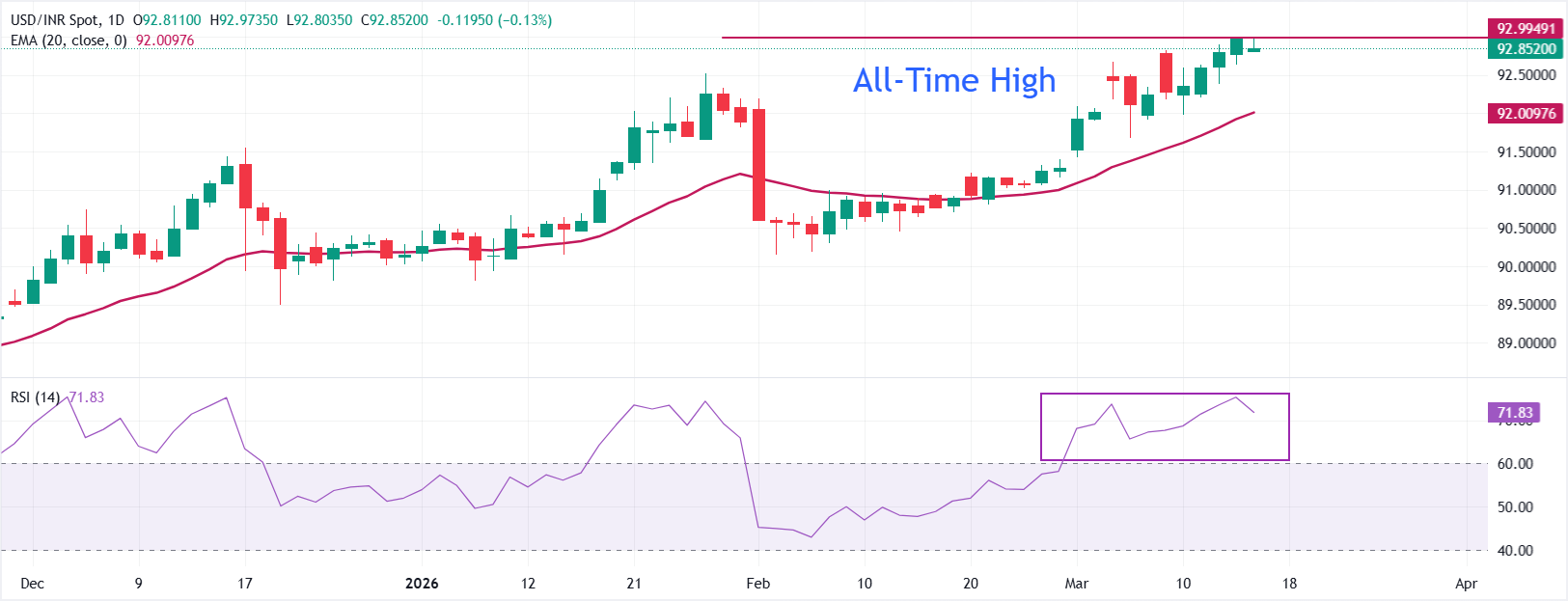
USD/INR drops to near 92.80 in the opening trade at the start of the week. However, the near-term bias is bullish as price holds above the rising 20-day Exponential Moving Average, which is around 92.00.
The sequence of higher closes from late in the series keeps buyers in control despite a minor pause, while the 14-day Relative Strength Index (RSI) around 72 stays in overbought territory but has not yet signaled a momentum reversal. Overall, the technical backdrop favors further upside while the pair remains above its short-term trend support.
Initial resistance is located at the recent high near 92.97, and a daily close above this level would open the way toward the psychological 93.50 zone next. On the downside, immediate support emerges at the 20-day EMA near 92.00, with a break below this area exposing deeper retracement toward 91.30 as the next notable floor. As long as pullbacks are contained above the 92.00 region, the path of least resistance stays to the upside.
(The technical analysis of this story was written with the help of an AI tool.)
Indian Rupee FAQs
The Indian Rupee (INR) is one of the most sensitive currencies to external factors. The price of Crude Oil (the country is highly dependent on imported Oil), the value of the US Dollar – most trade is conducted in USD – and the level of foreign investment, are all influential. Direct intervention by the Reserve Bank of India (RBI) in FX markets to keep the exchange rate stable, as well as the level of interest rates set by the RBI, are further major influencing factors on the Rupee.
The Reserve Bank of India (RBI) actively intervenes in forex markets to maintain a stable exchange rate, to help facilitate trade. In addition, the RBI tries to maintain the inflation rate at its 4% target by adjusting interest rates. Higher interest rates usually strengthen the Rupee. This is due to the role of the ‘carry trade’ in which investors borrow in countries with lower interest rates so as to place their money in countries’ offering relatively higher interest rates and profit from the difference.
Macroeconomic factors that influence the value of the Rupee include inflation, interest rates, the economic growth rate (GDP), the balance of trade, and inflows from foreign investment. A higher growth rate can lead to more overseas investment, pushing up demand for the Rupee. A less negative balance of trade will eventually lead to a stronger Rupee. Higher interest rates, especially real rates (interest rates less inflation) are also positive for the Rupee. A risk-on environment can lead to greater inflows of Foreign Direct and Indirect Investment (FDI and FII), which also benefit the Rupee.
Higher inflation, particularly, if it is comparatively higher than India’s peers, is generally negative for the currency as it reflects devaluation through oversupply. Inflation also increases the cost of exports, leading to more Rupees being sold to purchase foreign imports, which is Rupee-negative. At the same time, higher inflation usually leads to the Reserve Bank of India (RBI) raising interest rates and this can be positive for the Rupee, due to increased demand from international investors. The opposite effect is true of lower inflation.
Recommended Articles


