

Vanguard's Most Curious -- and Most Promising -- ETF Launch of 2025
Key Points
Vanguard's addition of a junk bond ETF to its lineup last year breaks with its traditions.
The deep investment research support, low-fee advantage, and bond market experience help set the Vanguard High-Yield Active ETF apart.
The fund is new and still under the radar, but everything is lined up for it to be a long-term winner.
- 10 stocks we like better than Vanguard Fixed Income Securities Funds - Vanguard High-Yield Active ETF ›
Ever since John Bogle founded Vanguard in 1975, the company's approach to investing has largely been a conservative one. Its foundation has been offering broadly diversified, low-cost investment funds geared toward everyday investors who are looking to build wealth over time.
In 2025, it made a slight deviation from that theme. The biggest announcement of the year came in December when Vanguard revealed that it would reverse an internal policy and allow crypto trading on its platform. Originally, it said in January 2024 that cryptocurrencies didn't align with the company's long-term investing approach.
Where to invest $1,000 right now? Our analyst team just revealed what they believe are the 10 best stocks to buy right now. Continue »
A cynic might say that management saw the money being made in crypto exchange-traded funds (ETFs) and finally relented to get in on the action. Regardless of the reason, the decision to allow crypto trading marked a significant deviation from its previous way of doing business.
The other big development was the September launch of the Vanguard High-Yield Active ETF (NYSEMKT: VGHY). Up to that point, Vanguard dealt almost exclusively in investment-grade bonds on the ETF side of its business. A pure junk bond ETF was new territory.
While it may seem out of place with the rest of the Vanguard ETF lineup, there's actually a pretty strong chance of success here. The company's deep research engine could ultimately produce above-average returns. Let's break down the fund to see why I think it's one of the more promising bond ETFs of 2026.
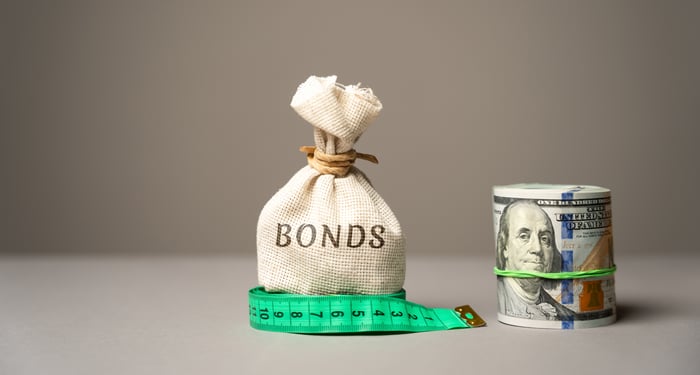
Image source: Getty Images.
What is the Vanguard High-Yield Active ETF?
The fund doesn't have a particularly unusual strategy. It will invest in a diversified portfolio of junk bonds and will attempt to outperform the high-yield market through security selection, sector allocation, and market analysis.
This ETF is actively managed, which is unusual given that most of the Vanguard ETF lineup is tied to a passively managed index, but that trend is changing. Of the 15 ETFs the company launched in 2025, eight of them are actively managed.
The company is actually changing with the times! The fund's expense ratio of 0.22% is quite competitive for an actively managed junk bond fund. The High-Yield Active ETF currently has about 48% of assets in BB-rated bonds, 36% in B-rated bonds, and roughly 9% in bonds rated CCC or worse. It has about 8% of assets in Treasuries for liquidity.
That's a slightly worse credit profile than we see currently in the iShares iBoxx $ High Yield Corporate Bond ETF (NYSEMKT: HYG). That probably won't be the case forever, but it's interesting that Vanguard sees value in some of the lower-grade issues. Given the current backdrop of healthy economic growth, falling interest rates, and more liquidity, there's an easy case to be made for why it is taking this position right now.
Why this ETF has a bright future
There are a few reasons I think the Vanguard High-Yield Active ETF is worth considering even though it's still less than a year old.
- The cost advantage: The fund's expense ratio of 0.22% is less than half that of the 0.59% average expense ratio for this category.
- The alpha target: The management team is targeting 40 basis points of outperformance annually relative to the returns of a broad high-yield bond index. While this is no guarantee of outperformance, it would provide meaningful returns above and beyond the category average with what's likely to be comparable risk over time.
- An experienced management team: Vanguard's Fixed Income Group has been around for longer than 40 years. It has over 200 investment professionals and more than $2.6 trillion under management. That's a deep roster of talent that should have all the resources necessary to achieve that alpha target.
In the evolving junk bond space, I think active management is crucial. It allows the fund to move nimbly should market conditions change, and to react in a way that index-bound funds may not be able to.
Vanguard's edge in its expense ratio translates directly to shareholder returns and should provide immediate results. In short, everything is lined up for the Vanguard High-Yield Active ETF to be a long-term winner.
Should you buy stock in Vanguard Fixed Income Securities Funds - Vanguard High-Yield Active ETF right now?
Before you buy stock in Vanguard Fixed Income Securities Funds - Vanguard High-Yield Active ETF, consider this:
The Motley Fool Stock Advisor analyst team just identified what they believe are the 10 best stocks for investors to buy now… and Vanguard Fixed Income Securities Funds - Vanguard High-Yield Active ETF wasn’t one of them. The 10 stocks that made the cut could produce monster returns in the coming years.
Consider when Netflix made this list on December 17, 2004... if you invested $1,000 at the time of our recommendation, you’d have $482,326!* Or when Nvidia made this list on April 15, 2005... if you invested $1,000 at the time of our recommendation, you’d have $1,133,015!*
Now, it’s worth noting Stock Advisor’s total average return is 968% — a market-crushing outperformance compared to 197% for the S&P 500. Don't miss the latest top 10 list, available with Stock Advisor, and join an investing community built by individual investors for individual investors.
See the 10 stocks »
*Stock Advisor returns as of January 11, 2026.
David Dierking has no position in any of the stocks mentioned. The Motley Fool has no position in any of the stocks mentioned. The Motley Fool has a disclosure policy.
Recommended Articles


