

China Plans to Approve Imports of Nvidia's H200 AI Chips as Early as This Quarter. Here's What It Means for Investors
Key Points
After nearly a year of uncertainty, China appears poised to approve the import of Nvidia H200 chips.
Nvidia has orders for more than 2 million of these AI chips for Chinese customers.
Simple math suggests huge upside for Nvidia stock and a potential boon for shareholders.
- 10 stocks we like better than Nvidia ›
After previously banning Nvidia's (NASDAQ: NVDA) H200 artificial intelligence (AI) chips, the Chinese government appears poised to approve the import of these processors, according to a report by Bloomberg, which cited "people familiar with the situation." This would mark the reentry into an important market for the chipmaker.
Regulators will reportedly permit the sale of these older-generation AI chips to commercial and technology customers, although details remain sketchy. There will be limitations, however. China will prohibit the use of these chips from government agencies, military applications, critical infrastructure, state-owned businesses, or other applications that may pose security concerns, according to the report.
Where to invest $1,000 right now? Our analyst team just revealed what they believe are the 10 best stocks to buy right now, when you join Stock Advisor. See the stocks »
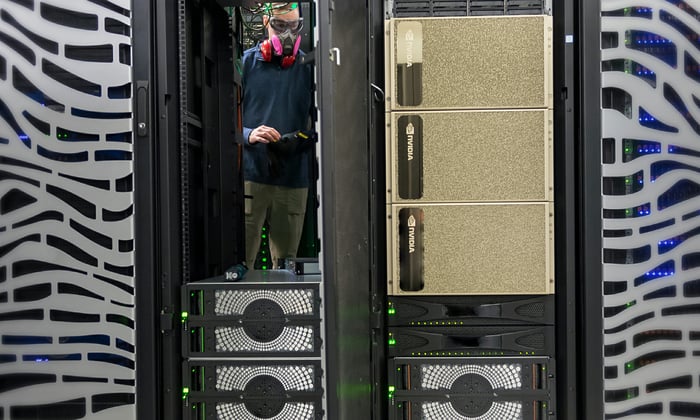
Image source: Nvidia.
A $50 billion opportunity?
The stakes are high. In calendar 2024, which marked the last full year of sales to China, Nvidia's revenue from the country was $17.1 billion -- despite existing export restrictions against the sale of its top-of-the-line chips. Early last year, Nvidia estimated it took an $8 billion revenue hit due to increased U.S. export restrictions.
CEO Jensen Huang previously stated that there was "very high" demand for the chips in China, and suggested that sales there could top $50 billion per year if approved. That figure could well be conservative.
The company already has orders from Chinese customers for more than 2 million H200 chips and plans to charge $27,000 each for the processors, according to a report by Reuters. This would result in additional revenue of about $54 billion. Subtracting the 25% export levy that will be due to the U.S. government, Nvidia could net more than $40 billion from existing orders alone.
Sales to China are currently excluded from Nvidia's outlook, so this would represent a material increase to the company's existing guidance. Nvidia has previously stated that sales of AI-centric data center processors are expected to generate $500 billion for the six quarters ending in early 2027. During the CES keynote address this week, Huang suggested that the figure was too conservative and its revenue outlook has only gotten brighter.
Analysts' consensus estimates for Nvidia's revenue next year clock in at $320 billion. Add to that a $40 billion boost to revenue, combined with its current 56% net profit margin, could potentially drive Nvidia's earnings per share (EPS) to $8.29. Using its current price-to-earnings (P/E) ratio of roughly 46 would result in a share price of about $380, more than double its current level.
Simply put, Nvidia's reentry into the Chinese market could be a windfall for shareholders.
Should you buy stock in Nvidia right now?
Before you buy stock in Nvidia, consider this:
The Motley Fool Stock Advisor analyst team just identified what they believe are the 10 best stocks for investors to buy now… and Nvidia wasn’t one of them. The 10 stocks that made the cut could produce monster returns in the coming years.
Consider when Netflix made this list on December 17, 2004... if you invested $1,000 at the time of our recommendation, you’d have $488,222!* Or when Nvidia made this list on April 15, 2005... if you invested $1,000 at the time of our recommendation, you’d have $1,134,333!*
Now, it’s worth noting Stock Advisor’s total average return is 969% — a market-crushing outperformance compared to 196% for the S&P 500. Don't miss the latest top 10 list, available with Stock Advisor, and join an investing community built by individual investors for individual investors.
See the 10 stocks »
*Stock Advisor returns as of January 9, 2026.
Danny Vena, CPA has positions in Nvidia. The Motley Fool has positions in and recommends Nvidia. The Motley Fool has a disclosure policy.
Recommended Articles


