

Is the Stock Market Going to Crash in 2026? History Suggests There's Good and Bad News
Key Points
With the market reaching new heights, it's unclear what 2026 will bring for investors.
Some market indicators -- like the Buffett indicator -- are sending warning signs for the stock market.
However, there's plenty of reason to stay optimistic about the future.
- 10 stocks we like better than S&P 500 Index ›
As the stock market closes out another record-breaking year, many investors have mixed feelings about what lies ahead.
Around 80% of Americans are at least slightly concerned about the potential for a recession, according to a December report from financial association MDRT. At the same time, though, around 44% of U.S. investors feel optimistic about the future of the market, according to the most recent weekly survey from the American Association of Individual Investors.
Where to invest $1,000 right now? Our analyst team just revealed what they believe are the 10 best stocks to buy right now, when you join Stock Advisor. See the stocks »
It's normal to feel conflicted about the future, as nobody knows where the market is headed. The last few years of record-breaking growth have been exciting for investors, but eventually, stock prices are bound to fall. So is that downturn coming in 2026? History has both good and not-so-good news.
Image source: Getty Images.
First, the bad news
To be clear, nobody can say exactly what the market will do in the short term. But some stock market indicators suggest that a downturn could be looming.
Take, for example, the ratio of the U.S. stock market's total market cap to the gross domestic product (GDP) -- nicknamed the Buffett indicator. In 2001, Warren Buffett told Fortune magazine that he'd used this indicator to correctly predict the onset of the tech bubble burst in the late 1990s.
"For me, the message of the chart is this: If the percentage relationship falls to the 70% or 80% area, buying stocks is likely to work very well for you," he explained. "If the ratio approaches 200% -- as it did in 1999 and a part of 2000 -- you are playing with fire."
As of this writing, the Buffett indicator is at its highest level ever, nearly 234%. According to Buffett, this suggests the market is significantly overvalued.
Keep in mind, though, that no stock market indicator is perfect. A lot has changed since Buffett made his previous prediction, and as company valuations naturally increase over time, the Buffett indicator may become less reliable.
The silver lining for investors
We may or may not face a bear market, recession, or correction in 2026. However, even if the market experiences a significant downturn, its long-term future remains incredibly bright.
Over time, the market is almost certain to recover from periods of volatility. It can sometimes take years for stock prices to begin reaching new highs again, but if history tells us anything, it's that investors who maintain a long-term outlook can earn the most in the stock market.
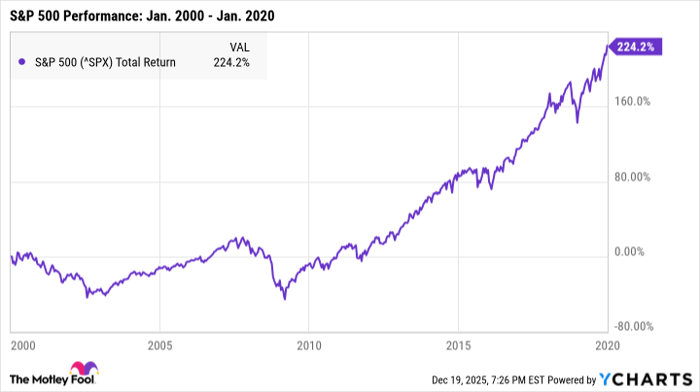
For example, say you were investing in the stock market in the early 2000s, immediately before stocks fell into a prolonged bear market when the dot-com bubble burst. After the S&P 500 reached a new high, officially entering a new bull market, it almost immediately sank into the Great Recession.
^SPX data by YCharts
Those first few years of the 2000s would have been rough, without a doubt. But after 20 years, the S&P 500 had earned total returns of 224%. In other words, despite facing two of the worst bear markets in U.S. history, investors could have more than tripled their money in the S&P 500 in those two decades.
The stock market's ability to recover from downturns isn't anything new, either. Throughout the S&P 500's history, there's never been a single 20-year period in which the index earned negative total returns, according to analysis from Crestmont Research. This means that if you'd invested in an S&P 500–tracking fund at any point and held it for 20 years, you'd have made money.
It's unclear what the market will do in 2026, but even if we face the worst-case scenario of a deep recession, time is your best asset as an investor. By investing in quality stocks and holding them for at least a decade or so, you make it very likely that your portfolio will thrive no matter what the market does.
Should you buy stock in S&P 500 Index right now?
Before you buy stock in S&P 500 Index, consider this:
The Motley Fool Stock Advisor analyst team just identified what they believe are the 10 best stocks for investors to buy now… and S&P 500 Index wasn’t one of them. The 10 stocks that made the cut could produce monster returns in the coming years.
Consider when Netflix made this list on December 17, 2004... if you invested $1,000 at the time of our recommendation, you’d have $509,039!* Or when Nvidia made this list on April 15, 2005... if you invested $1,000 at the time of our recommendation, you’d have $1,109,506!*
Now, it’s worth noting Stock Advisor’s total average return is 972% — a market-crushing outperformance compared to 193% for the S&P 500. Don't miss the latest top 10 list, available with Stock Advisor, and join an investing community built by individual investors for individual investors.
See the 10 stocks »
*Stock Advisor returns as of December 21, 2025.
Katie Brockman has no position in any of the stocks mentioned. The Motley Fool has no position in any of the stocks mentioned. The Motley Fool has a disclosure policy.
Recommended Articles


