

Forget President Donald Trump's Tariffs and Talk of an AI Bubble -- There's a Far More Sinister Catalyst for a Stock Market Crash in 2026
Key Points
It's been another stellar year for the stock market, with the Dow Jones Industrial Average, S&P 500, and Nasdaq Composite, respectively, climbing by 13% to 20% year-to-date.
The president's tariff and trade policy, as well as the prospect of an AI bubble forming and subsequently bursting, are common scapegoats for a potential stock market crash in 2026.
However, Wall Street's No. 1 risk stems from a historic level of division at America's central bank.
- 10 stocks we like better than S&P 500 Index ›
When the page is finally turned on 2025, investors are likely to be looking back on another banner year for Wall Street. Through the closing bell on Dec. 16, the iconic Dow Jones Industrial Average (DJINDICES: ^DJI), broad-based S&P 500 (SNPINDEX: ^GSPC), and innovation-inspired Nasdaq Composite (NASDAQINDEX: ^IXIC) have, respectively, risen by 13% to 20% year-to-date.
In some respects, outsize returns for stocks shouldn't come as a surprise. There's abundant investor euphoria concerning the evolution of artificial intelligence (AI), and the Federal Open Market Committee (FOMC) cutting interest rates in each of its last three meetings has fueled the prospect of cheaper corporate borrowing, which can entice hiring, acquisitions, and an uptick in innovation.
Where to invest $1,000 right now? Our analyst team just revealed what they believe are the 10 best stocks to buy right now. Continue »
On the other hand, headwinds are mounting for the world's greatest wealth creator. Although bull markets last disproportionately longer than bear markets, the velocity of emotion-driven moves lower in the Dow Jones, S&P 500, and Nasdaq Composite garners a lot of attention.
Image source: Getty Images.
The all-important question is, which catalyst could be responsible for sending stocks over the proverbial cliff in the new year? While plenty of fingers are likely to point at President Donald Trump's tariff and trade policy, or perhaps the growing prospects of an AI bubble, there's a far more sinister catalyst capable of leading equities significantly lower in 2026.
Trump's tariffs and the prospect of an AI bubble may not be the stock market's biggest concern
Arguably, nothing has garnered more attention on Wall Street this year than Donald Trump's tariff and trade policy, which was unveiled in early April. The president introduced a 10% sweeping global tariff along with dozens of higher "reciprocal tariffs" on countries deemed to have unfavorable trade imbalances with America.
Trump's tariffs are designed to make U.S.-manufactured goods more price-competitive with those being brought in from overseas. It's also a way to encourage multinational businesses to build their products in the U.S., which would be a boon for the U.S. job market.
However, an analysis by four economists from the New York Federal Reserve of President Trump's China tariffs in 2018 and 2019 paints a different picture. Writing for Liberty Street Economics, the authors found that Trump's China tariffs increased costs for some domestic manufacturers.
Moreover, the U.S. companies impacted by these tariffs endured a negative impact on their productivity, employment, sales, and profits between 2019 and 2021. If corporate earnings were to collectively weaken in 2026 amid a historically pricey stock market, it could spell disaster.
The other prominent concern for investors is the growing prospect of an AI bubble forming and subsequently bursting.
There's no denying that infrastructure companies such as Nvidia (NASDAQ: NVDA) have the potential to change the world for the better. Nvidia's graphics processing units (GPUs) are flying off the proverbial shelf, with orders for all three generations of its GPUs (Hopper, Blackwell, and Blackwell Ultra) backlogged at some point or another. Artificial intelligence can add more than $15 trillion to the global economy by 2030, according to PwC's "Sizing the Prize" report.
At the same time, no game-changing technological advancement has avoided an early stage bubble-bursting event in over 30 years. All innovations require time to mature and evolve; yet investors consistently overestimate this timeline to maturation and product/service optimization.
Although AI infrastructure sales are robust, businesses aren't particularly close to optimizing this technology, nor are they necessarily generating a positive return on their AI investments. Historical precedent would suggest this foreshadows another in a long line of bubbles.
While both of these headwinds are tangible risks for the stock market, there's an even greater destabilizing force that can upend equities and lead to a crash: the Federal Reserve.
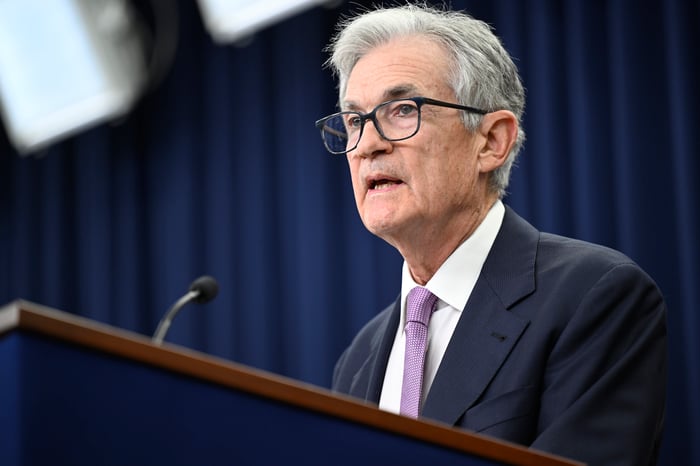
Fed Chair Jerome Powell delivering remarks. Image source: Official Federal Reserve Photo.
The Federal Reserve is Wall Street's No. 1 risk factor in 2026
On paper, the Fed's job looks easy: maximize employment while maintaining stable prices. But the practical application of these goals is easier said than done.
The primary way the nation's central bank influences monetary policy is through adjustments to the federal funds rate -- the overnight lending rate between financial institutions. Adjusting the federal funds target rate ripples through to borrowing rates and indirectly affects mortgage rates.
On Dec. 10, the FOMC, which is comprised of Fed Chair Jerome Powell and 11 other Fed Board governors, voted 9-3 in favor of lowering the fed funds rate to a new target of 3.50% to 3.75%. It was the third straight meeting featuring a 25-basis-point cut to the target rate. Although investors received what they were looking for -- a third rate cut to end the year -- it came with a hefty cost.

Target Federal Funds Rate Lower Limit data by YCharts.
The Dec. 10 FOMC meeting featured three dissenting opinions, with Kansas City Fed President Jeffrey Schmid and Chicago Fed President Austan Goolsbee favoring no cut, while Fed Governor Stephen Miran preferred a 50-basis-point reduction. It marked the second consecutive FOMC meeting with dissenting opinions in opposite directions, and only the third instance of this occurring in the last 35 years.
While an argument can be made that the Fed being late to act can be dangerous for the U.S. economy and equities, there's an equally strong counterargument that a divided central bank is even more dangerous.
Professional and everyday investors look to the central bank for a cohesive message. Even if this message isn't always right – since the Fed is often reacting to backward-looking economic data, the FOMC isn't always going to make the correct call – Wall Street takes comfort in leading economists agreeing on the best path forward. It's been decades since we've witnessed the central bank this divided regarding our nation's monetary policy.
To further complicate things, Jerome Powell's term as Fed chair comes to an end in May 2026. President Trump has been vocal about his displeasure with the Federal Reserve's slow-stepped rate-cutting, which suggests he's going to nominate someone who'll advocate for more aggressive easing. This has the potential to magnify the instability of what's normally the bedrock institution of U.S. financial markets.
With transparency being of the utmost importance for the stock market, the historic lack of clarity from the Fed points to a heightened probability of a bear market or crash in 2026.
Should you buy stock in S&P 500 Index right now?
Before you buy stock in S&P 500 Index, consider this:
The Motley Fool Stock Advisor analyst team just identified what they believe are the 10 best stocks for investors to buy now… and S&P 500 Index wasn’t one of them. The 10 stocks that made the cut could produce monster returns in the coming years.
Consider when Netflix made this list on December 17, 2004... if you invested $1,000 at the time of our recommendation, you’d have $509,039!* Or when Nvidia made this list on April 15, 2005... if you invested $1,000 at the time of our recommendation, you’d have $1,109,506!*
Now, it’s worth noting Stock Advisor’s total average return is 972% — a market-crushing outperformance compared to 193% for the S&P 500. Don't miss the latest top 10 list, available with Stock Advisor, and join an investing community built by individual investors for individual investors.
See the 10 stocks »
*Stock Advisor returns as of December 21, 2025.
Sean Williams has no position in any of the stocks mentioned. The Motley Fool has positions in and recommends Nvidia. The Motley Fool has a disclosure policy.
Recommended Articles


