

1 Big Reason Why Today's Value Investors Won't Find Tomorrow's Nvidia
Key Points
Nvidia had an above-average valuation right before the stock went up by 3,000%.
Investors must not neglect to look toward the future when investing in stocks.
- 10 stocks we like better than Nvidia ›
In his 1992 letter to Berkshire Hathaway shareholders, Warren Buffett, a renowned investor, said, "We think the very term 'value investing' is redundant." In other words, seeking value is the only way to invest. Given Buffett's affinity for value investing and his incredible success over the years, many investors seek to emulate his approach to stocks.
Unfortunately, most value investors miss the forest for the trees. And I'll explain how by using Nvidia (NASDAQ: NVDA) -- the best-performing large-cap stock of the past decade -- as an example.
Where to invest $1,000 right now? Our analyst team just revealed what they believe are the 10 best stocks to buy right now. Continue »

Image source: Getty Images.
Yes, I know it's a cherry-picked example. But many value investors would have never invested in Nvidia because they think about value in the wrong way. It's important to recognize the misconception that holds investors back from life-changing opportunities.
Why value investors missed Nvidia
Value investing aims to buy cheap stocks. And cheapness is measured by comparing the value of the company with something from its financial results, including profits.
Let's say a company is valued at $50 billion and only has $50 million in net income. This stock would be valued at 1,000 times its earnings. In other words, its price-to-earnings (P/E) ratio (a popular valuation metric) would be 1,000. Another $50 billion company that earns $5 billion in net income would have a P/E of 10, which would be 100 times cheaper.
In 2019, Nvidia's market cap, the value of the company, was around $100 billion. But its average P/E ratio for the year was 35, as the chart below shows.
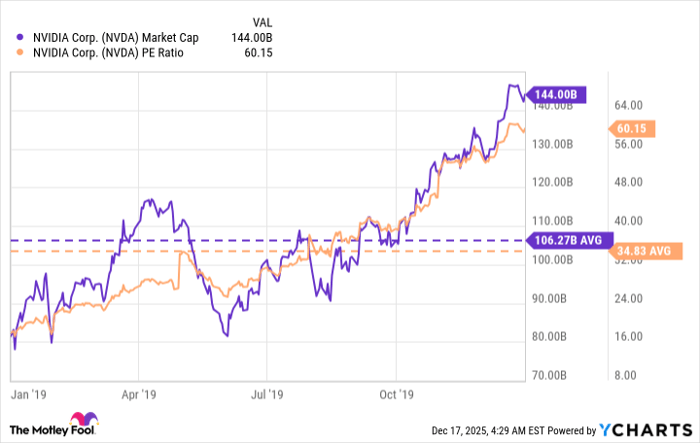
NVDA Market Cap data by YCharts
The average P/E ratio for the S&P 500 is somewhere around 25. Anything above that has an above-average valuation and is considered expensive by value investors. Nvidia in 2019, therefore, would have been too pricey to buy.
Value investors believe that the best value stocks to buy trade at a P/E ratio below the average. And often, value investors think that the cheaper a stock is, the better.
However, Nvidia has gone on to outperform virtually every other publicly traded company since the start of 2020, despite having an above-average P/E ratio. In short, value investing, as traditionally approached, prevented some investors from buying one of the greatest stocks of our time.
How to improve the value mindset
There's another important quote from Buffett that needs to be considered here. In the same letter, he wrote, "Growth is always a component in the calculation of value." In other words, value investors must look ahead when looking for a bargain.
Herein lies the problem with value investing as it's usually done: The P/E ratio (and others) measures past results. But investors must buy stocks today, looking ahead to what the business results could be tomorrow.
Returning to Nvidia stock, the P/E ratio looked pricey in 2019. But the P/E ratio didn't reflect the company's superb future earnings growth. As the chart below shows, the stock price is up nearly 3,000% in the last five years, but its earnings per share (EPS) are up even more than that.
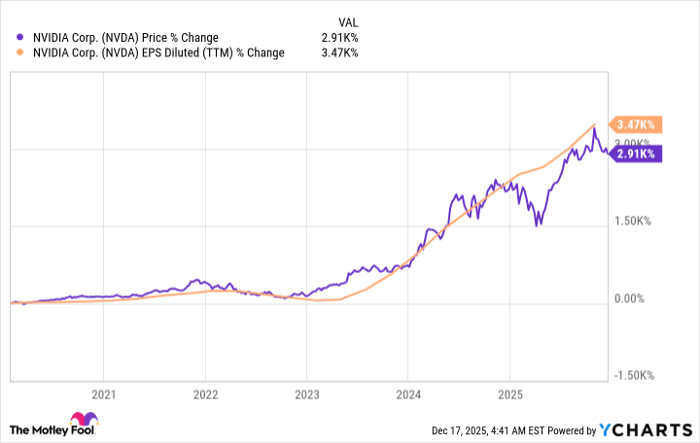
NVDA data by YCharts
Nvidia has earned $100 billion in net income over the past year. The stock traded at 35 times trailing earnings in 2019, which looked expensive. But for those with foresight, the entire value of the company then was equal to its profits right now, which is about as cheap as a stock could possibly be.
On a personal note, I missed Nvidia stock in 2019, not because of its pricey P/E ratio, but rather because I didn't foresee earnings growth of this magnitude. I didn't believe that the current build-out for AI infrastructure would be so big and last for so long. And in a traditionally cyclical space, I worried that overestimating demand would lead to lower margins at Nvidia.
I was dead wrong, and that underscores why investing is hard. Looking at a P/E ratio or a market cap is easy. Predicting where the world is going, how a company is positioned, and what that means financially is a tall order. It's why even the best investors often make mistakes.
The takeaway is that, to find tomorrow's Nvidia, investors must balance backward-looking valuation metrics with a forward-looking outlook for the business, such as how it will grow and what growth will do for profitability. The best stocks for the next 10 years might not look like value stocks right now. But they will be a tremendous value in hindsight.
Should you buy stock in Nvidia right now?
Before you buy stock in Nvidia, consider this:
The Motley Fool Stock Advisor analyst team just identified what they believe are the 10 best stocks for investors to buy now… and Nvidia wasn’t one of them. The 10 stocks that made the cut could produce monster returns in the coming years.
Consider when Netflix made this list on December 17, 2004... if you invested $1,000 at the time of our recommendation, you’d have $509,039!* Or when Nvidia made this list on April 15, 2005... if you invested $1,000 at the time of our recommendation, you’d have $1,109,506!*
Now, it’s worth noting Stock Advisor’s total average return is 972% — a market-crushing outperformance compared to 193% for the S&P 500. Don't miss the latest top 10 list, available with Stock Advisor, and join an investing community built by individual investors for individual investors.
See the 10 stocks »
*Stock Advisor returns as of December 20, 2025.
Jon Quast has no position in any of the stocks mentioned. The Motley Fool has positions in and recommends Berkshire Hathaway and Nvidia. The Motley Fool has a disclosure policy.
Recommended Articles


