




Why Chevron Could Thrive If Energy Prices Stay Elevated Through 2030
Key Points
Chevron can produce a growing stream of free cash flow if crude prices remain in the $60s through 2030.
It can fund its capital program and dividend payment even if they fall below $50 a barrel.
The oil company is in a strong position to continue returning cash to investors via higher dividends and meaningful repurchases.
- 10 stocks we like better than Chevron ›
Chevron (NYSE: CVX) is one of the world's biggest oil and gas producers. As a result, energy prices have a big impact on the company's earnings and cash flow. It can make a lot more money when prices are higher.
While Chevron can weather lower prices better than most of its rivals, it could really thrive if they stay elevated through 2030.
Where to invest $1,000 right now? Our analyst team just revealed what they believe are the 10 best stocks to buy right now. Continue »
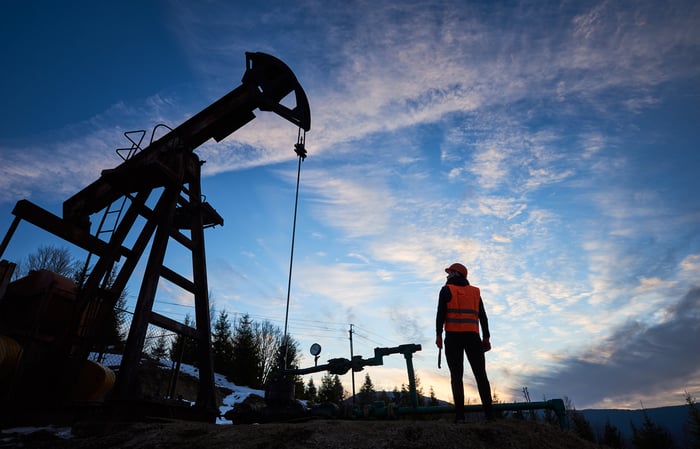
Image source: Getty Images.
Built for lower oil prices
Chevron has built one of the most resilient upstream oil and gas portfolios in the energy sector. It has the lowest projected breakeven level this year at $30 a barrel. This enables the company to generate substantial free cash flow at the current price point of around $60 per barrel.
The company also has one of the strongest balance sheets in the industry. Its net debt ratio was 15.1% at the end of the third quarter, well below its 20%-25% target range. That low leverage ratio provides Chevron with the flexibility to borrow money during periods of lower oil prices to fund its capital allocation strategy.
With a low breakeven level and fortress balance sheet, Chevron is returning a substantial amount of cash to investors each quarter. It sent them $6 billion in the third quarter, paying $3.4 billion of dividends and repurchasing $2.6 billion of its shares. It has now returned over $78 billion in cash to investors over the last three years.
Positioned to thrive through 2030
Chevron expects to keep its annual capital spending between $18 billion and $21 billion over the next several years to maintain and grow its global energy operations. It plans to stay disciplined next year, keeping spending within the lower end of the target range, at $18 billion to $19 billion. It's investing capital in its highest-return opportunities, positioning it to produce growing free cash flow in the future.
The company believes its disciplined strategy of investing in its highest return opportunities will pay off over the next several years. It's on track to generate an additional $12.5 billion in free cash flow next year, assuming oil averages $70 a barrel. It can still produce a significant amount of incremental free cash flow even if oil prices are in the $60s. The company expects to benefit from recently completed expansion projects in Kazakhstan and the Gulf of Mexico, as well as its cost-savings initiatives and the recently closed merger with Hess.
Chevron estimates that it can grow its free cash flow to more than $20 billion per year at an average oil price of $60 a barrel through 2030. That number would approach $30 billion annually should crude average $70 a barrel during that period, a more than 10% compound annual growth rate from this year's level. Growth drivers include offshore Guyana (acquired through the Hess deal), future expansion opportunities in the Eastern Mediterranean, the Gulf, and West Africa, as well as its investments in building out several lower-carbon energy platforms.
The company could still thrive if oil prices are lower, as it can cover its capital spending plan and dividend payment at an oil price below $50 a barrel through 2030. Chevron's durable and growing free cash flow, combined with its strong balance sheet, will enable it to continue returning cash to investors. The company has increased its dividend payment for 38 consecutive years, a streak that is likely to continue. Additionally, the company aims to repurchase $10 billion to $20 billion of its shares each year. That's enough to retire 3% to 6% of its outstanding shares each year at the recent price. It can still buy back stock at the lower end of its target range even if crude prices are below $60 a barrel.
A well-oiled machine
Chevron can do very well for investors if crude prices remain around $60 a barrel through 2030. It can continue to increase its 4.7%-yielding dividend and repurchase at least 3% of its shares each year. Add in the growth of its free cash flow, and Chevron could produce robust total returns over the next several years if oil prices continue to cooperate.
Should you buy stock in Chevron right now?
Before you buy stock in Chevron, consider this:
The Motley Fool Stock Advisor analyst team just identified what they believe are the 10 best stocks for investors to buy now… and Chevron wasn’t one of them. The 10 stocks that made the cut could produce monster returns in the coming years.
Consider when Netflix made this list on December 17, 2004... if you invested $1,000 at the time of our recommendation, you’d have $509,955!* Or when Nvidia made this list on April 15, 2005... if you invested $1,000 at the time of our recommendation, you’d have $1,089,460!*
Now, it’s worth noting Stock Advisor’s total average return is 968% — a market-crushing outperformance compared to 193% for the S&P 500. Don't miss the latest top 10 list, available with Stock Advisor, and join an investing community built by individual investors for individual investors.
See the 10 stocks »
*Stock Advisor returns as of December 18, 2025.
Matt DiLallo has positions in Chevron. The Motley Fool has positions in and recommends Chevron. The Motley Fool has a disclosure policy.
Recommended Articles


