




Will Chamath Palihapitiya's American Exceptionalism SPAC Succeed? Here's What History Says.
Key Points
Chamath Palihapitiya has been involved with a number of high-profile SPAC deals, including SoFi and Virgin Galactic.
Both Palihapitiya's personal track record and the long-term performance of the broader SPAC landscape suggests investors should approach this new opportunity with caution.
- These 10 stocks could mint the next wave of millionaires ›
For the first time in nearly three years, investors (finally!) have something to talk about that isn't related to artificial intelligence (AI).
The latest buzz on Wall Street comes from a familiar but controversial corner of the stock market: special purpose acquisition companies (SPACs). And perhaps unsurprisingly, the sponsor behind the deal is none other than Chamath Palihapitiya -- often referred to as the "SPAC King."
Where to invest $1,000 right now? Our analyst team just revealed what they believe are the 10 best stocks to buy right now. Learn More »
While his early launches drew enormous hype, Palihapitiya's SPAC stocks have been anything but royal -- often leaving retail investors holding the bag. This track record has led some to question whether SPACs are good investments at all.
Still, Palihapitiya is back in the arena -- this time with American Exceptionalism Acquisition Corp., a name as ambitious as the investor behind it. The question now is whether this latest venture signals a genuine comeback or simply another high-profile gamble in a market rife with wary investors.
Will Palihapitiya's new SPAC succeed? Read on to explore what history shows and what it could mean for investors.
Who is Chamath Palihapitiya?
Chamath Palihapitiya began his career in management roles at AOL and Facebook (now Meta Platforms). Outside of those corporate posts, he proved fortunate -- and shrewd -- in backing early-stage start-ups that ultimately found lucrative exits through acquisitions by larger companies.
Eventually, Palihapitiya left Facebook to pursue investing full-time -- launching his own venture capital firm, Social Capital.
Fast-forward to the SPAC boom between 2020 and 2021, and Palihapitiya instantly became one of the most vocal voices and recognizable personalities in the space.
Some of his high-profile deals included SoFi Technologies (NASDAQ: SOFI), Virgin Galactic, MP Materials, Clover Health, and Opendoor Technologies.
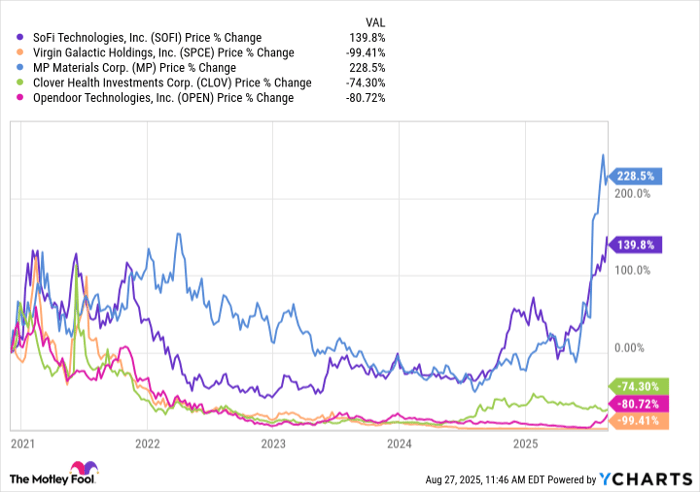
SOFI data by YCharts
While admirers paint Palihapitiya as a bold contrarian investor willing to challenge Wall Street's status quo, the uneven performance of many of these SPACs has given critics plenty of ammunition.
What is a SPAC?
A SPAC, often referred to as a "blank check company," is a shell entity that raises money from investors through a public offering with the sole purpose of merging with a private company. Once a target is identified, the SPAC combines with that company -- instantly taking it public without the lengthy, complex process of a traditional initial public offering (IPO).
The main difference between a SPAC and an IPO comes down to structure and timing. In an IPO, a company works with an investment bank to underwrite the deal -- a process that can take months as bankers conduct roadshows, pitch to accredited investors, and determine an appropriate valuation.
By contrast, a SPAC is already listed on an exchange, so merging with it allows a company to bypass much of the regulatory and logistical friction.
For companies, SPACs provide a quicker, simpler alternative to the traditional IPO process. For investors, they offer exposure to buzzy businesses -- often unicorns -- that might otherwise be off-limits before they go public.

Image source: Getty Images.
Are SPACs good investments?
Just like traditional IPO stocks, determining whether a SPAC is a good investment ultimately comes down to "it depends." While Palihapitiya's most recognizable SPACs are often cited, it's important to remember that he also backed some companies that later delisted or even went bankrupt. Taken as a whole, Palihapitiya's personal track record in the SPAC arena has been disappointing.
That said, not every SPAC has fared poorly. Some companies have managed to carve out a path to success.
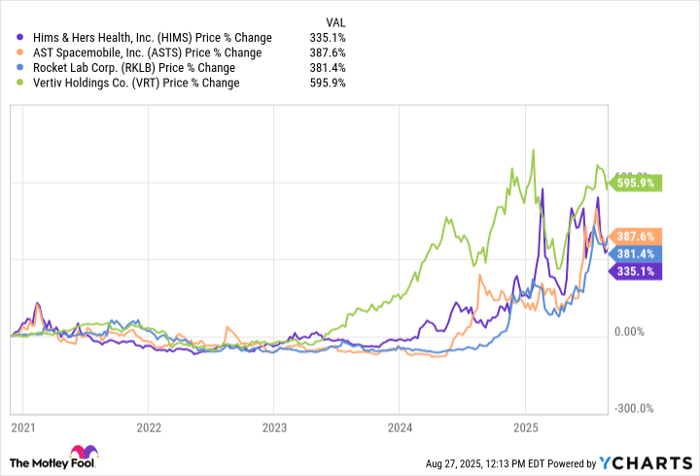
HIMS data by YCharts
Hims & Hers Health has become something of a darling among retail investors thanks to its bold entrance into the red-hot weight loss market, going toe-to-toe with GLP-1 juggernauts Eli Lilly and Novo Nordisk. Moreover, AST Spacemobile and Rocket Lab have attracted speculative enthusiasm from investors captivated by the space exploration economy. Meanwhile, Vertiv has enjoyed tailwinds from the AI boom as its liquid cooling systems prove critical to ongoing data center infrastructure investment.
These examples come with important caveats. Winners like these tend to be outliers, often driven by retail hype or unique secular catalysts. A detailed study from the University of Florida underscores this point: Between 2012 and 2022 SPAC stocks delivered returns of negative 58% one year following their merger. Moreover, the median SPAC performance across industries from 2009 through 2025 has drastically trailed the broader market.
In other words, while some SPACs have thrived, these seem to be exceptions rather than the norm. American Exceptionalism Acquisition Corp. may succeed in capturing headlines, but for smart investors, it should be viewed as a speculative bet rather than a proven opportunity.
Considering both Palihapitiya's past ventures and the results of the broader SPAC landscape, history suggests caution is warranted.
Where to invest $1,000 right now
When our analyst team has a stock tip, it can pay to listen. After all, Stock Advisor’s total average return is 1,069%* — a market-crushing outperformance compared to 186% for the S&P 500.
They just revealed what they believe are the 10 best stocks for investors to buy right now, available when you join Stock Advisor.
See the stocks »
*Stock Advisor returns as of August 25, 2025
Adam Spatacco has positions in Eli Lilly, Meta Platforms, Novo Nordisk, and SoFi Technologies. The Motley Fool has positions in and recommends Hims & Hers Health, Meta Platforms, and Rocket Lab. The Motley Fool recommends MP Materials and Novo Nordisk. The Motley Fool has a disclosure policy.
Recommended Articles


