

Gold pulls back from $4,500 amid profit-taking ahead of key US macro data
- Gold faces rejection near $4,500 as the underlying bullish sentiment prompts profit-taking.
- Rising geopolitical tensions and dovish Fed expectations could support the precious metal.
- Investors now look forward to important US macro releases for some meaningful impetus.
Gold (XAU/USD) struggles to capitalize on its strong weekly gains registered over the past two days and faces rejection near the $4,500 psychological mark, or over a one-week high touched during the Asian session on Wednesday. As investors digest the recent US attack on Venezuela, the prevalent risk-on environment prompts some profit-taking around the commodity. However, US President Donald Trump's threats to annex Greenland, along with confrontational rhetoric toward Colombia and Mexico, keep geopolitical risks in play and help limit losses for the safe-haven precious metal.
Meanwhile, rising bets for more interest rate cuts by the US Federal Reserve (Fed) fail to assist the US Dollar (USD) in capitalizing on the previous day's move higher. This turns out to be another factor acting as a tailwind for the non-yielding Gold. Traders also seem reluctant and opt to wait for the release of important US macroeconomic indicators, including the crucial Nonfarm Payrolls (NFP) report on Friday, before positioning for the next leg of a directional move. The data will be looked for Fed rate-cut cues, which will drive the USD and provide a fresh impetus to the XAU/USD pair.
Daily Digest Market Movers: Gold might continue to draw support from geopolitical risks, Fed rate cut bets
- Investors appeared to shrug off worries stemming from the US attack on Venezuela over the weekend, with the S&P 500 and the Dow Jones Industrial Average notching fresh record highs on Tuesday.
- Meanwhile, US President Donald Trump openly signaled that Colombia and Mexico could also face US military action as part of a widening campaign against criminal networks and regional instability.
- Moreover, the White House said on Tuesday that Trump is discussing options for acquiring Greenland, including potential use of the US military, in a revival of his ambition to control the strategic island.
- This comes on top of the lack of progress in the Russia-Ukraine peace deal, unrest in Iran, and issues surrounding Gaza, which keeps geopolitical risks in play and should support the safe-haven Gold.
- According to the CME Group's FedWatch tool, traders are pricing in the possibility that the US Federal Reserve will lower borrowing costs in March and deliver another rate cut by the end of this year.
- Richmond Fed President Thomas Barkin said that further changes to the short-term rate will need to be tuned to incoming data amid the risks to both the central bank's employment and inflation goals.
- Friday's release of the closely-watched US Nonfarm Payrolls (NFP) report and the US consumer inflation figures, due next Tuesday, could offer more cues about the Fed's further rate-cut path.
- This, in turn, will play a key role in influencing the USD price dynamics in the near-term and help in determining the next leg of a directional move for the non-yielding yellow metal.
- In the meantime, Wednesday's US economic docket – featuring the ADP report on private-sector employment, ISM Services PMI, and JOLTS Job Openings – might provide some impetus.
Gold could find some support near the $4,450-4,445 congestion zone
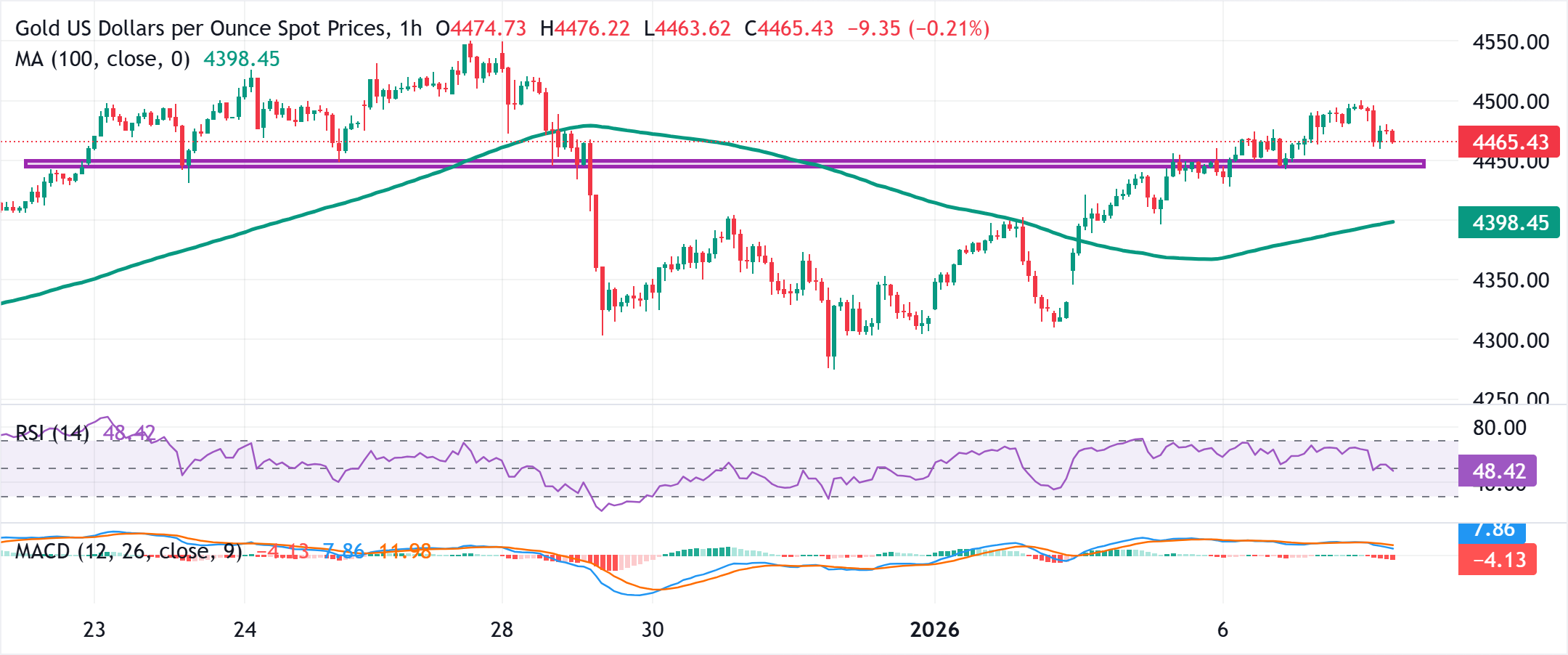
The 100-hour Simple Moving Average (SMA) rises and sits beneath spot prices, suggesting underlying trend support near the $4,400 mark. The Moving Average Convergence Divergence (MACD) slips below the Signal line and holds in negative territory, with the histogram expanding on the downside. The Relative Strength Index (RSI) eased to 48.58, neutral, reflecting balanced momentum after recent softness.
In the near term, momentum would need to stabilize to reassert the bullish tone. A MACD turn toward a bullish crossover and an RSI push back above 50 would support an upswing, while failure to improve could keep the bias heavy and expose a retest of the 100-hour SMA. With price still above that rising baseline, dips could remain contained, but a close beneath it would open room for further downside.
(The technical analysis of this story was written with the help of an AI tool)
Gold FAQs
Gold has played a key role in human’s history as it has been widely used as a store of value and medium of exchange. Currently, apart from its shine and usage for jewelry, the precious metal is widely seen as a safe-haven asset, meaning that it is considered a good investment during turbulent times. Gold is also widely seen as a hedge against inflation and against depreciating currencies as it doesn’t rely on any specific issuer or government.
Central banks are the biggest Gold holders. In their aim to support their currencies in turbulent times, central banks tend to diversify their reserves and buy Gold to improve the perceived strength of the economy and the currency. High Gold reserves can be a source of trust for a country’s solvency. Central banks added 1,136 tonnes of Gold worth around $70 billion to their reserves in 2022, according to data from the World Gold Council. This is the highest yearly purchase since records began. Central banks from emerging economies such as China, India and Turkey are quickly increasing their Gold reserves.
Gold has an inverse correlation with the US Dollar and US Treasuries, which are both major reserve and safe-haven assets. When the Dollar depreciates, Gold tends to rise, enabling investors and central banks to diversify their assets in turbulent times. Gold is also inversely correlated with risk assets. A rally in the stock market tends to weaken Gold price, while sell-offs in riskier markets tend to favor the precious metal.
The price can move due to a wide range of factors. Geopolitical instability or fears of a deep recession can quickly make Gold price escalate due to its safe-haven status. As a yield-less asset, Gold tends to rise with lower interest rates, while higher cost of money usually weighs down on the yellow metal. Still, most moves depend on how the US Dollar (USD) behaves as the asset is priced in dollars (XAU/USD). A strong Dollar tends to keep the price of Gold controlled, whereas a weaker Dollar is likely to push Gold prices up.
Recommended Articles


