

Gold consolidates gains as Venezuela crisis keeps investors cautious
- Gold holds just below record territory as geopolitical tensions between the US and Venezuela keep safe-haven demand elevated.
- A modest rebound in the US Dollar and Treasury yields caps follow-through buying.
- Technically, Gold holds a bullish bias, supported by rising moving averages.
Gold (XAU/USD) consolidates on Tuesday after posting gains of more than 2.5% the previous day, driven by a surge in safe-haven demand following United States (US) attacks on Venezuela. At the time of writing, XAU/USD is trading around $4,460, down modestly from an intraday peak near $4,475.
The downside for Gold remains limited as investors continue to monitor developments in the US-Venezuela relationship. Over the weekend, US armed forces captured and brought Venezuelan President Nicolás Maduro to New York, where Maduro is facing narco-terrorism and drug-trafficking charges.
While safe-haven demand remains elevated, fresh buying has eased after Monday’s sharp advance, with a modest rebound in the US Dollar (USD) and US Treasury yields capping further upside. At the same time, relatively stable risk sentiment across global equity markets is also tempering additional safe-haven flows.
That said, persistent geopolitical tensions and sustained expectations of two interest rate cuts by the Federal Reserve (Fed) this year continue to underpin Gold’s broader bullish bias, keeping prices anchored just below record highs.
Traders are also looking ahead to upcoming US jobs data later this week, which could shape near-term Fed expectations and provide the next directional cue for Bullion.
Market movers: Markets digest Venezuela fallout and weak US factory data
- Venezuelan President Nicolás Maduro appeared alongside his wife before a federal judge in New York on Monday and pleaded not guilty, saying, “I’m innocent. I am not guilty. I am a decent man, the president of my country.”
- Following the attacks, US President Donald Trump told reporters on Sunday that the United States would temporarily “run” Venezuela. Meanwhile, newly inaugurated President Delcy Rodríguez said late Monday that Venezuela is seeking cooperation, adding, “We invite the US government to collaborate with us on an agenda of cooperation oriented toward shared development within the framework of international law.”
- The US Dollar stages a modest recovery on Tuesday after coming under pressure on Monday following the release of weak ISM Manufacturing Purchasing Managers Index (PMI) data. The US Dollar Index (DXY), which tracks the Greenback's value against a basket of six major currencies, is trading around 98.40 after dipping to 98.16 earlier in the Asian session.
- The ISM Manufacturing PMI remained in contraction territory in December at 47.9, missing expectations of 48.3 and slipping from 48.2 in November. The Prices Paid Index held steady at 58.5, below forecasts of 59. The Employment Index rose to 44.9 from 44.0, while the New Orders Index contracted for a fourth straight month in December after one month of growth, edging up to 47.7 from 47.4.
- Minneapolis Fed President Neel Kashkari said on Monday that his “guess” is that monetary policy is now close to neutral, while adding that he expects the US economy to remain resilient. Kashkari also noted that there is a risk the Unemployment Rate could rise and flagged inflation persistence as a key concern.
Technical analysis: Rising moving averages keep bullish bias intact
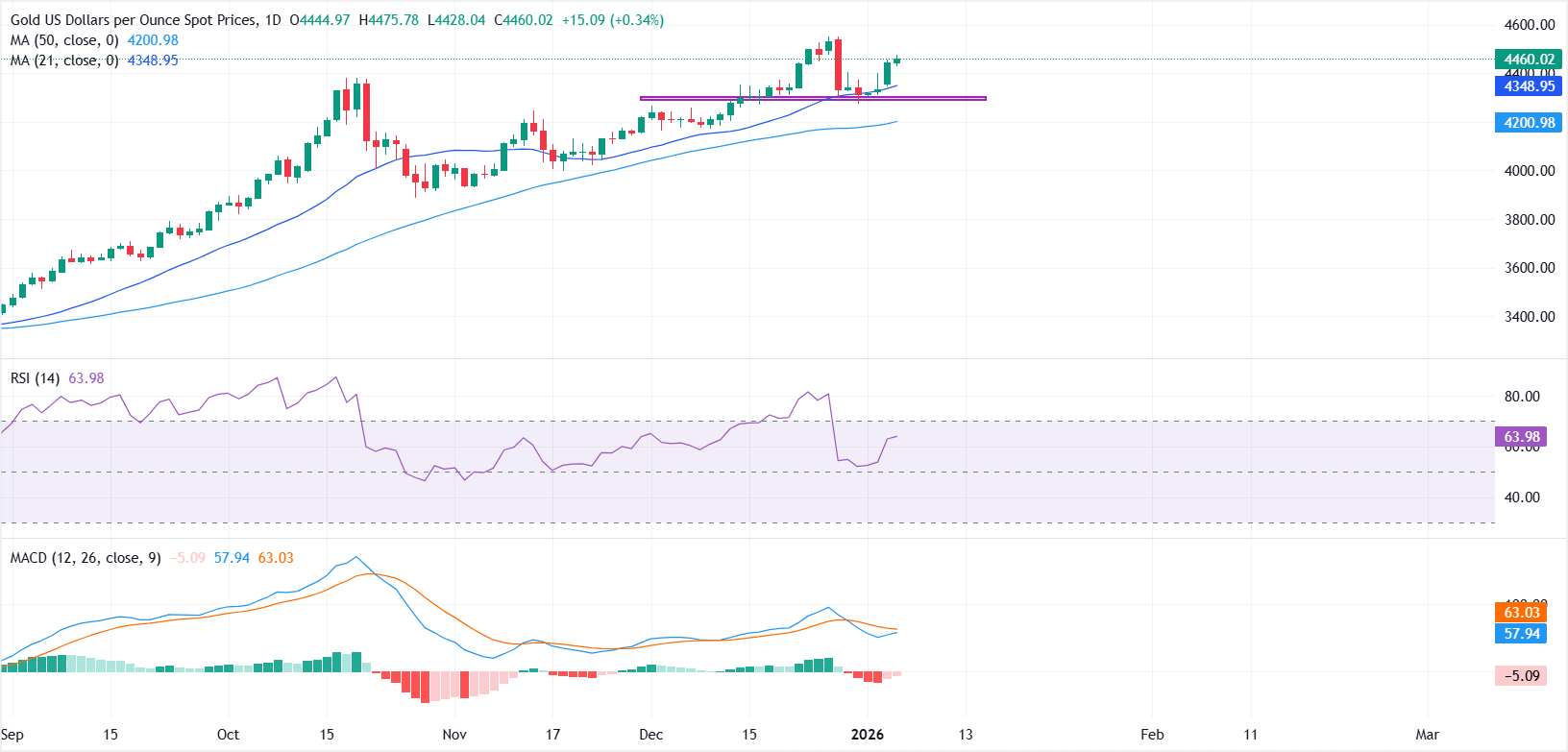
From a technical perspective, the daily chart reflects a broadly constructive setup. The 21-day Simple Moving Average (SMA) remains above the 50-day SMA, with both indicators sloping higher and prices holding comfortably above them.
On the downside, the rising 21-day SMA near $4,348.80 offers the first layer of dynamic support, ahead of the $4,300 psychological level. A deeper pullback could see buyers defend the 50-day SMA around $4,200.92, which continues to underpin the broader uptrend.
On the upside, the $4,450-$4,470 zone caps the immediate advance. A sustained break above this barrier would expose the all-time high near $4,549, with scope for further upside extension if bullish momentum accelerates.
Momentum indicators are stabilising. The Moving Average Convergence Divergence (MACD) remains below the signal line and under the zero mark, but the negative histogram is contracting, pointing to fading bearish pressure. Meanwhile, the Relative Strength Index (RSI) stands near 64, reflecting positive momentum without yet flashing overbought conditions.
Gold FAQs
Gold has played a key role in human’s history as it has been widely used as a store of value and medium of exchange. Currently, apart from its shine and usage for jewelry, the precious metal is widely seen as a safe-haven asset, meaning that it is considered a good investment during turbulent times. Gold is also widely seen as a hedge against inflation and against depreciating currencies as it doesn’t rely on any specific issuer or government.
Central banks are the biggest Gold holders. In their aim to support their currencies in turbulent times, central banks tend to diversify their reserves and buy Gold to improve the perceived strength of the economy and the currency. High Gold reserves can be a source of trust for a country’s solvency. Central banks added 1,136 tonnes of Gold worth around $70 billion to their reserves in 2022, according to data from the World Gold Council. This is the highest yearly purchase since records began. Central banks from emerging economies such as China, India and Turkey are quickly increasing their Gold reserves.
Gold has an inverse correlation with the US Dollar and US Treasuries, which are both major reserve and safe-haven assets. When the Dollar depreciates, Gold tends to rise, enabling investors and central banks to diversify their assets in turbulent times. Gold is also inversely correlated with risk assets. A rally in the stock market tends to weaken Gold price, while sell-offs in riskier markets tend to favor the precious metal.
The price can move due to a wide range of factors. Geopolitical instability or fears of a deep recession can quickly make Gold price escalate due to its safe-haven status. As a yield-less asset, Gold tends to rise with lower interest rates, while higher cost of money usually weighs down on the yellow metal. Still, most moves depend on how the US Dollar (USD) behaves as the asset is priced in dollars (XAU/USD). A strong Dollar tends to keep the price of Gold controlled, whereas a weaker Dollar is likely to push Gold prices up.
Recommended Articles


