

USD/INR slumps at open while US Dollar trades steady ahead of key US data
- The Indian Rupee attracts significant bids at open against the US Dollar, pushing USD/INR lower to near 89.80.
- The pace of FIIs selling in the Indian stock market has slowed down this week.
- Investors await a slew of US economic data due in the North American session.
The Indian Rupee (INR) gains sharply against the US Dollar (USD) at the open on Wednesday, with the USD/INR pair slumping almost 0.5% to near 89.80.
However, the pair is expected to remain under pressure as renewed trade frictions between the United States (US) and India, and the consistent Foreign Institutional Investors (FIIs) selling in the Indian equity market, will likely keep the Indian Rupee on the backfoot.
Earlier this week, US President Donald Trump threatened to increase tariffs on India for not supporting on Russia oil issue, which is directly linked to the purchase of oil by New Delhi from Moscow.
New Delhi is already charged with 50% tariffs on its exports to Washington, which includes a 25% punitive duty for buying Russian oil, which is one of the highest among all trading partners of the US.
Though the impact of trade tensions between the US and India is merely 0.3%-0.5% on India’s Gross Domestic Product (GDP), according to a report from Times of India (ToI), the influence is more sentimental, which is clear from the consistent outflow of foreign funds from the Indian stock market.
In 2025, FIIs offloaded their stake worth Rs. 3,06,418.88 crore in the Indian equity market after remaining net sellers in eight out of 12 months. So far in January, overseas investors have sold shares worth Rs. 3,122.68 crore; however, the pace of selling appears to have slowed in the last two trading days. FIIs have cumulatively sold shares worth Rs. 143.88 crore on Monday and Tuesday.
Investors will closely monitor US ADP Employment Change and JOLTS Job Openings data
- The USD/INR pair is expected to trade cautiously during the day ahead of the release of key US economic data in the North American session. As of writing, the US Dollar Index (DXY), which tracks the Greenback’s value against six major currencies, trades subduedly near 98.50.
- In North American trading hours, investors will focus on the ADP Employment Change and the ISM Services PMI data for December, and the JOLTS Job Openings data for November.
- The ADP is expected to report that the private sector added 45K fresh workers after firing 32K in November. The ISM Services PMI is estimated to come in at 52.3, lower than the prior reading of 52.6, which suggests that the service activity continues to expand but at a moderate pace. And, the JOLTS Job Openings data will likely show that employers posted fresh 7.64 million, almost similar to October’s reading.
- Investors will pay close attention to private payrolls and job postings data to get cues on the current state of labor demand in the US. The employment-linked data will significantly influence market expectations for the Federal Reserve’s (Fed) monetary policy outlook, given that officials delivered three interest rate cuts in 2025, mainly due to a weakening job market.
- On Tuesday, Richmond Fed Bank President Thomas Barkin again highlighted employment risks, stating that "no one wants the labor market to deteriorate much further". Barkin also signaled that policymakers will perform a delicate balancing act in upcoming meetings as inflation is still above the 2% target.
- The major highlight of the week will be the US Nonfarm Payrolls (NFP) data for December, which will be released on Friday.
Technical Analysis: USD/INR falls below 20-day EMA
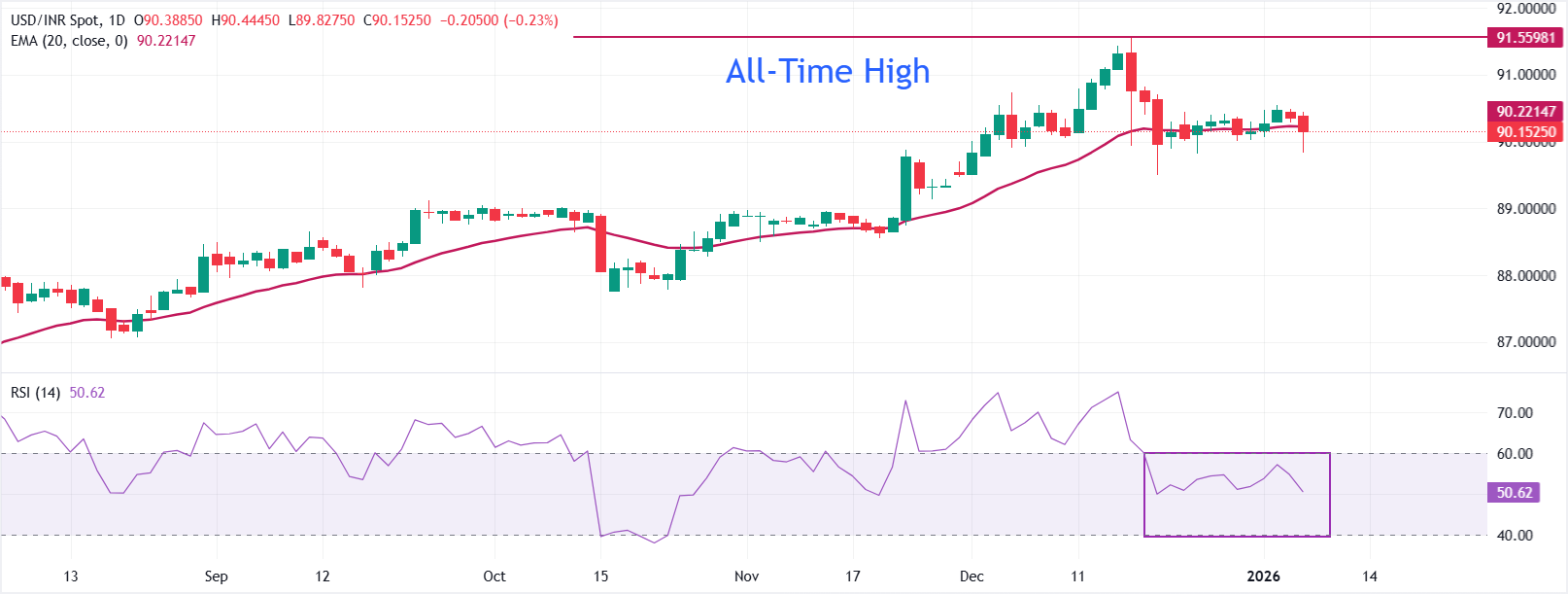
USD/INR tests regions below the psychological level of 90.00 at the open on Wednesday. The outlook of the price has become uncertain as it struggles to hold the 20-day Exponential Moving Average (EMA), which trades around 90.22.
The 14-day Relative Strength Index (RSI) slips to 49.28 after unwinding overbought conditions, placing momentum at the neutral line and tilting pressure modestly to the downside.
With momentum fading, upside attempts would need an RSI recovery above 50 to reassert buying interest and open a retest of 91.3115. If RSI extends lower toward the mid-40s, sellers could press the pullback and keep the cross range-bound until momentum stabilizes.
(The technical analysis of this story was written with the help of an AI tool.)
Indian Rupee FAQs
The Indian Rupee (INR) is one of the most sensitive currencies to external factors. The price of Crude Oil (the country is highly dependent on imported Oil), the value of the US Dollar – most trade is conducted in USD – and the level of foreign investment, are all influential. Direct intervention by the Reserve Bank of India (RBI) in FX markets to keep the exchange rate stable, as well as the level of interest rates set by the RBI, are further major influencing factors on the Rupee.
The Reserve Bank of India (RBI) actively intervenes in forex markets to maintain a stable exchange rate, to help facilitate trade. In addition, the RBI tries to maintain the inflation rate at its 4% target by adjusting interest rates. Higher interest rates usually strengthen the Rupee. This is due to the role of the ‘carry trade’ in which investors borrow in countries with lower interest rates so as to place their money in countries’ offering relatively higher interest rates and profit from the difference.
Macroeconomic factors that influence the value of the Rupee include inflation, interest rates, the economic growth rate (GDP), the balance of trade, and inflows from foreign investment. A higher growth rate can lead to more overseas investment, pushing up demand for the Rupee. A less negative balance of trade will eventually lead to a stronger Rupee. Higher interest rates, especially real rates (interest rates less inflation) are also positive for the Rupee. A risk-on environment can lead to greater inflows of Foreign Direct and Indirect Investment (FDI and FII), which also benefit the Rupee.
Higher inflation, particularly, if it is comparatively higher than India’s peers, is generally negative for the currency as it reflects devaluation through oversupply. Inflation also increases the cost of exports, leading to more Rupees being sold to purchase foreign imports, which is Rupee-negative. At the same time, higher inflation usually leads to the Reserve Bank of India (RBI) raising interest rates and this can be positive for the Rupee, due to increased demand from international investors. The opposite effect is true of lower inflation.
Recommended Articles


