

USD/INR opens lower as US inflation cools down
- The Indian Rupee gains against the US Dollar as the US CPI growth remains moderate in November.
- FIIs turned out to be net buyers on Wednesday and Thursday.
- US President Trump called Fed’s Waller “great” after interviewing him for the next chairman.
The Indian Rupee (INR) opens on a bullish note against the US Dollar (USD) on Friday. The USD/INR pair declines to near 90.30 as weakness in the US Dollar due to an unexpected slowdown in the United States (US) inflation has supported the Reserve Bank of India’s (RBI) tentative boost to the Indian Rupee.
On Thursday, the US Consumer Price Index (CPI) data for November showed that the headline inflation cooled down to 2.7% year-on-year (YoY) from 3% in October. Economists expected the inflation data to come in higher at 3.1%. The so-called core reading, which strips out volatile food and energy items, dropped to 2.6% from estimates and the prior reading of 3%.
Initially, the US Dollar reacted negatively to soft inflation data, but has since recovered losses as the data has not materially affected dovish expectations for the Federal Reserve’s (Fed) January policy meeting. According to the CME FedWatch tool, the probability of the Fed reducing interest rates by 25 basis points (bps) to 3.25%-3.50% in the January meeting.
Chicago President Austan Goolsbee welcomed soft inflation prints in his interview with Fox Business on Thursday, stating that “there’s a lot to like” in the data. Goolsbee signaled that there could be additional interest rate cuts next year if inflation remains on track toward the 2% target.
Daily digest market movers: Indian Rupee’s recovery is likely to be short-lived
- Though investors have underpinned the Indian Rupee against the US Dollar, the Indian currency’s recovery is unlikely to be sustained amid an absence of supportive fundamentals.
- Earlier this week, the Indian Rupee bounced back strongly from its record lows of 91.55 against the US Dollar after RBI’s intervention in spot and non-deliverable forward (NDF) markets.
- So far this year, the Indian Rupee has depreciated more than 6% against the US Dollar due to strong demand for Greenback by Indian importers and the consistent outflow of foreign funds from the Indian stock market amid an absence of a US-India trade deal announcement.
- Currently, Washington is charging 50% tariffs on imports from New Delhi, which includes a 25% punitive import duty for buying Oil from Russia. This is one of the highest tariffs charged by Washington among its trading partners.
- This month, Foreign Institutional Investors (FIIs) have offloaded a stake worth Rs. 21,688.26 crore in the Indian equity market. However, some sort of buying has been observed in the past two trading days. FIIs have turned out to be net buyers of Rs. 1,767.49 crore worth of shares collectively on Wednesday and Thursday. Nominal buying interest in FIIs' activity is unlikely to provide a sustainable boost to risk sentiment, as the overall mood is still cautious amid the US-India trade stalemate.
- Going forward, the next major trigger for the USD/INR pair will be the announcement of Fed Chair Jerome Powell’s successor by the White House. On Thursday, US President Donald Trump interviewed Fed Governor Christopher Waller for the Chairman post, and praised him as “great”, while responding to reporters. Trump also called Governor Michelle Bowman, "fantastic", when asked about his views on her as Powell’s successor.
- Last week, US President Trump stated he has downsized his choices for Fed’s chairman to both Kevins, which are White House Economic Adviser Kevin Hassett and former Fed Chairman Kevin Warsh.
Technical Analysis: USD/INR drops to near 20-day EMA
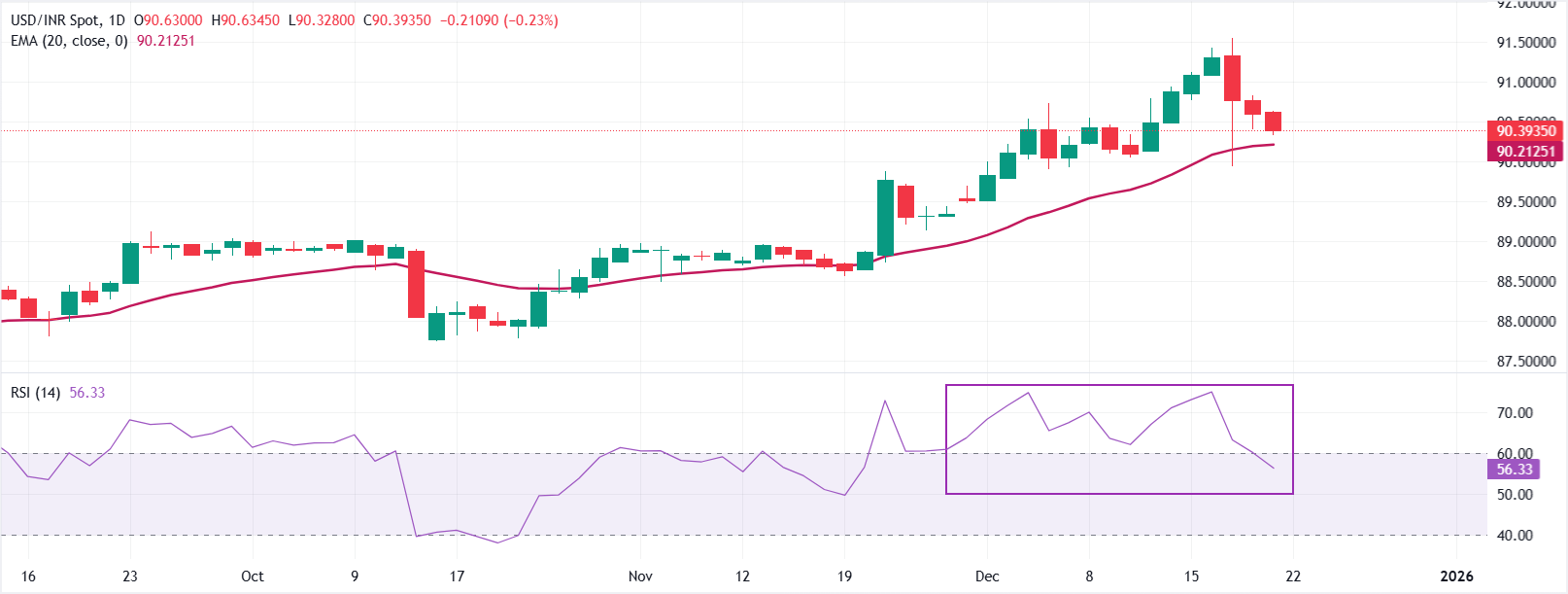
In the daily chart, USD/INR trades at 90.3935. Price holds above the rising 20-day Exponential Moving Average (EMA) at 90.2125, preserving an upward bias. The average’s positive slope continues to guide the price higher and has absorbed recent pullbacks.
The 14-day Relative Strength Index (RSI) at 56 (neutral) has eased from prior overbought readings, pointing to moderated momentum. Support sits at the 20-day EMA at 90.2125; a decisive close below it could open a deeper corrective phase.
Bulls retain control while the pair maintains a distance above the 20-day EMA, which continues to trend higher and supports dips. Sustained trading above this dynamic support would keep the path oriented to the upside. RSI at 56 (neutral) shows momentum cooling; a rebound in the oscillator would bolster renewed upside pressure. A break of the 20-day EMA at 90.2125 would hand initiative to sellers and tilt risks toward a broader pullback.
(The technical analysis of this story was written with the help of an AI tool.)
Indian Rupee FAQs
The Indian Rupee (INR) is one of the most sensitive currencies to external factors. The price of Crude Oil (the country is highly dependent on imported Oil), the value of the US Dollar – most trade is conducted in USD – and the level of foreign investment, are all influential. Direct intervention by the Reserve Bank of India (RBI) in FX markets to keep the exchange rate stable, as well as the level of interest rates set by the RBI, are further major influencing factors on the Rupee.
The Reserve Bank of India (RBI) actively intervenes in forex markets to maintain a stable exchange rate, to help facilitate trade. In addition, the RBI tries to maintain the inflation rate at its 4% target by adjusting interest rates. Higher interest rates usually strengthen the Rupee. This is due to the role of the ‘carry trade’ in which investors borrow in countries with lower interest rates so as to place their money in countries’ offering relatively higher interest rates and profit from the difference.
Macroeconomic factors that influence the value of the Rupee include inflation, interest rates, the economic growth rate (GDP), the balance of trade, and inflows from foreign investment. A higher growth rate can lead to more overseas investment, pushing up demand for the Rupee. A less negative balance of trade will eventually lead to a stronger Rupee. Higher interest rates, especially real rates (interest rates less inflation) are also positive for the Rupee. A risk-on environment can lead to greater inflows of Foreign Direct and Indirect Investment (FDI and FII), which also benefit the Rupee.
Higher inflation, particularly, if it is comparatively higher than India’s peers, is generally negative for the currency as it reflects devaluation through oversupply. Inflation also increases the cost of exports, leading to more Rupees being sold to purchase foreign imports, which is Rupee-negative. At the same time, higher inflation usually leads to the Reserve Bank of India (RBI) raising interest rates and this can be positive for the Rupee, due to increased demand from international investors. The opposite effect is true of lower inflation.
Recommended Articles


