

EUR/USD steadies with all eyes on the ECB monetary policy decision
- The Euro consolidates near 1.1750 against the US Dollar, halfway through the weekly range.
- The pair is likely to remain steady ahead of the ECB's monetary policy decision and US CPI data.
- The ECB is widely expected to leave interest rates unchanged.
EUR/USD posts marginal losses on Thursday, trading near 1.1730 at the time of writing, after bouncing from lows near 1.1700 the previous day. The pair has found some balance halfway through the weekly range after whipsawing earlier in the week.
The highlight of the day will be the outcome of the European Central Bank's (ECB) monetary policy decision. The bank is widely expected to leave its benchmark Rate On the Deposit Facility unchanged at 2% and signal steady monetary policy for the foreseeable future. Any nod to a rate hike on the horizon would be considered a hawkish sign and boost the Euro (EUR) higher.
In the US, investors will be attentive to the release of November's Consumer Price Index (CPI) for further insight about the US Federal Reserve's (Fed) monetary policy plans. Labour data released earlier in the week has been fairly soft, and the risk now is on a moderate inflation reading, which would pave the path for further monetary easing and increase bearish pressure on the US Dollar (USD)
Euro Price Today
The table below shows the percentage change of Euro (EUR) against listed major currencies today. Euro was the strongest against the New Zealand Dollar.
| USD | EUR | GBP | JPY | CAD | AUD | NZD | CHF | |
|---|---|---|---|---|---|---|---|---|
| USD | 0.08% | 0.09% | 0.08% | -0.04% | -0.07% | 0.17% | -0.00% | |
| EUR | -0.08% | -0.00% | 0.00% | -0.13% | -0.15% | 0.09% | -0.09% | |
| GBP | -0.09% | 0.00% | -0.02% | -0.13% | -0.16% | 0.08% | -0.10% | |
| JPY | -0.08% | 0.00% | 0.02% | -0.12% | -0.14% | 0.07% | -0.08% | |
| CAD | 0.04% | 0.13% | 0.13% | 0.12% | -0.02% | 0.21% | 0.03% | |
| AUD | 0.07% | 0.15% | 0.16% | 0.14% | 0.02% | 0.24% | 0.06% | |
| NZD | -0.17% | -0.09% | -0.08% | -0.07% | -0.21% | -0.24% | -0.18% | |
| CHF | 0.00% | 0.09% | 0.10% | 0.08% | -0.03% | -0.06% | 0.18% |
The heat map shows percentage changes of major currencies against each other. The base currency is picked from the left column, while the quote currency is picked from the top row. For example, if you pick the Euro from the left column and move along the horizontal line to the US Dollar, the percentage change displayed in the box will represent EUR (base)/USD (quote).
Daily Digest Market Movers: Euro remains supported by ECB-Fed divergence
- The Euro downside attempts remain limited so far, with the EUR/USD pair trading near three-month highs as investors anticipate further interest rate cuts by the Fed, while, in the ECB, the next move is likely to be a rate hike.
- The European Central Bank will, most likely, leave interest rates on hold for the fourth consecutive meeting and stick to the "meeting-by-meeting" rhetoric. Investors, however, will be attentive to the bank's economic growth forecasts, amid growing speculation about the possibility of a rate hike in the second half of 2026.
- The Fed, on the contrary, is immersed in its easing cycle, which, according to US President Donald Trump, might have a long way to go. Trump said on Wednesday that he will soon announce the name of the next Fed Chairman and that it will be someone who believes in lowering borrowing costs "by a lot".
- With those comments in the review, the market will be particularly attentive to the November US Consumer Price Index (CPI) figures, due later on Thursday. Consumer inflation is expected to have ticked up to a 3.1% year-on-year rate in November from September's 3.0%. October's reading will not be released because the US government shutdown discontinued data collection.
- On Wednesday, Eurostat revised the Eurozone's November Harmonized Index of Consumer Prices (HICP) growth to 2.1% year-on-year, from the 2.2% previously estimated. The core HICP was left unchanged at a 2.4% yearly growth.
- Also on Wednesday, German IFO data showed that the business climate deteriorated for the second consecutive month in December. The headline indicator eased to 87.6 from 88.0 in November, against the market consensus of a moderate improvement to 88.2. The index measuring the sentiment about the current economic situation remained unchanged at 85.6, below market expectations of 85.7, while the Expectations index dropped to 89.7 from 90.5. The market consensus had anticipated a steady reading.
- In the US, Fed officials continued highlighting their divergences. Governor Christopher Waller, one of Trump's favourite candidates to replace Jerome Powell, said that the central bank has room to cut interest rates further. On the hawkish side, Atlanta Fed President Raphael Bostic warned about excessive monetary easing amid the lingering inflationary pressures.
Technical Analysis: EUR/USD maintains its bullish bias with bears halted at 1.1700
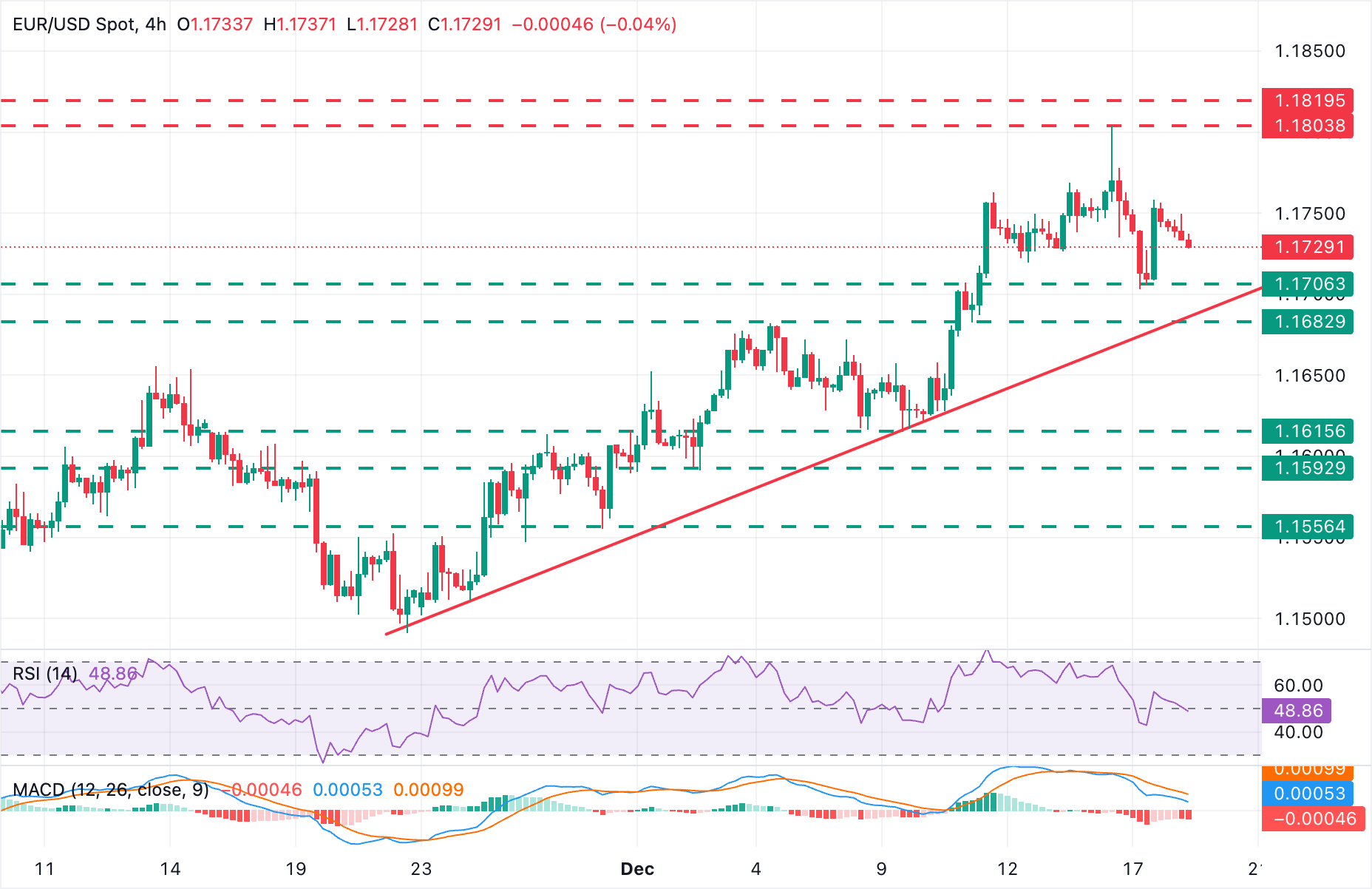
The EUR/USD pair keeps the broader bullish bias intact, as the correction from 1.1800 highs has been contained above 1.1700. On Thursday, the 4-hour Relative Strength Index (RSI) has returned to bullish territory above the 50 level, and the Moving Average Convergence Divergence (MACD) indicator is showing shallower red histogram bars.
Immediate support is at Wednesday's low near 1.1700 ahead of an important area near 1.1685, where a trendline support converges with the December 11 low and the December 4 high. A confirmation below this level would cancel the bullish view and bring the December 9 low, at 1.1615, into focus.
To the upside, the intraday high, near 1.1760, is likely to challenge bulls ahead of Wednesday's peak, at 1.1804, and the September 23 and 24 highs, near 1.1820.
ECB FAQs
The European Central Bank (ECB) in Frankfurt, Germany, is the reserve bank for the Eurozone. The ECB sets interest rates and manages monetary policy for the region. The ECB primary mandate is to maintain price stability, which means keeping inflation at around 2%. Its primary tool for achieving this is by raising or lowering interest rates. Relatively high interest rates will usually result in a stronger Euro and vice versa. The ECB Governing Council makes monetary policy decisions at meetings held eight times a year. Decisions are made by heads of the Eurozone national banks and six permanent members, including the President of the ECB, Christine Lagarde.
In extreme situations, the European Central Bank can enact a policy tool called Quantitative Easing. QE is the process by which the ECB prints Euros and uses them to buy assets – usually government or corporate bonds – from banks and other financial institutions. QE usually results in a weaker Euro. QE is a last resort when simply lowering interest rates is unlikely to achieve the objective of price stability. The ECB used it during the Great Financial Crisis in 2009-11, in 2015 when inflation remained stubbornly low, as well as during the covid pandemic.
Quantitative tightening (QT) is the reverse of QE. It is undertaken after QE when an economic recovery is underway and inflation starts rising. Whilst in QE the European Central Bank (ECB) purchases government and corporate bonds from financial institutions to provide them with liquidity, in QT the ECB stops buying more bonds, and stops reinvesting the principal maturing on the bonds it already holds. It is usually positive (or bullish) for the Euro.
Recommended Articles


