

USD/INR opens flat on hopes of RBI’s follow-through intervention
- The Indian Rupee flattens against the US Dollar at around 90.80 after a sharp recovery move on Wednesday.
- FIIs turned out to be net buyers in the Indian stock market on Wednesday.
- US President Trump said that Fed Chair Powell’s successor would lower interest rates by a lot.
The Indian Rupee (INR) opens on a flat note against the US Dollar (USD) on Thursday, with the USD/INR pair wobbling around 90.80. Investors anticipated a flat opening amid expectations that the Reserve Bank of India (RBI) could intervene again to support the Indian Rupee.
There is a "high probability" that the central bank may step in again today, traders said, Reuters reported.
On Wednesday, the RBI sold US Dollars aggressively in both spot and non-deliverable forward (NDF) markets to halt the one-way rally in the pair when it hit record highs at 91.55.
The Indian Rupee has been underperforming the US Dollar for a long period, as foreign investors are consistently offloading their stake in the Indian stock market due to the United States (US)- India trade stalemate. This month, Foreign Institutional Investors (FIIs) remained net sellers on all trading days, but have surprisingly turned out to be net buyers on Wednesday. The net purchase by FIIs on Wednesday was Rs. 1,171.71 crore worth of shares.
A sudden halt in FIIs' selling in the Indian equity market might boost risk sentiment; however, the impact would remain short-lived amid the absence of a US-India trade deal announcement.
Daily digest market movers: US Dollar ticks up ahead of US CPI data
- The sideways mover in the USD/INR pair is also driven by a flat US Dollar. At the time of writing, the US Dollar Index (DXY), which tracks the Greenback’s value against six major currencies, trades marginally higher at near 98.45.
- In the last two trading days, the Fed has regained ground on expectations that there will be no interest rate cut in the first policy meeting of 2026. According to the CME FedWatch tool, the probability of the Fed reducing interest rates by 25 basis points (bps) to 3.25%-3.50% in the January meeting is 24.4%.
- Traders hesitate to raise Fed dovish bets as Chairman Jerome Powell stated in last week’s policy meeting that “the bar for another interest rate cut is very high."
- Broadly, the US Dollar seems on the back foot as Fed Chair Powell’s successor is expected to support more interest rate cuts in his term, assuming that his decisions would be more biased towards US President Donald Trump’s economic agenda.
- Earlier in the day, US President Trump said in a national address, "I’ll soon announce our next chairman of the Federal Reserve, someone who believes in lower interest rates, by a lot, and mortgage payments will be coming down even further." Such a scenario will hurt the Fed’s independence and weigh on the US Dollar.
- In Thursday’s session, investors will focus on the US Consumer Price Index (CPI) data for November, which will be published at 13:30 GMT. The inflation data will influence market expectations for the US interest rate outlook. Both the headline and the core CPI are expected to have grown at an annualized pace of 3%.
Technical Analysis: USD/INR's rally hits pause near 91.50
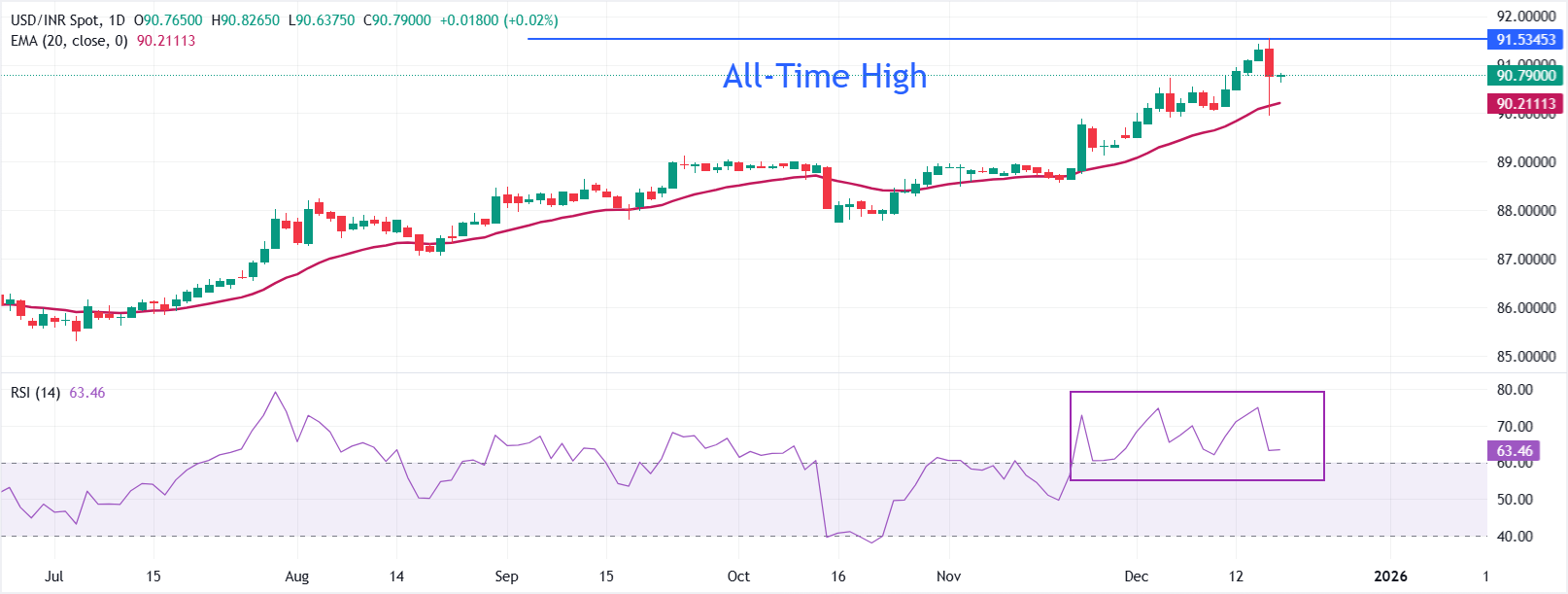
In the daily chart, USD/INR trades at 90.7840. The pair holds above a rising 20-day EMA at 90.2106, preserving an upward bias. The average continues to slope higher, keeping pullbacks contained. RSI at 63.40 stays in bullish territory after easing from overbought, confirming firm momentum.
Bulls retain control while daily closes remain above the 20-day EMA, with dips expected to find support in that band. RSI edging higher in the mid-60s favors trend extension; a reversal toward 50 would weaken the impulse. A decisive break below the moving average would turn the bias neutral and open a deeper retracement.
(The technical analysis of this story was written with the help of an AI tool)
Indian Rupee FAQs
The Indian Rupee (INR) is one of the most sensitive currencies to external factors. The price of Crude Oil (the country is highly dependent on imported Oil), the value of the US Dollar – most trade is conducted in USD – and the level of foreign investment, are all influential. Direct intervention by the Reserve Bank of India (RBI) in FX markets to keep the exchange rate stable, as well as the level of interest rates set by the RBI, are further major influencing factors on the Rupee.
The Reserve Bank of India (RBI) actively intervenes in forex markets to maintain a stable exchange rate, to help facilitate trade. In addition, the RBI tries to maintain the inflation rate at its 4% target by adjusting interest rates. Higher interest rates usually strengthen the Rupee. This is due to the role of the ‘carry trade’ in which investors borrow in countries with lower interest rates so as to place their money in countries’ offering relatively higher interest rates and profit from the difference.
Macroeconomic factors that influence the value of the Rupee include inflation, interest rates, the economic growth rate (GDP), the balance of trade, and inflows from foreign investment. A higher growth rate can lead to more overseas investment, pushing up demand for the Rupee. A less negative balance of trade will eventually lead to a stronger Rupee. Higher interest rates, especially real rates (interest rates less inflation) are also positive for the Rupee. A risk-on environment can lead to greater inflows of Foreign Direct and Indirect Investment (FDI and FII), which also benefit the Rupee.
Higher inflation, particularly, if it is comparatively higher than India’s peers, is generally negative for the currency as it reflects devaluation through oversupply. Inflation also increases the cost of exports, leading to more Rupees being sold to purchase foreign imports, which is Rupee-negative. At the same time, higher inflation usually leads to the Reserve Bank of India (RBI) raising interest rates and this can be positive for the Rupee, due to increased demand from international investors. The opposite effect is true of lower inflation.
Recommended Articles


