

EUR/USD steady as markets gear up for Fed decision, Powell´s guidance
- EUR/USD steady as US job gains and rising vacancies do little to shift Fed cut expectations.
- Markets await Wednesday’s Fed decision, Powell’s remarks, and dot-plot signals for the 2026 rate path.
- Germany’s €16.9B trade surplus beats forecasts, offering mild support as ECB signals steady policy.
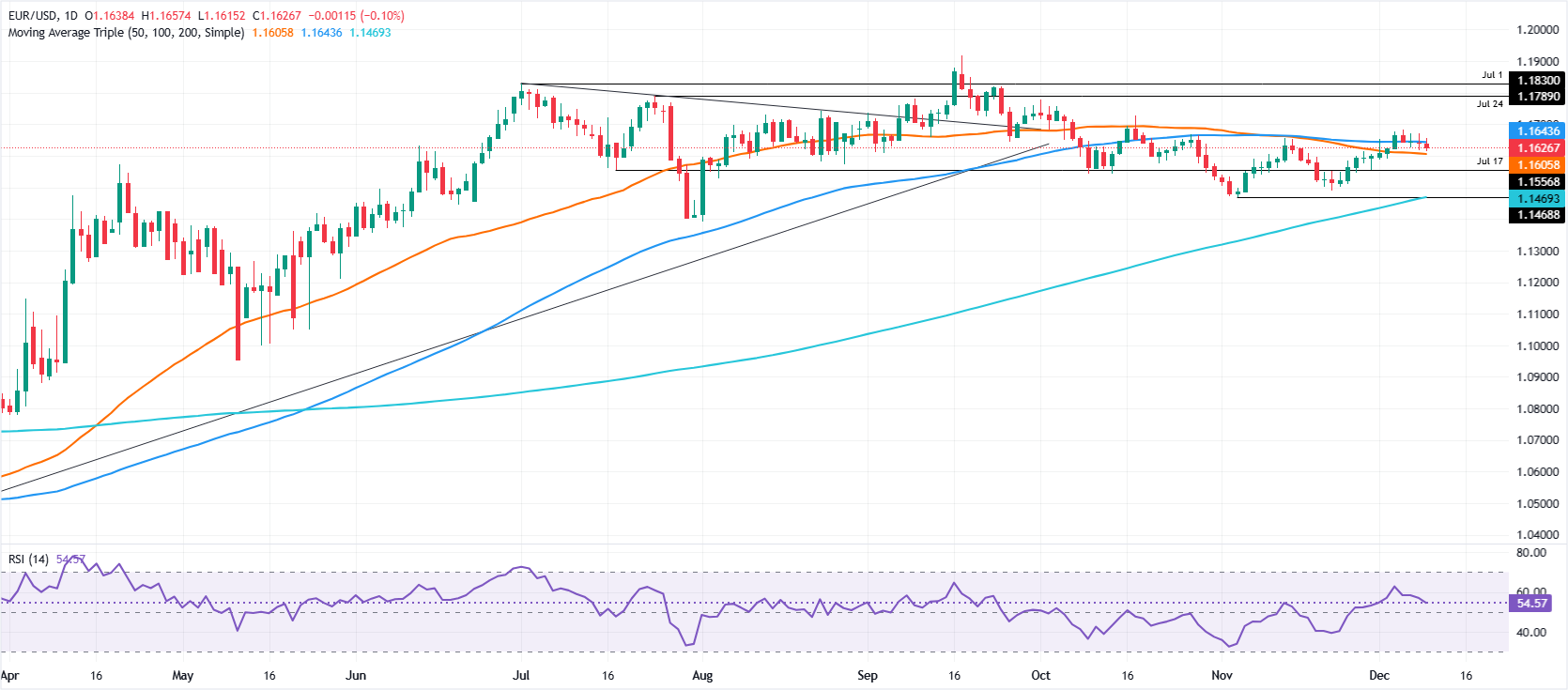
EUR/USD continues to trade sideways poised to finish Tuesday’s session with minuscule losses of 0.09% as market participants wait for the Federal Reserve’s monetary policy decision on Wednesday. At the time of writing, the pair trades at 1.1626.
Euro trades sideways as solid US labor data fails to sway expectations for a December rate cut
Economic data in the US revealed that the jobs market is still solid, yet the data barely moved expectations for a Fed rate cut on December 10. ADP showed that companies hired people in the week ending November 22, while job vacancies rose according to the Job Openings and Labor Turnover Survey (JOLTS) published by the Bureau of Labor Statistics (BLS).
Money markets indicated an 88% probability that the Fed would lower rates by 25 basis points. Additionally, investors are watching the “dot-plot” for hints about interest rates in 2026. Economic forecasts released at the same time may also shed light on the central bank’s outlook.
Across the pond, Germany’s Trade Balance in October printed a surplus €16.9B up from September €15.3B, exceeding forecasts of €15.2B as Exports outweighed Imports. Earlier, the Bundesbank President Joachim Nagel was neutral, emphasizing that monetary policy is in a good place and it would remain unchanged some time.
Euro Price This Month
The table below shows the percentage change of Euro (EUR) against listed major currencies this month. Euro was the strongest against the Japanese Yen.
| USD | EUR | GBP | JPY | CAD | AUD | NZD | CHF | |
|---|---|---|---|---|---|---|---|---|
| USD | -0.26% | -0.48% | 0.45% | -0.94% | -1.42% | -0.82% | 0.34% | |
| EUR | 0.26% | -0.22% | 0.71% | -0.68% | -1.16% | -0.57% | 0.60% | |
| GBP | 0.48% | 0.22% | 1.19% | -0.47% | -0.97% | -0.35% | 0.82% | |
| JPY | -0.45% | -0.71% | -1.19% | -1.39% | -1.88% | -1.28% | -0.12% | |
| CAD | 0.94% | 0.68% | 0.47% | 1.39% | -0.54% | 0.11% | 1.29% | |
| AUD | 1.42% | 1.16% | 0.97% | 1.88% | 0.54% | 0.61% | 1.79% | |
| NZD | 0.82% | 0.57% | 0.35% | 1.28% | -0.11% | -0.61% | 1.17% | |
| CHF | -0.34% | -0.60% | -0.82% | 0.12% | -1.29% | -1.79% | -1.17% |
The heat map shows percentage changes of major currencies against each other. The base currency is picked from the left column, while the quote currency is picked from the top row. For example, if you pick the Euro from the left column and move along the horizontal line to the US Dollar, the percentage change displayed in the box will represent EUR (base)/USD (quote).
Daily digest market movers: Euro’s treads water amid dull trading session
- The US Dollar Index (DXY), which tracks Greenbacks’ performance against a basket of six peers, gains over 0.14% up at 99.23.
- US JOLTS data showed a surprise increase in labor demand for October, with job openings rising to 7.67 million from 7.227 million, according to the Bureau of Labor Statistics (BLS).
- ADP revealed that private companies added 4,750 people to the workforce in the week ending November 22, exceeding November’s 15 -13,500 reduction.
- Ahead, the Federal Reserve’s decision is expected to show a division between the Federal Open Market Committee (FOMC) members. In the last meeting, there were two dissenters, Governor Miran, voting for a 50-bps cut, while Kansas City Fed Jeffrey Schmid wanted to hold rates unchanged.
- There’s some speculation that the Fed will cut rates, but Powell would lean hawkish at the press conference, pushing against immediate easing next year, to please the hawks in the room.
Technical analysis: EUR/USD rangebound below 1.1650, eyes on FOMC meeting
EUR/USD holds below 1.1650 for a sixth consecutive session, carving out a narrow consolidation band between 1.1650 and 1.1600. The pair’s inability to reclaim 1.1700 kept buyers at bay, as bearish momentum builds as depicted by the Relative Strength Index (RSI) flattening and signaling fading buying pressure—putting at risk any attempt to revisit 1.1800 or the year-to-date high at 1.1918.
Immediate support below 1.1650 emerges at the 50-day Simple Moving Average (SMA) near 1.1604. A decisive break beneath this zone would expose the 20-day SMA at 1.1597, followed by the 1.1500 psychological level.
Euro FAQs
The Euro is the currency for the 20 European Union countries that belong to the Eurozone. It is the second most heavily traded currency in the world behind the US Dollar. In 2022, it accounted for 31% of all foreign exchange transactions, with an average daily turnover of over $2.2 trillion a day. EUR/USD is the most heavily traded currency pair in the world, accounting for an estimated 30% off all transactions, followed by EUR/JPY (4%), EUR/GBP (3%) and EUR/AUD (2%).
The European Central Bank (ECB) in Frankfurt, Germany, is the reserve bank for the Eurozone. The ECB sets interest rates and manages monetary policy. The ECB’s primary mandate is to maintain price stability, which means either controlling inflation or stimulating growth. Its primary tool is the raising or lowering of interest rates. Relatively high interest rates – or the expectation of higher rates – will usually benefit the Euro and vice versa. The ECB Governing Council makes monetary policy decisions at meetings held eight times a year. Decisions are made by heads of the Eurozone national banks and six permanent members, including the President of the ECB, Christine Lagarde.
Eurozone inflation data, measured by the Harmonized Index of Consumer Prices (HICP), is an important econometric for the Euro. If inflation rises more than expected, especially if above the ECB’s 2% target, it obliges the ECB to raise interest rates to bring it back under control. Relatively high interest rates compared to its counterparts will usually benefit the Euro, as it makes the region more attractive as a place for global investors to park their money.
Data releases gauge the health of the economy and can impact on the Euro. Indicators such as GDP, Manufacturing and Services PMIs, employment, and consumer sentiment surveys can all influence the direction of the single currency. A strong economy is good for the Euro. Not only does it attract more foreign investment but it may encourage the ECB to put up interest rates, which will directly strengthen the Euro. Otherwise, if economic data is weak, the Euro is likely to fall. Economic data for the four largest economies in the euro area (Germany, France, Italy and Spain) are especially significant, as they account for 75% of the Eurozone’s economy.
Another significant data release for the Euro is the Trade Balance. This indicator measures the difference between what a country earns from its exports and what it spends on imports over a given period. If a country produces highly sought after exports then its currency will gain in value purely from the extra demand created from foreign buyers seeking to purchase these goods. Therefore, a positive net Trade Balance strengthens a currency and vice versa for a negative balance.
Recommended Articles


