


President Donald Trump's 5-Word Response on Inflation May Come Back to Haunt Wall Street
Key Points
President Trump remains adamant that the inflationary pressures consumers and businesses are facing will be short-lived.
A historic energy supply disruption caused by the Iran war has sent crude oil prices soaring, pinching consumers' wallets at the fuel pump.
However, the inflationary effects of energy supply shocks on businesses often lag by a few months, implying that inflation isn't done accelerating -- and that's terrible news for an expensive stock market.
- 10 stocks we like better than S&P 500 Index ›
Volatility aside, the stock market has delivered outsize returns under President Donald Trump.
In his first, non-consecutive term, the Dow Jones Industrial Average (DJINDICES: ^DJI), S&P 500 (SNPINDEX: ^GSPC), and Nasdaq Composite (NASDAQINDEX: ^IXIC) delivered gains of 57%, 70%, and 142%, respectively. Since his second term began on Jan. 20, 2025, the Dow, S&P 500, and Nasdaq have rallied 14%, 23%, and 33%, respectively.
Will AI create the world's first trillionaire? Our team just released a report on the one little-known company, called an "Indispensable Monopoly" providing the critical technology Nvidia and Intel both need. Continue »

President Trump delivering remarks from the South Lawn of the White House. Image source: Official White House Photo by Patrick B. Ruddy.
What's been noteworthy about these second-term gains is that they're occurring amid an ongoing war (as of this writing on May 12). The Iran war has had a decisive impact on energy markets and U.S. inflation.
Though the president has been clear about his stance on inflation, claiming "our inflation is just short-term," while fielding questions on the White House lawn on May 12, historical trends suggest Trump's words may come back to haunt Wall Street.
The Iran war has sent U.S. inflation to a three-year high
Earlier this week, the U.S. Bureau of Labor Statistics reported trailing 12-month (TTM) inflation for April of 3.8%, which is up 140 basis points in two months (i.e., since the Iran war began) and represents a three-year high.
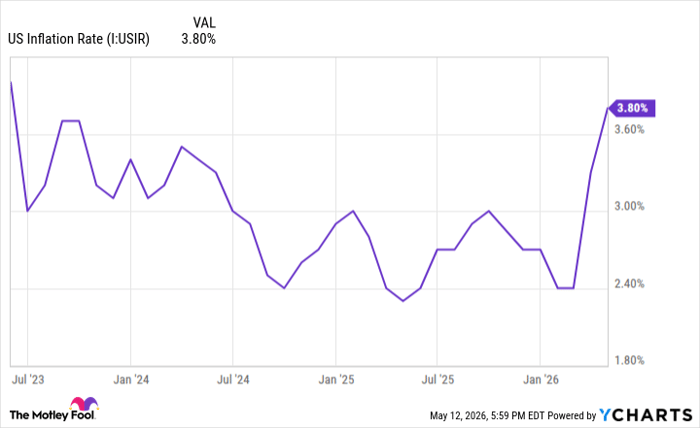
US Inflation Rate data by YCharts.
Shortly after President Trump gave the order for U.S. military forces to commence operations against Iran on Feb. 28, the latter closed down the Strait of Hormuz to commercial vessels. This closure halted the flow of approximately 20% of the world's crude oil supply (about 20 million barrels of petroleum liquids per day).
Unsurprisingly, energy prices have soared. West Texas Intermediate crude oil has jumped from $67 per barrel the day before the Iran war began to more than $102 per barrel, as of this writing. This has driven up fuel pump prices at the fastest pace in decades, pinching consumers' pocketbooks and leading to a sizable increase in TTM inflation.
The worry for Wall Street is that we may not have seen the worst of inflation, even if Trump is successful in quickly ending the Iran war.

Image source: Getty Images.
A second wave of inflation can wreak havoc on a historically pricey stock market
While energy supply shocks tend to hit consumers at the fuel pump within days, the adverse effects of energy supply disruptions can come in waves. For instance, we observed higher airfares impacting inflation in April.
History tells us that the inflationary effects of energy price shocks on businesses lag by a few months. But higher transportation and/or production costs are invariably passed on to consumers. Once this impact begins to work its way into economic data, U.S. TTM inflation can rise even more, despite Trump's prediction that "our inflation is just short-term."
Shiller PE Ratio has the Dot Com Bubble all-time high in its sight 🚨🤯👀 pic.twitter.com/XDfXBeDyxL
-- Barchart (@Barchart) May 8, 2026
Rapidly rising inflation is particularly worrisome for a historically expensive stock market. Investors had been counting on several rate cuts in 2026-2027 to propel the Dow, S&P 500, and Nasdaq higher. But with the Iran war effectively taking these cuts off the table, an expensive stock market is exposed and vulnerable for the first time in years.
The velocity at which inflation is increasing might also spur the Federal Reserve to shift to a neutral or hiking bias, or even raise interest rates. This is shaping up as a potential nightmare scenario for Wall Street.
Should you buy stock in S&P 500 Index right now?
Before you buy stock in S&P 500 Index, consider this:
The Motley Fool Stock Advisor analyst team just identified what they believe are the 10 best stocks for investors to buy now… and S&P 500 Index wasn’t one of them. The 10 stocks that made the cut could produce monster returns in the coming years.
Consider when Netflix made this list on December 17, 2004... if you invested $1,000 at the time of our recommendation, you’d have $472,744!* Or when Nvidia made this list on April 15, 2005... if you invested $1,000 at the time of our recommendation, you’d have $1,353,500!*
Now, it’s worth noting Stock Advisor’s total average return is 991% — a market-crushing outperformance compared to 207% for the S&P 500. Don't miss the latest top 10 list, available with Stock Advisor, and join an investing community built by individual investors for individual investors.
See the 10 stocks »
*Stock Advisor returns as of May 14, 2026.
Sean Williams has no position in any of the stocks mentioned. The Motley Fool has no position in any of the stocks mentioned. The Motley Fool has a disclosure policy.
Recommended Articles


