


Futures Traders Are Raising the Odds of a Fed Hike This Year. What Does That Mean for the Market?
Key Points
Today, we received important labor market data about the possibility of higher rates this year.
Next week we'll get new inflation data.
- These 10 stocks could mint the next wave of millionaires ›
The futures market has been radically changing its forecast of where interest rates will go this year. And that has major implications for the entire stock market.
As recently as late February, futures traders were pricing in two quarter-point rate cuts by the Federal Reserve by the end of 2026. There was even a growing possibility, according to futures prices, that the Fed might cut rates three times by December.
Will AI create the world's first trillionaire? Our team just released a report on the one little-known company, called an "Indispensable Monopoly" providing the critical technology Nvidia and Intel both need. Continue »
That has changed radically over the past month.
As of this writing, futures markets were assigning about a 30% chance that the Fed's target interest rate would be higher -- not lower -- at the end of 2026 than it is today.
The yield of the two-year Treasury note also indicates expectations of a rate hike. That yield is very sensitive to monetary policy, and right now it stands at 3.88%, which is above the federal funds rate range of 3.5% to 3.75%, suggesting that bond traders, like futures traders, expect a higher federal funds rate in the near future.
Don't fight the Fed
What does the possibility of rising interest rates mean for stocks?
There's a very good reason that investment strategists say "don't fight the Fed." Because when the Fed is raising rates -- also known as tightening the money supply -- risk assets like stocks tend to fare poorly.
That's because higher borrowing costs limit companies' investments in new equipment and people, slow expansion plans, and reduce profits. Higher rates also weigh on consumer spending because the effective costs of items that are often financed, such as homes and cars, rise along with interest rates.
Also, bond yields tend to rise in tandem with the Fed's benchmark interest rate, making bonds more competitive with stocks, which are much riskier.
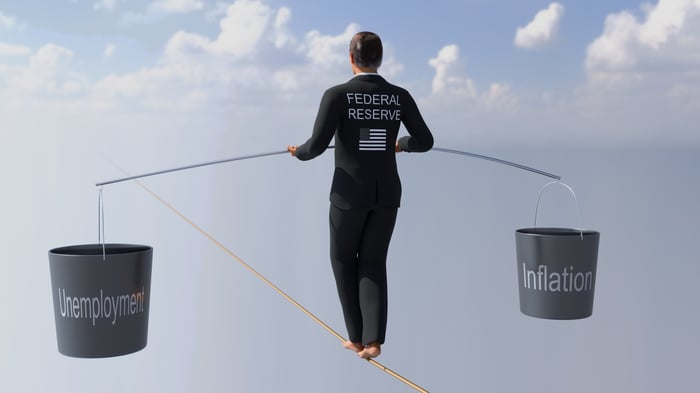
Image source: Getty Images.
On Friday morning, investors received more information about what the Fed might do through the end of this year regarding interest rate policy.
The Bureau of Labor Statistics released the April employment report. Payrolls increased by 115,000 last month, after a 185,000 gain in March. That's the strongest two-month gain since 2024, and suggests the labor market is gaining momentum. And that will allow the Fed to focus on the inflation part of its dual mandate.
And on May 12, the Bureau of Labor Statistics will release the Consumer Price Index for April. That data is potentially more important than the jobs report, as inflation has been rising in recent months and is currently at 3.3% year over year, well above the Fed's desired level of 2%.
Another uptick in the price index in April will lend significant weight to the idea that the Fed will hike rates later this year.
My guess is that the Fed won't raise or cut rates this year. But it's leaning more toward a rate hike than a rate cut.
Where to invest $1,000 right now
When our analyst team has a stock tip, it can pay to listen. After all, Stock Advisor’s total average return is 981%* — a market-crushing outperformance compared to 205% for the S&P 500.
They just revealed what they believe are the 10 best stocks for investors to buy right now, available when you join Stock Advisor.
See the stocks »
*Stock Advisor returns as of May 8, 2026.
The Motley Fool has a disclosure policy.
Recommended Articles


