


Gold swells as Middle East peace hopes hit the US Dollar
- Gold rises as Middle East peace hopes pressure Oil prices.
- Weaker US Dollar and lower Treasury yields support bullion demand.
- Traders eye CPI, PPI, Retail Sales and Fed speeches.
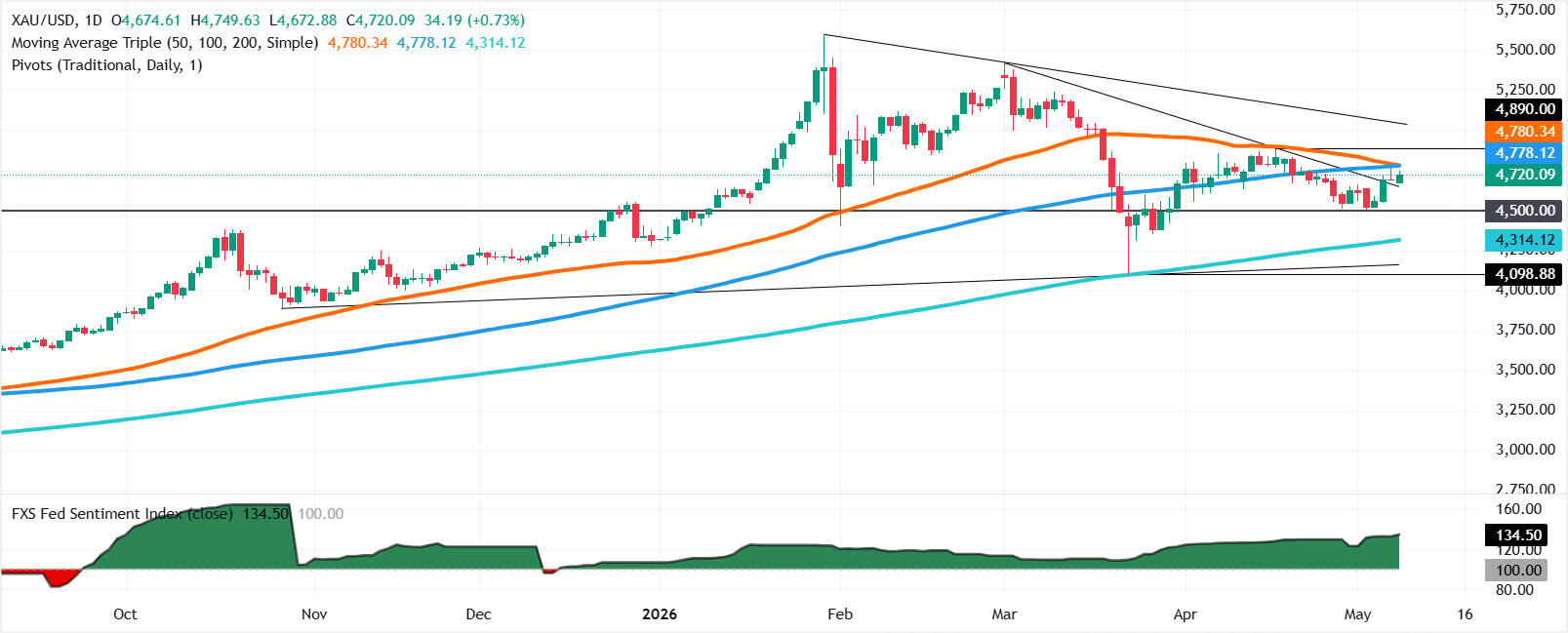
Gold (XAU/USD) rises some 0.75% on Friday as financial markets remain optimistic about a possible end to the Middle East conflict, which could potentially drive Oil prices lower and ease inflationary pressures. At the time of writing, the XAU/USD pair trades at $4,711 after bouncing off daily lows of $4,673.
XAU/USD climbs as falling yields offset solid US payrolls
Tensions in the Middle East remain high as Iran prolongs its answer to the US 14-point memorandum proposal to end the conflict. The Secretary of State, Marco Rubio, said that they’re waiting for a response, while both countries exchanged fire within the Persian Gulf, and the United Arab Emirates (UAE) was under attack.
Oil prices have been swinging between extending and trimming losses, yet West Texas Intermediate (WTI) is poised to finish the week down more than 6%. Consequently, the Greenback, which has been correlating positively with WTI, is also on the back foot as the US Dollar Index (DXY), which tracks the buck’s value against a basket of six currencies, falls 0.33% to 97.93.
The drop in US Treasury yields is underpinning the price of the yellow metal. The US 10-year T-note is down two basis points at 4.362%.
Steller NFP data, ignored by traders
US Nonfarm Payrolls in April rose by 115K, beating the 62K estimate; March's figure was revised up from 178K to 185K. The Unemployment Rate held at 4.3%, below the Fed's 4.5% annual projection, while average hourly earnings grew 3.6%, short of the 3.8% forecast.
Other data showed that households in the US are becoming pessimistic, as the University of Michigan Consumer Sentiment fell to a record low in May, down from April’s 49.8 to 48.2, the all-time low. The survey found that Americans are feeling the pain of surging pump prices.
The survey revealed that one-year inflation expectations fell to 4.5%, while five-year expectations declined to 3.4%.
Given the solid US jobs report and inflation expectations anchoring at 4% or higher, money markets are not expecting rate cuts in 2026, according to Prime Terminal data.
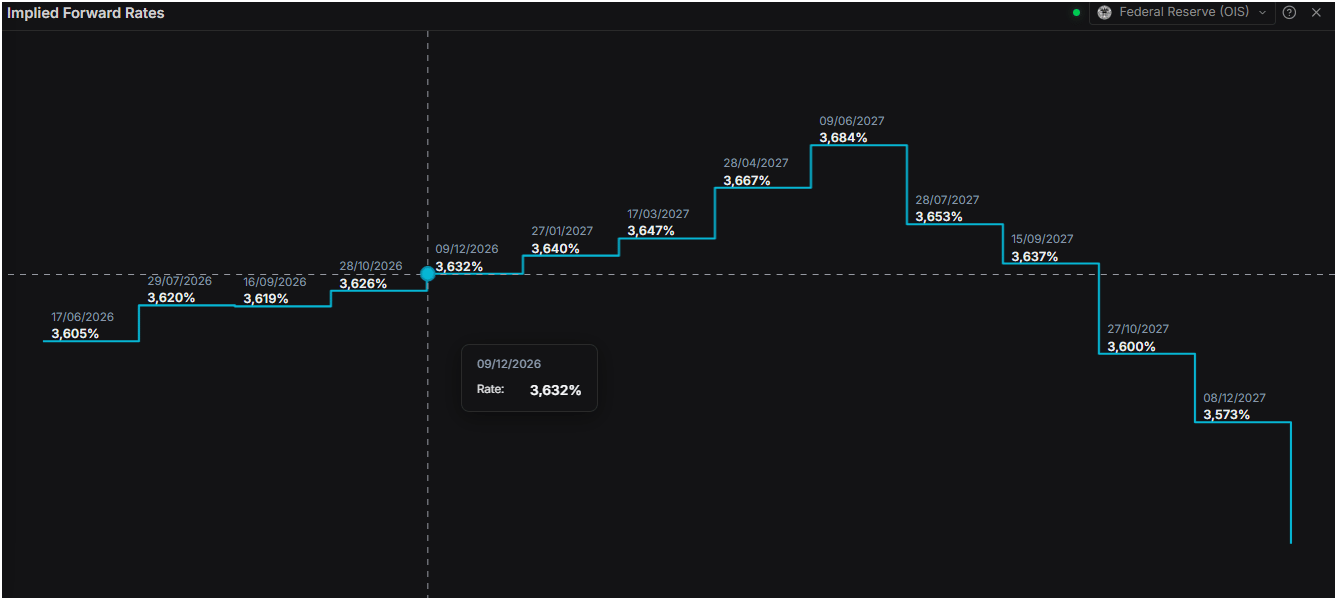
Federal Reserve (Fed) officials hit the wires, with Chicago Fed President Austan Goolsbee remaining hawkish, saying that the jobs market is pretty much stable and that inflation has not been great and is going the wrong way. Conversely, Governor Stephen Miran said that it’s appropriate to cut rates.
Next week, traders' eyes will be on the release of the US April inflation data, including the Consumer Price Index (CPI) and the Producer Price Index (PPI). Alongside this, Retail Sales and speeches by Federal Reserve officials would grab the headlines.
XAU/USD technical outlook: Gold buyers test key resistance, eyes on $5,000
Given the fundamental backdrop, the Gold price is testing a key resistance trendline in the $4,700-$4,715 area, which, if decisively broken, could open the door to further upside. Buyers are gaining momentum as the Relative Strength Index (RSI) has cleared its 50-neutral level, turning bullish. Hence, the path of least resistance is likely tilted upwards, but a strong supply zone lies ahead of higher prices.
Above, the next line of defense for bears would be the 100-day Simple Moving Average (SMA) at $4,768. If hurdled, the next resistance would be the 50-day SMA at $4,781, followed by the $4,900. Overhead lies the $5,000 milestone.
On the flip side, a daily close of Gold prices below $4,700 could pave the way for a pullback, with sellers eyeing the May 4 daily and weekly low of $4,500.
Gold FAQs
Gold has played a key role in human’s history as it has been widely used as a store of value and medium of exchange. Currently, apart from its shine and usage for jewelry, the precious metal is widely seen as a safe-haven asset, meaning that it is considered a good investment during turbulent times. Gold is also widely seen as a hedge against inflation and against depreciating currencies as it doesn’t rely on any specific issuer or government.
Central banks are the biggest Gold holders. In their aim to support their currencies in turbulent times, central banks tend to diversify their reserves and buy Gold to improve the perceived strength of the economy and the currency. High Gold reserves can be a source of trust for a country’s solvency. Central banks added 1,136 tonnes of Gold worth around $70 billion to their reserves in 2022, according to data from the World Gold Council. This is the highest yearly purchase since records began. Central banks from emerging economies such as China, India and Turkey are quickly increasing their Gold reserves.
Gold has an inverse correlation with the US Dollar and US Treasuries, which are both major reserve and safe-haven assets. When the Dollar depreciates, Gold tends to rise, enabling investors and central banks to diversify their assets in turbulent times. Gold is also inversely correlated with risk assets. A rally in the stock market tends to weaken Gold price, while sell-offs in riskier markets tend to favor the precious metal.
The price can move due to a wide range of factors. Geopolitical instability or fears of a deep recession can quickly make Gold price escalate due to its safe-haven status. As a yield-less asset, Gold tends to rise with lower interest rates, while higher cost of money usually weighs down on the yellow metal. Still, most moves depend on how the US Dollar (USD) behaves as the asset is priced in dollars (XAU/USD). A strong Dollar tends to keep the price of Gold controlled, whereas a weaker Dollar is likely to push Gold prices up.
Recommended Articles


