


1 Glorious Growth Stock Down 68% to Buy Hand Over Fist, According to Wall Street
Key Points
Workiva's software platform helps organizations aggregate data and manage their compliance obligations.
The stock was slammed by the recent "SaaSpocalypse," despite strong revenue and customer growth.
Wall Street thinks Workiva stock could now be a good long-term buying opportunity for investors.
- 10 stocks we like better than Workiva ›
Many software-as-a-service (SaaS) companies have plummeted in value in 2026, as investors worry that artificial intelligence (AI) will disrupt their businesses. Workiva (NYSE: WK) is one of the victims of the so-called "SaaSpocalypse," and following a 39% decline this year, its stock is now down 68% from its 2021 record high.
The company typically flies under the radar because of its relatively "boring" portfolio of software products, which help organizations manage their compliance obligations. However, it's generating solid revenue growth, and it's attracting high-spending customers at a lightning-fast pace.
Will AI create the world's first trillionaire? Our team just released a report on the one little-known company, called an "Indispensable Monopoly" providing the critical technology Nvidia and Intel both need. Continue »
As a result, the overwhelming majority of the analysts tracked by The Wall Street Journal have given Workiva a buy rating, and none recommend selling. Their average price target also points to strong upside over the next 12 months, so here's why it might be time to buy the dip.

Image source: Getty Images.
Workiva probably won't fall victim to AI
Managers inside large organizations are often tasked with compiling data from across dozens or even hundreds of digital applications that their employees use each day. This is a time-consuming endeavor prone to errors, as critical information is manually transferred to a central location.
Workiva's software solves those problems by plugging into every major third-party productivity app, storage platform, and system of record, and automatically aggregating all of their data onto one dashboard. From there, managers can use Workiva's ready-made templates to rapidly compile reports for regulators or even their executive team.
There are a couple of reasons Workiva probably won't fall victim to the broader AI revolution. First, unlike most software companies, Workiva charges its customers based on the value it provides, rather than using a traditional per-user subscription model. This nullifies concerns that Workiva will lose revenue if AI shrinks the global workforce.
Second, data aggregation software needs to be fast, seamless, and perfectly accurate. A large company could technically use AI coding tools to build its own version of Workiva, but there is no guarantee it will be as proficient. When crafting regulatory reports, nothing less than perfection is acceptable, which is why I think most companies would prefer to rely on the experts at a third-party vendor like Workiva.
Plus, Workiva is actually using AI to its advantage right now. It launched an AI-powered assistant called Workiva AI last year, which introduced new capabilities to its platform. With a few simple prompts, it can turn tabulated data into useful insights, or draft generic disclosures for regulatory filings. Moreover, the company launched a series of AI agents this year designed to uncover risks, identify trends in data, and summarize complex disclosures in plain language.
No sign of a spending slowdown
Workiva generated $247 million in revenue during the first quarter, which was up 20% year over year, and topped the company's $245 million forecast. The strong result prompted management to issue revenue guidance of $1.039 billion for the whole of 2026, which was a modest increase of $1 million from its prior forecast.
The company's customer base grew by just 4% during the first quarter to 6,665 enterprises, but it experienced far more explosive growth among the highest-spending cohorts. The company had 605 customers with annual contract values of at least $300,000, which jumped by 38%, and 265 customers with annual contract values of at least $500,000, which surged by 39%.
Moreover, Workiva's net revenue retention rate was 112% in the first quarter, up from 110% in the same quarter last year. This suggests existing customers increased their spending by 12% over the 12-month period.
To cap off the strong quarter, Workiva held its operating costs steady, which resulted in a generally accepted accounting principles (GAAP) profit of $18.9 million. That was a big positive swing from the $21.3 million loss the company generated in the year-ago period.
Workiva stock looks cheap
The Wall Street Journal tracks 13 analysts who cover Workiva stock, and 11 have given it a buy rating. The remaining two are in the overweight (bullish) camp, so no analysts recommend selling. The analysts have an average price target of $84.55, implying a potential upside of 71% in the stock over the next 12 months. The Street-high target of $102 points to an even higher potential return of 106%.
In my view, both of those targets are achievable because of Workiva's valuation. Its price-to-sales (P/S) ratio is just 3.2, which is not only the cheapest level in five years, but it's also more than 50% below its five-year average of 8.6.
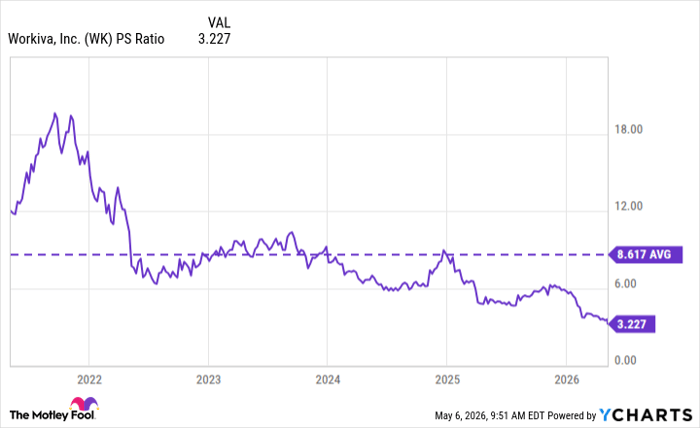
WK PS Ratio data by YCharts
As a result, I think Workiva stock could be a solid addition to any diversified portfolio, especially for long-term investors who are willing to hold for the next three to five years, by which point the recent SaaSpocalypse will probably be nothing more than a memory.
Should you buy stock in Workiva right now?
Before you buy stock in Workiva, consider this:
The Motley Fool Stock Advisor analyst team just identified what they believe are the 10 best stocks for investors to buy now… and Workiva wasn’t one of them. The 10 stocks that made the cut could produce monster returns in the coming years.
Consider when Netflix made this list on December 17, 2004... if you invested $1,000 at the time of our recommendation, you’d have $475,926!* Or when Nvidia made this list on April 15, 2005... if you invested $1,000 at the time of our recommendation, you’d have $1,296,608!*
Now, it’s worth noting Stock Advisor’s total average return is 981% — a market-crushing outperformance compared to 205% for the S&P 500. Don't miss the latest top 10 list, available with Stock Advisor, and join an investing community built by individual investors for individual investors.
See the 10 stocks »
*Stock Advisor returns as of May 8, 2026.
Anthony Di Pizio has no position in any of the stocks mentioned. The Motley Fool has positions in and recommends Workiva. The Motley Fool has a disclosure policy.
Recommended Articles


