


PayPal Stock's Bad Year Just Got Even Worse. Is This a Good Time to Buy Shares?
Key Points
Shares dropped sharply following the company's first-quarter update this week.
Online branded checkout volume grew just 2% on a currency-neutral basis -- a sluggish pace for the company's most important business.
The stock now trades at roughly 9 times earnings.
- 10 stocks we like better than PayPal ›
It's been a rough year for PayPal (NASDAQ: PYPL) shareholders, and Tuesday's reaction to the company's first-quarter 2026 earnings only added to the pain. Shares dropped roughly 9% in early trading following the report, deepening a slide that had already left the stock down about 14% year to date heading into the release.
What's striking is that the headline numbers actually came in ahead of analysts' consensus forecasts. The digital payments specialist's revenue rose 7% year over year to $8.4 billion, and adjusted earnings per share edged up 1% to $1.34.
Will AI create the world's first trillionaire? Our team just released a report on the one little-known company, called an "Indispensable Monopoly" providing the critical technology Nvidia and Intel both need. Continue »
This was helped by total payment volume (TPV) reaching $464 billion -- up 11%. But investors took aim at what was happening beneath the surface -- particularly weak branded checkout growth and contracting margins. And the company's lukewarm second-quarter outlook didn't help.
So, with PayPal's price-to-earnings ratio now compressed to about 9 times earnings, is this finally the buying opportunity PayPal investors have been hoping for?
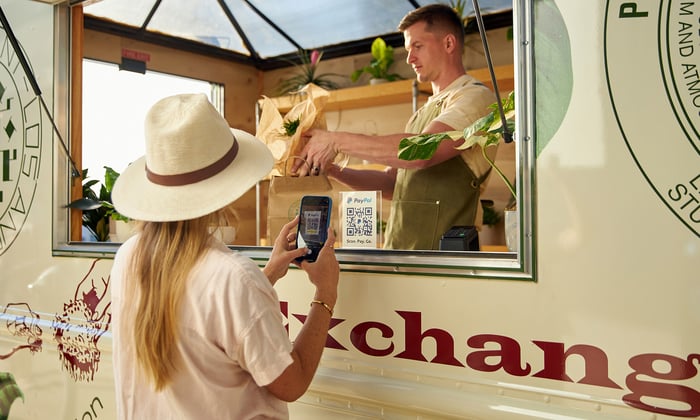
Image source: PayPal.
Beneath the surface
Step away from the headline beat, and the picture gets more complicated.
Online branded checkout -- the heart of PayPal's online presence -- grew just 2% on a currency-neutral basis. That was technically an improvement from 1% growth in the fourth quarter. But it's a far cry from the kind of growth investors expect from a company that helped pioneer digital checkout.
Fortunately, PayPal's other businesses helped pick up some slack. Venmo's total payment volume climbed 14% year over year, marking the sixth consecutive quarter of double-digit growth. Also helping, PayPal's enterprise payments processing volume accelerated to 11% from 7% in the back half of 2025.
But profitability is moving in the wrong direction. PayPal's non-GAAP (adjusted) operating income fell 5% year over year to $1.5 billion, and the adjusted operating margin contracted by 229 basis points to 18.4%. Management attributed the pressure to pulled-forward investments in technology, marketing, and product. But the second-quarter outlook didn't reassure anyone: PayPal expects adjusted earnings per share to decline about 9% in the period, with further investment headwinds and the absence of some one-time benefits from the year-ago quarter.
Adding to the unease, international markets continue to disappoint. PayPal's international revenue grew just 4% year over year and was flat on a currency-neutral basis.
During the company's first-quarter earnings call, PayPal chief financial officer Jamie Miller pointed to "slower growth in the travel vertical as well as more muted growth in Europe," with continued softness in markets like the United Kingdom and Germany.
Further, new CEO Enrique Lores may have spooked investors with his candid admission that the company needs to invest heavily in the technology supporting its offerings.
"Due to years of underinvestment, we need to accelerate the modernization of our technology platform," Lores explained.
And Lores isn't wasting any time. The company announced a sweeping reorganization into three business lines and outlined a plan to deliver at least $1.5 billion in gross cost savings over the next two to three years through restructuring and AI-driven automation.
Cheap, but is it cheap enough?
This all leaves the stock looking awfully inexpensive.
PayPal also generated $6.8 billion in adjusted free cash flow on a trailing 12-month basis, returned $6 billion to shareholders through share repurchases over the same period, and recently introduced a $0.14 quarterly dividend.
But there's a reason the stock is cheap -- one that goes beyond some of the concerns highlighted in PayPal's latest earnings report: The competitive landscape is unforgiving.
Apple's Apple Pay keeps gaining ground at digital checkout, while Block's Cash App and Stripe are encroaching on Venmo's and Braintree's (a PayPal-owned payment processor) turf. Even stablecoin-based payment rails are emerging as a longer-term threat.
Miller herself said during the company's first-quarter earnings call that the company operates in a "dynamic" and "highly competitive industry." The branded checkout slowdown and margin compression, on top of persistent international softness, all look like symptoms of a company fighting to defend a position that may be eroding rather than expanding.
The transformation plan could change that, but it will take years to play out, and the second-quarter guide suggests things may get worse before they get better.
At its current price, PayPal is undeniably cheap. But cheap isn't always a buy signal.
The digital payments space is intensely competitive, and I'd rather watch from the sidelines while the company works through its transformation. Of course, I could be wrong. Investors who have conviction in the durability of PayPal's competitive moat may very well find that today's depressed share price is just the buying opportunity they've been looking for.
Should you buy stock in PayPal right now?
Before you buy stock in PayPal, consider this:
The Motley Fool Stock Advisor analyst team just identified what they believe are the 10 best stocks for investors to buy now… and PayPal wasn’t one of them. The 10 stocks that made the cut could produce monster returns in the coming years.
Consider when Netflix made this list on December 17, 2004... if you invested $1,000 at the time of our recommendation, you’d have $473,985!* Or when Nvidia made this list on April 15, 2005... if you invested $1,000 at the time of our recommendation, you’d have $1,204,650!*
Now, it’s worth noting Stock Advisor’s total average return is 950% — a market-crushing outperformance compared to 203% for the S&P 500. Don't miss the latest top 10 list, available with Stock Advisor, and join an investing community built by individual investors for individual investors.
See the 10 stocks »
*Stock Advisor returns as of May 6, 2026.
Daniel Sparks and his clients have positions in Apple. The Motley Fool has positions in and recommends Apple, Block, and PayPal. The Motley Fool recommends the following options: short June 2026 $50 calls on PayPal. The Motley Fool has a disclosure policy.
Recommended Articles


