


3 Vanguard ETFs Long-Term Investors Should Consider Adding in May
Key Points
Investing in the S&P 500 is one of the easiest ways to grow your money alongside the U.S. economy.
The Vanguard Dividend Appreciation ETF owns stocks with at least 10 straight years of dividend increases.
The Vanguard Total International Stock ETF provides exposure to around 98% of the international market.
- 10 stocks we like better than Vanguard S&P 500 ETF ›
One of my favorite ways to invest is through exchange-traded funds (ETFs) because they simplify investing. Instead of picking individual stocks, you can invest in a few ETFs and cover tons of ground in the stock market. And it doesn't mean you have to sacrifice gains, either.
Plenty of ETFs have shown they can be productive long-term pieces in a portfolio. Three Vanguard ETFs in particular are worth adding in May. They each have a different focus and complement each other well.
Will AI create the world's first trillionaire? Our team just released a report on the one little-known company, called an "Indispensable Monopoly" providing the critical technology Nvidia and Intel both need. Continue »
Image source: Getty Images.
1. Vanguard S&P 500 ETF
The Vanguard S&P 500 ETF (NYSEMKT: VOO) is an ETF I'll always recommend for long-term investors because of its correlation with the U.S. economy. It's not a direct 1:1 correlation with GDP or anything like that. However, over time, the S&P 500 has grown with the economy.
Investing in the S&P 500 might not be flashy, but it works. Nothing is guaranteed in the stock market, and past performance doesn't guarantee future results, but it has proven to be one of the more straightforward ways to build wealth.
Over the long haul, the S&P 500 has averaged around 10% annual returns. And despite how much information, technology, or talent the experts have, most actively managed funds consistently underperform the S&P 500. When you invest in VOO, you're getting a trifecta: instant diversification, low cost (0.03% expense ratio), and proven results.
VOO isn't as diversified as it has historically been -- with the tech sector accounting for nearly a third of it -- but it still contains virtually every blue-chip stock across every major U.S. sector. Still, as the tech sector goes, so does VOO for now.
After rising 14% since its March 30 bottom for the year, the S&P 500 closed at an all-time high on May 1. However, that shouldn't discourage anyone who believes they've missed the boat. Trust in its long-term upward trajectory.
2. Vanguard Dividend Appreciation ETF
The Vanguard Dividend Appreciation ETF (NYSEMKT: VIG) isn't your typical dividend ETF that places a heavy emphasis on companies with high dividend yields. Instead, as the name hints, its focus is on companies with a history of increasing their annual dividends. To be included, a company needs at least 10 consecutive years of increases.
VIG isn't a dividend ETF you invest in if you want a high payout right now. With a yield of only 1.5%, it's one of the lower-yielding dividend ETFs on the market. It's a dividend ETF you invest in if you want compounding growth. That's why it's a good choice for long-term investors.
Since VIG doesn't place heavy emphasis on yield, it contains more tech companies than traditional high-yield funds. Companies like Apple, Microsoft, and Broadcom might not have high yields, but they have routinely increased their annual payouts. They're VIG's top three holdings and have 14, 21, and 15 consecutive years of increases, respectively.
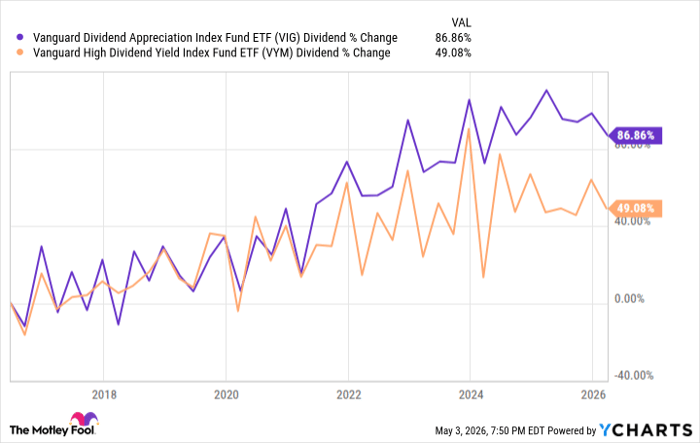
Dividend payouts from ETFs aren't consistent because companies pay them out at different times. However, VIG's latest payout ($0.8334) was up over 86% from a decade ago. That's a much faster rate than Vanguard's other marquee dividend ETF, the Vanguard High Dividend Yield ETF.
VIG Dividend data by YCharts
How much it increases going forward will ultimately depend on its holdings, but you can trust that its direction is up.
3. Vanguard Total International Stock ETF
The Vanguard Total International Stock ETF (NASDAQ: VXUS) is an ETF I routinely add to ensure that not all of my portfolio is in U.S. stocks. With VXUS, you don't have to overthink it because it includes 8,794 companies, roughly 98% of the international stock market.
You gain exposure to developed markets such as Japan, the U.K., and Canada, as well as emerging markets such as Brazil, China, and India. It's truly a one-stop shop for exposure to the international market.
More so than a growth play, VXUS is about hedging against rough patches in the U.S. stock market. With so much of the current market's performance tied to large tech companies, it's nice to invest in markets that aren't as influenced.
A good example of when it comes in handy is this year, when VXUS has outperformed the S&P 500, up 8.4% versus the S&P 500's 5.4% (as of market close on May 1).
If you're going to invest in all three Vanguard ETFs, I would prioritize VOO and VIG. However, a small stake (less than 10% of your portfolio) in VXUS is a good move if you want a truly well-rounded portfolio. As a bonus, it offers a dividend that is routinely much higher than those of both VOO and VIG.
Should you buy stock in Vanguard S&P 500 ETF right now?
Before you buy stock in Vanguard S&P 500 ETF, consider this:
The Motley Fool Stock Advisor analyst team just identified what they believe are the 10 best stocks for investors to buy now… and Vanguard S&P 500 ETF wasn’t one of them. The 10 stocks that made the cut could produce monster returns in the coming years.
Consider when Netflix made this list on December 17, 2004... if you invested $1,000 at the time of our recommendation, you’d have $490,864!* Or when Nvidia made this list on April 15, 2005... if you invested $1,000 at the time of our recommendation, you’d have $1,216,789!*
Now, it’s worth noting Stock Advisor’s total average return is 963% — a market-crushing outperformance compared to 201% for the S&P 500. Don't miss the latest top 10 list, available with Stock Advisor, and join an investing community built by individual investors for individual investors.
See the 10 stocks »
*Stock Advisor returns as of May 5, 2026.
Stefon Walters has positions in Apple, Microsoft, Vanguard S&P 500 ETF, and Vanguard Total International Stock ETF. The Motley Fool has positions in and recommends Apple, Broadcom, Microsoft, Vanguard Dividend Appreciation ETF, Vanguard High Dividend Yield ETF, and Vanguard S&P 500 ETF. The Motley Fool has a disclosure policy.
Recommended Articles


