


Holdings Exceed Expectations. SpaceX Reveals 18,000 Bitcoins for the First Time, Will It Surpass Strategy After Listing?
TradingKey - SpaceX's Bitcoin holdings rank 11th globally, far exceeding companies like Tesla and Coinbase, but they lag far behind MicroStrategy and are unlikely to match them in the future.
On May 20, ET, Elon Musk's SpaceX filed its IPO prospectus, revealing its long-awaited Bitcoin ( BTC) holdings. According to financial data, as of March 31, 2026, SpaceX held 18,712 Bitcoins, far exceeding previous on-chain data estimates of over 8,000 Bitcoins.
As of the time of publication, SpaceX's Bitcoin holdings rank 11th globally, far exceeding Tesla ( TSLA ), Coinbase ( COIN ), Block ( XYZ ), Hut 8 Corp ( HUT) and other public companies. However, compared to the top-ranked MicroStrategy ( MSTR ), there is still a massive gap, as the company currently holds over 840,000 BTC, which is more than 40 times that of SpaceX. However, can SpaceX stage a comeback and overtake MicroStrategy after its IPO?
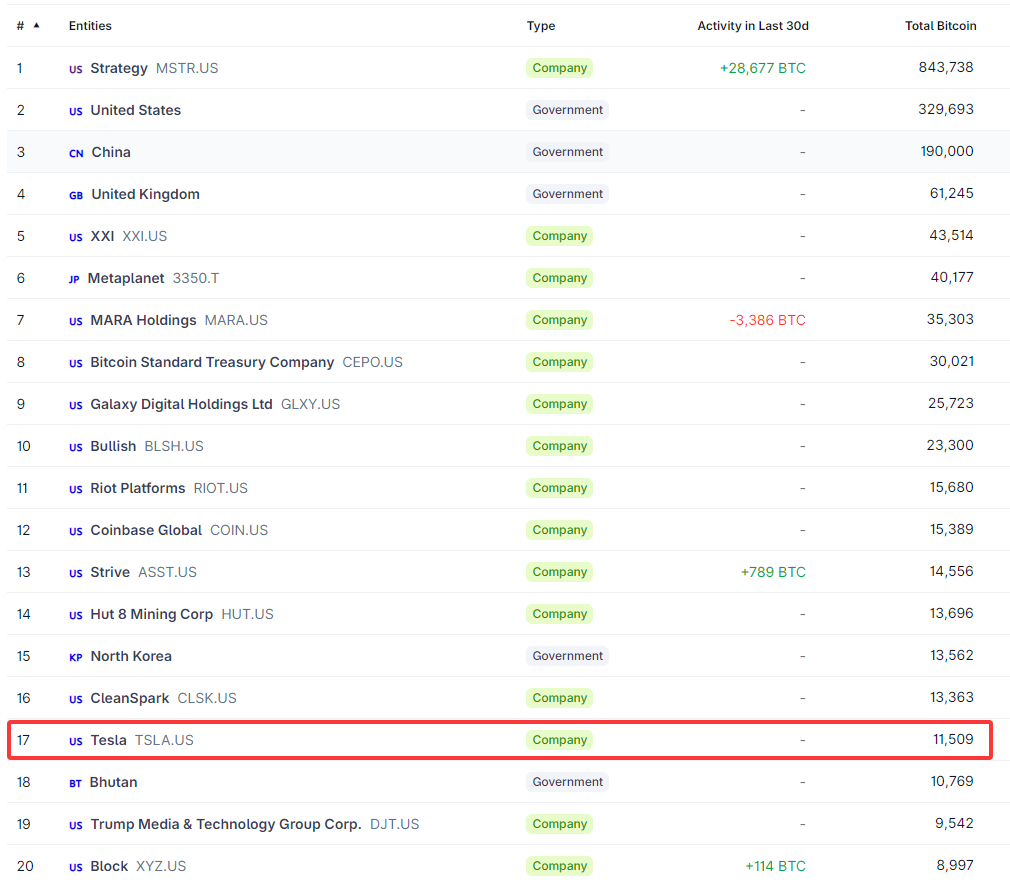 Top 20 entities by Bitcoin holdings. Source: CoinGecko
Based on Bitcoin's current market price of $78,000, MicroStrategy's total Bitcoin valuation is approximately $65 billion. SpaceX's total revenue reached $18.7 billion in 2025, with an operating profit of $4.423 billion and an adjusted EBITDA of $7.168 billion, while its market valuation remains between $1.75 trillion and $2 trillion. From the scale of the two companies, SpaceX certainly has the potential to surpass MicroStrategy, but this is difficult to achieve in practice.
From a business logic perspective, MicroStrategy is a DAT company that maintains Bitcoin reserves; its core business involves utilizing leverage in the U.S. stock market to continuously raise capital or issue debt to aggressively accumulate BTC. In contrast, while SpaceX purchases Bitcoin, this is not its primary business. Its core focus is on developing Starship, deploying orbital AI computing satellites, and building infrastructure on the Moon and Mars; therefore, it must invest substantial capital into these operations.
Furthermore, SpaceX will face pressure from shareholders and regulators after its IPO. During its private phase, Musk could decide on capital allocation based entirely on personal preference, even if it meant using all funds to purchase Bitcoin. However, after going public, the board of directors and Wall Street institutional shareholders will strictly scrutinize the use of funds, with Microsoft ( MSFT) being a prime example. In December 2024, its shareholders' meeting rejected a proposal for the company to purchase Bitcoin.
Recommended Articles


