


BTC miners signal commitment to AI pivot in latest quarterly disclosures
The latest rounds of disclosures made across the week have revealed that publicly traded miners are selling mined BTC to fund operations, with many retiring ASIC hardware in favor of GPUs, while also securing and committing billions in contracts to serve AI cloud customers.
While Bitcoin miners pivoting into AI is no longer novel, the announcements make the scale of those pivots hard to ignore.
Mining revenue has been on a decline, and given the current AI boom, many have moved and pivoted to AI infrastructure, diverting their spending budgets there.
MARA splashes $1.5 billion on a gas plant
On April 30, MARA Holdings announced that it will be acquiring Long Ridge Energy & Power from FTAI Infrastructure for $1.5 billion, including $785 million in assumed debt. The deal gives MARA a 505 MW natural gas plant in Hannibal, Ohio, and more than 1,600 acres of industrially permitted land where it plans to build a data center campus.
“It has all the key components for us, for the ideal data center campus,” MARA CEO Fred Thiel told Reuters. He said the company had already attracted interest from hyperscalers looking to lease space and expects to have a tenant secured around the time the deal closes later in 2026.
MARA followed up with a consent solicitation on May 7 to amend the indenture on Long Ridge’s $600 million in senior secured notes, a procedural step required because MARA’s acquisition triggers a change-of-control clause under the existing debt terms.
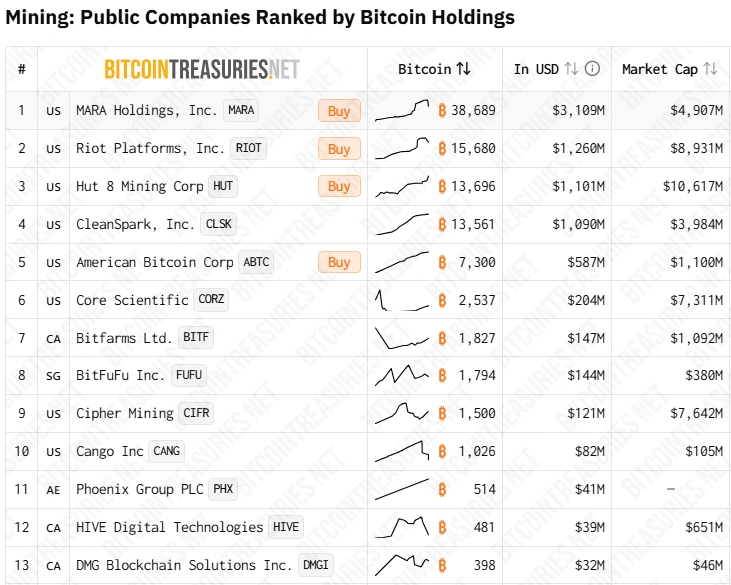
MARA holds 38,689 BTC on its balance sheet, the largest treasury position among publicly traded miners, according to BitcoinTreasuries.net.
IREN posts $248 million loss as it swaps ASICs for Blackwell GPUs
IREN Limited reported a Q3 FY26 revenue of $144.8 million, which is a 22% decline from the $184.7 million it recorded in the previous quarter. The company reported $3.1 billion in annual recurring revenue under contract and is targeting $3.7 billion by year-end.
It signed a five-year AI cloud contract with NVIDIA worth $3.4 billion. NVIDIA will be providing it with air-cooled Blackwell GPUs, which will be deployed inside 60 MW of existing data center space at its Childress, Texas, facility starting in early 2027. It also entered a 5GW strategic partnership with NVIDIA covering infrastructure design across its global power portfolio.
“The world is structurally short compute, and the bottleneck is delivered data center and GPU capacity,” said Daniel Roberts, IREN’s Co-Founder and Co-CEO.
Smaller miners selling BTC, creating AI subsidiaries
Small miners are also doing away with their BTC holdings and pivoting to AI infrastructure as well. DMG Blockchain Solutions reported mining 21 BTC in April, down from 23 BTC in March.
DMG also announced the creation of a new subsidiary, DMG Infrastructure, dedicated to transitioning its Christina Lake data center to AI and high-performance computing workloads. CEO Sheldon Bennett said the company’s access to wholesale power at 3.5 to 5.0 cents Canadian per kilowatt-hour has provided a cost advantage during lower Bitcoin price periods.
Bitdeer, meanwhile, reported that its BTC holdings separate from customer deposits are now zero. It stated that it had 193.8 BTC in mining output and had sold every coin mined.
Cango Inc., which holds 1,026 BTC according to BitcoinTreasuries.net, launched its AI subsidiary EcoHash commercially in April. The company previously sold $305 million in Bitcoin holdings to retire debt and reset its balance sheet before pivoting toward AI inference services.
The numbers tell the story
These disclosures reveal that Bitcoin mining margins are getting compressed. AI infrastructure contracts, on the other hand, are coming in hot with some worth billions of dollars and backed by hyperscaler demand.
IREN alone expects to reach 1,210MW of capacity by 2027. MARA is buying a 505MW gas plant. DMG is converting an entire facility. The infrastructure pipeline exceeds anything these companies have ever deployed for mining, and it is likely to go up as more miners make their own disclosures.
If you want a calmer entry point into DeFi crypto without the usual hype, start with this free video.
Recommended Articles


