




Canadian Dollar pares gains further as risk aversion grips holiday-thinned markets
- The Canadian Dollar backslid against the Greenback for a third straight day.
- The Loonie push, bolstered entirely by bearish US Dollar flows, is getting hammered by souring investor sentiment.
- Middle East tensions continue to rise as the Trump administration weighs getting involved structurally.
The Canadian Dollar pared recent gains on Thursday, declining against the US Dollar for a third straight day. Global markets are turning increasingly sour on the Trump administration not only failing to quickly and quietly resolve the Israel-Iran conflict, but openly floating the idea that they might directly involve American military assets in the altercation.
Economic data remains limited on the Loonie side; however, CAD traders will be looking forward to next week’s Canadian Consumer Price Index (CPI) inflation print. It’s been a particularly dry run on the Canadian side of the economic data docket since the Bank of Canada’s (BoC) last rate call, where the BoC snapped a seven-straight rate-cutting streak.
Daily digest market movers: US markets dark for midweek holiday, but market tensions continue to climb
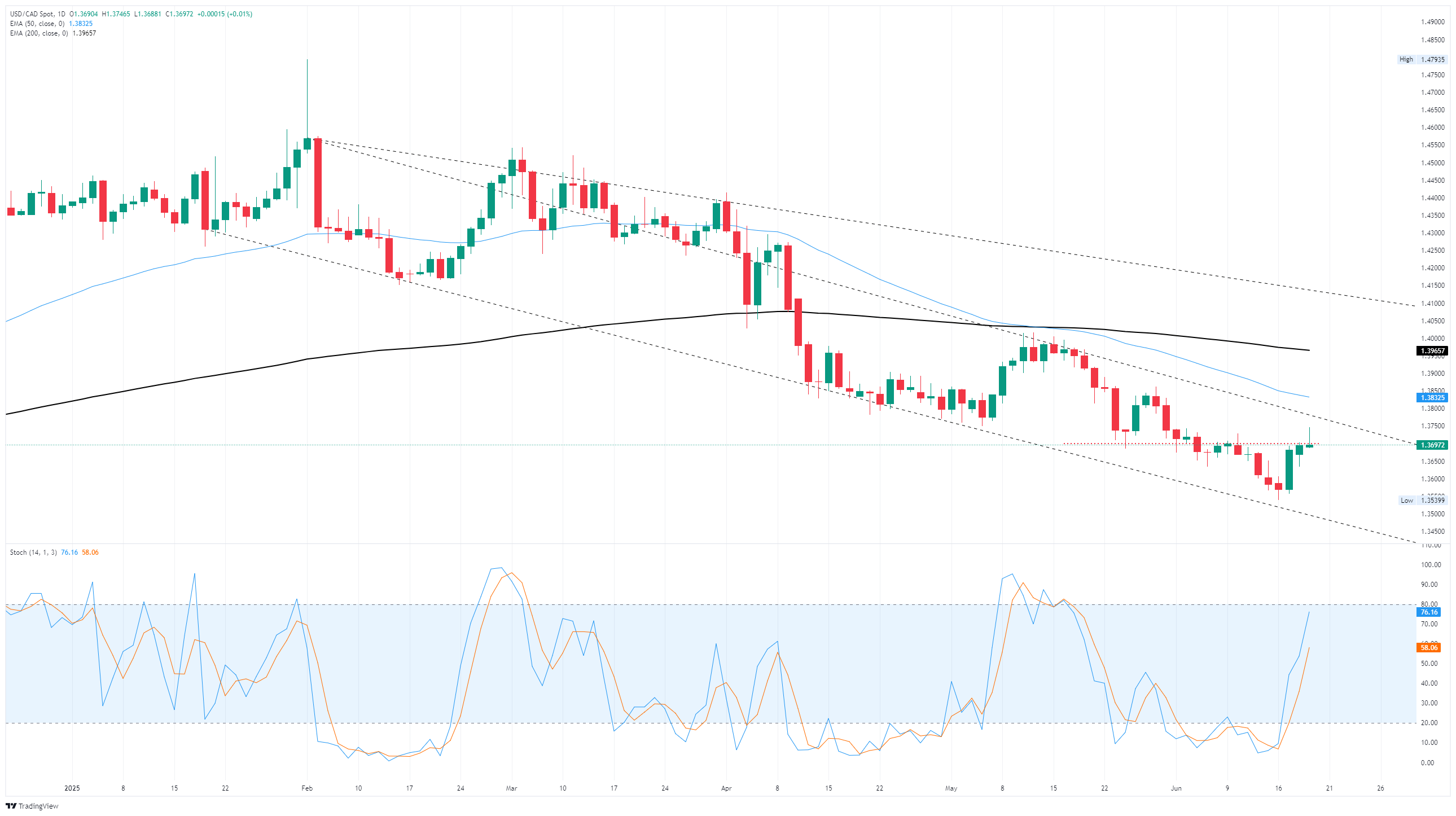
- The Canadian Dollar shed weight against the US Dollar, pushing the USD/CAD pair back up to the 1.3700 handle.
- Market tensions are on the rise as the Israel-Iran conflict continues to spin up.
- According to reporting outlets, the Trump administration is actively engaging in talks with Iranian officials.
- Despite back-channel talks, President Donald Trump is still considering getting the US involved directly in the altercation, which would represent the first time the US directly deployed military assets to a foreign country since the 2003 invasion of Iraq.
- Despite insistence from the Israeli government for an answer on the US’s involvement in a day or two, US White House Press Secretary Karoline Leavitt announced that the Trump team would make a decision “in a couple of weeks”, a famously popular timeline for Trump watchers.
Canadian Dollar price forecast
A third straight day of declines has forced the Loonie into lower territory against the US Dollar, pushing USD/CAD back into the 1.3700 region. A near-term bull run might run out of room quickly, as downward trendlines from the multi-decade peaks set in January are still in play.
USD/CAD daily chart
Canadian Dollar FAQs
The key factors driving the Canadian Dollar (CAD) are the level of interest rates set by the Bank of Canada (BoC), the price of Oil, Canada’s largest export, the health of its economy, inflation and the Trade Balance, which is the difference between the value of Canada’s exports versus its imports. Other factors include market sentiment – whether investors are taking on more risky assets (risk-on) or seeking safe-havens (risk-off) – with risk-on being CAD-positive. As its largest trading partner, the health of the US economy is also a key factor influencing the Canadian Dollar.
The Bank of Canada (BoC) has a significant influence on the Canadian Dollar by setting the level of interest rates that banks can lend to one another. This influences the level of interest rates for everyone. The main goal of the BoC is to maintain inflation at 1-3% by adjusting interest rates up or down. Relatively higher interest rates tend to be positive for the CAD. The Bank of Canada can also use quantitative easing and tightening to influence credit conditions, with the former CAD-negative and the latter CAD-positive.
The price of Oil is a key factor impacting the value of the Canadian Dollar. Petroleum is Canada’s biggest export, so Oil price tends to have an immediate impact on the CAD value. Generally, if Oil price rises CAD also goes up, as aggregate demand for the currency increases. The opposite is the case if the price of Oil falls. Higher Oil prices also tend to result in a greater likelihood of a positive Trade Balance, which is also supportive of the CAD.
While inflation had always traditionally been thought of as a negative factor for a currency since it lowers the value of money, the opposite has actually been the case in modern times with the relaxation of cross-border capital controls. Higher inflation tends to lead central banks to put up interest rates which attracts more capital inflows from global investors seeking a lucrative place to keep their money. This increases demand for the local currency, which in Canada’s case is the Canadian Dollar.
Macroeconomic data releases gauge the health of the economy and can have an impact on the Canadian Dollar. Indicators such as GDP, Manufacturing and Services PMIs, employment, and consumer sentiment surveys can all influence the direction of the CAD. A strong economy is good for the Canadian Dollar. Not only does it attract more foreign investment but it may encourage the Bank of Canada to put up interest rates, leading to a stronger currency. If economic data is weak, however, the CAD is likely to fall.
Recommended Articles


