


Wall Street Is Sleeping on This AI Stock, and That's Your Opportunity This Year
Key Points
ASML holds a dominant competitive position in supplying critical manufacturing equipment to the semiconductor industry.
Over $2.5 trillion is expected to be invested in AI infrastructure over the next three years, providing a tailwind for ASML.
Relative to earnings growth estimates, the stock still appears undervalued.
- 10 stocks we like better than ASML ›
ASML (NASDAQ: ASML) serves an essential role in the artificial intelligence (AI) supply chain. It leads in the critical equipment used to make chips, and it's seeing solid revenue growth as investment floods into AI data centers.
Even though the stock has more than doubled over the past year, Wall Street still appears to be underestimating demand for this company's most advanced chipmaking machines.
Will AI create the world's first trillionaire? Our team just released a report on the one little-known company, called an "Indispensable Monopoly" providing the critical technology Nvidia and Intel both need. Continue »
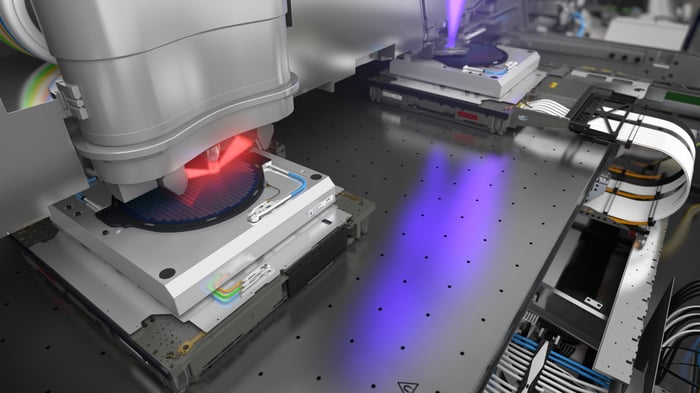
Image source: ASML.
ASML's dominant position in the chip supply chain
Taiwan Semiconductor Manufacturing is the world's largest chip manufacturer, producing everything from smartphone chips to the processors powering the most advanced data centers. It makes chips for Nvidia and other AI leaders. But TSMC can't make those chips without ASML.
ASML builds advanced lithography systems that etch circuits onto chips. It has a near-monopoly on extreme ultraviolet (EUV) machines -- the tools TSMC and Micron Technology need to manufacture cutting-edge AI processors and high-performance memory components.
$2.5 trillion is expected to flow into AI infrastructure
ASML's quarterly revenue growth has been uneven, but the bigger picture is clear: trailing 12-month revenue is up 76% since 2022. And there's still plenty of runway for growth over the next several years.
Here's how CEO Christophe Fouquet described the opportunity at the company's recent annual meeting:
"We are looking in the next two-three years at more than $2.5 trillion that will be invested in AI to build basically the infrastructure that is needed in terms of data center, in terms of [high-performance computing], to create the ability to develop the models that will later on basically feed the application of AI."
Fouquet called that level of investment "unprecedented." Indeed, there are signs that chip demand is broadening, with companies like Advanced Micro Devices and Micron seeing accelerating demand -- customers who, in the end, rely on ASML's machines.
Demand for chips outpacing supply
ASML's first-quarter results showed continued momentum in AI infrastructure demand. Sales rose 13% year over year to $8.7 billion, while earnings climbed 19%.
The key detail was how Fouquet described the most recent demand trends: "In the past months, our customers have increased their expected short- and medium-term demand for our products."
With chip demand outpacing supply, Fouquet noted that customers are accelerating their expansion plans for 2026 and beyond. This positions ASML for further growth.
Why the stock is a buy
ASML's valuation suggests further upside. On a price-to-earnings growth (PEG) basis, quality growth companies often trade around a PEG of 2. Yet ASML -- despite its near-monopoly on EUV systems -- trades at a forward earnings multiple of 32, while analysts project 23% annualized earnings growth. That works out to a relatively low PEG ratio of 1.4.
Investors will have to be mindful of risks that could derail AI momentum, such as regulations that slow data center build-out or geopolitical conflicts that threaten to stall chip supply from Asia.
Still, the recent strength in semiconductor stocks suggests demand for AI chips is still running ahead of expectations. ASML is often overlooked, but it's arguably the most important company in the AI supply chain. The stock offers solid return potential for long-term investors.
Should you buy stock in ASML right now?
Before you buy stock in ASML, consider this:
The Motley Fool Stock Advisor analyst team just identified what they believe are the 10 best stocks for investors to buy now… and ASML wasn’t one of them. The 10 stocks that made the cut could produce monster returns in the coming years.
Consider when Netflix made this list on December 17, 2004... if you invested $1,000 at the time of our recommendation, you’d have $460,826!* Or when Nvidia made this list on April 15, 2005... if you invested $1,000 at the time of our recommendation, you’d have $1,345,285!*
Now, it’s worth noting Stock Advisor’s total average return is 983% — a market-crushing outperformance compared to 207% for the S&P 500. Don't miss the latest top 10 list, available with Stock Advisor, and join an investing community built by individual investors for individual investors.
See the 10 stocks »
*Stock Advisor returns as of May 13, 2026.
John Ballard has positions in Nvidia. The Motley Fool has positions in and recommends ASML, Advanced Micro Devices, Intel, Micron Technology, Nvidia, and Taiwan Semiconductor Manufacturing. The Motley Fool has a disclosure policy.
Recommended Articles


