


LendingClub Is Rebranding to Happen Bank. Here's Why It Could Be a Catalyst for a Higher Stock Price.
Key Points
LendingClub is changing its name to better reflect its current business model.
Fortunately, the current business model is far superior to the old one, and LendingClub's financial results back it up.
The stock is very cheap, so the name change could be a catalyst.
- 10 stocks we like better than LendingClub ›
LendingClub (NYSE: LC) has decided to rebrand; soon, this incumbent fintech leader will change its name to Happen Bank.
Investors may be skeptical that a mere name change can turn a stock's fortunes around. But when a company's fundamentals steadily improve amid massive undervaluation, well, a name change to reflect a better business model could be just the catalyst for a higher stock price.
Will AI create the world's first trillionaire? Our team just released a report on the one little-known company, called an "Indispensable Monopoly" providing the critical technology Nvidia and Intel both need. Continue »
Why the rebrand?
LendingClub began in 2006 as a peer-to-peer lending platform, enabling retail investors to buy high-yield loans from unsecured personal loan borrowers, underwritten by LendingClub's tech-enabled risk models.
Fast-forward to today, and LendingClub has transformed into an institutionally focused, technology-forward bank. Its loan buyers are no longer retail investors, but some of the largest loan buyers in the world, including major banks, private credit asset managers, and insurance companies. As such, LendingClub is not really a "club" anymore, but an institution with 20 years of staying power.
How did LendingClub make this transformation? The old-fashioned way: by proving itself over a long period of better underwriting versus peers, especially through tumultuous times.
The "motivated middle" happens
LendingClub has managed very well through highly difficult economic environments over the past decade. This period includes the COVID-19 downturn, the post-COVID inflation shock, and the regional banking crisis in 2023, during which many loan buyers paused purchases. Yet since the beginning of the pandemic, LendingClub's loans have experienced roughly 50% lower delinquencies than its competitive set.
Those good underwriting results actually accelerated last quarter; net charge-offs fell from 6.1% a year ago to 3.5%. Provision for credit losses fell to practically zero, at just $390,000. That zero provision was thanks to older vintages performing much better than expected, allowing the company to release prior reserves, which were enough to bring current provisions down to pretty much zero.
As the "oldest" tech platform for unsecured personal loans, LendingClub has leveraged its longer history and data advantage to out-underwrite peers. The company has also done a great job of targeting a particular customer segment it calls the "motivated middle." These are high-income, high-FICO-score consumers who use debt to fund progress in their lives, such as large purchases, home improvements, fertility treatments, and other use cases.
LendingClub has also designed its deposit franchise to attract financially savvy customers and incentivize good habits. For instance, LendingClub's checking account offers 2% cash back to borrowers who make on-time payments, and its savings account offers higher rates to those who save regularly.

Image source: Getty Images.
AI happens
I had the pleasure of speaking with CEO Scott Sanborn after the earnings release. Traditionally a skeptic of new trends, Sanborn shared his excitement about artificial intelligence (AI) for LendingClub's business going forward, saying, "I am not a skeptic on this trend."
On the conference call with analysts, Sanborn noted tangible AI-enabled improvements, including 90% of loan issuance now fully automated, a 60% reduction in the time needed for consumers to complete an application, and record-low costs for loan origination.
In our post-earnings conversation, Sanborn also gave an example of how AI is revolutionizing LendingClub's business. For example, LendingClub used to sample call center interactions and rate them on a scale. But now, with AI agents, an agent can analyze every single call in detail, then summarize key points that might have gone undiscovered before. For instance, AI recently revealed that LendingClub's call centers had received hundreds of calls about a particular marketing email. That enabled LendingClub to tweak that email's language, which might not have been discovered before.
LendingClub has always been a technology- and data-driven company, which it has used to outpace rivals. Management is now taking that technology and data advantage into the age of AI.
Home improvement and equity loans are happening
As it transitions to become Happen Bank, LendingClub is making an aggressive move into a new market: home loans.
The company recently partnered with home improvement finance software company Wisetack, whose platform helps about 40,000 contractors of all types secure loans for customers to pay for home improvements and other large purchases.
On the call, Sanborn said that LendingClub had already begun underwriting loans this quarter, as it looks to aggressively penetrate the $500 billion home improvement market. Sanborn explained that the market for contractors, aggregators, and contractor-oriented software solutions remains fragmented, with between 4,000 and 6,000 purchase finance partners. LendingClub thinks it has the technological skills to integrate with these vendors while bringing the balance sheet of a large bank to this market need.
If the home improvement product goes well, LendingClub also sees an opportunity to expand with these customers into home equity lines of credit next year, and, potentially, even mortgages.
Home improvement fits with LendingClub's "motivated middle" target consumer. The new vertical should be an important part of the company's medium-term goal of reaching $20 billion in assets on its balance sheet, up from $11.9 billion today.
Will a valuation rerating happen?
In the first quarter, LendingClub grew originations 31% year over year, well ahead of guidance and expectations, with total revenue up 16% and diluted earnings per share (EPS) rising 340% to $0.44.
These were excellent results, and Sanborn noted, "We remain oversubscribed with an ability to sell more loans than we are generating."
Despite the high growth, low charge-offs, and new share repurchase program, LendingClub trades at a meager $16.57 per share as of this writing. That's just 1.25 times book value and less than 10 times this year's earnings guidance, which LendingClub has forecast at $1.65 to $1.80 in earnings per share.
That's a valuation more in line with, or even cheaper than, a traditional, low-growth bank today. And it's certainly a massive discount compared to its younger, higher-growth fintech peers.
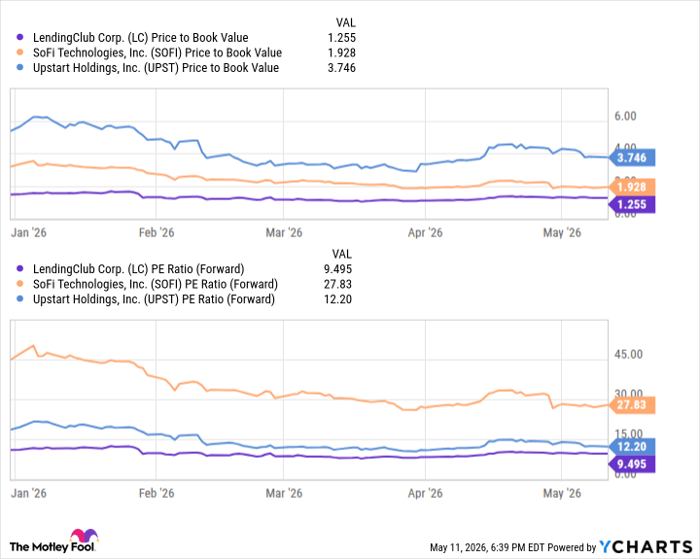
LC Price to Book Value data by YCharts
Will things start to happen?
On the call, Sanborn noted the rebrand to Happen Bank "speaks not only to our broad ambitions but also to our promise."
Will the rebrand to Happen Bank also lift LendingClub's valuation to a level more in sync with its financial results? While one can never be sure, it may be the right time for investors to buy this up-and-coming financial stock at a discount, before the name change occurs.
Should you buy stock in LendingClub right now?
Before you buy stock in LendingClub, consider this:
The Motley Fool Stock Advisor analyst team just identified what they believe are the 10 best stocks for investors to buy now… and LendingClub wasn’t one of them. The 10 stocks that made the cut could produce monster returns in the coming years.
Consider when Netflix made this list on December 17, 2004... if you invested $1,000 at the time of our recommendation, you’d have $460,826!* Or when Nvidia made this list on April 15, 2005... if you invested $1,000 at the time of our recommendation, you’d have $1,345,285!*
Now, it’s worth noting Stock Advisor’s total average return is 983% — a market-crushing outperformance compared to 207% for the S&P 500. Don't miss the latest top 10 list, available with Stock Advisor, and join an investing community built by individual investors for individual investors.
See the 10 stocks »
*Stock Advisor returns as of May 13, 2026.
Billy Duberstein has positions in LendingClub. The Motley Fool has positions in and recommends Upstart. The Motley Fool has a disclosure policy.
Recommended Articles


