


Berkshire Hathaway Just Resumed Stock Buybacks After a Long Pause. Here's What It Signals.
Key Points
Berkshire Hathaway recently revealed that it started buying back stock for the first time in nearly two years.
The buyback amount wasn’t large by Berkshire’s standards, but it sends a clear signal.
Berkshire can buy back stock whenever CEO Greg Abel and Chairman Warren Buffett agree it is attractive.
- 10 stocks we like better than Berkshire Hathaway ›
Berkshire Hathaway (NYSE: BRKA)(NYSE: BRKB) spent about $78 billion on stock buybacks from 2018 through 2024. But then the billions stopped flowing and simply accumulated as cash on Berkshire's balance sheet.
However, we recently learned that Berkshire completed its first buybacks in nearly two years, with recent regulatory filings showing that Berkshire spent about $234 million on buybacks during the first quarter of 2026. Here's a rundown of what this means to investors like you and me.
Will AI create the world's first trillionaire? Our team just released a report on the one little-known company, called an "Indispensable Monopoly" providing the critical technology Nvidia and Intel both need. Continue »
Why Berkshire's buyback is such a big deal
To be fair, $234 million isn't a massive buyback for Berkshire. It represents about 0.02% of Berkshire's current market cap of $1 trillion. However, there are two key points to consider. First, the buybacks in question occurred only in March -- that's just one month of the first quarter. We have no idea whether CEO Greg Abel will (or has already) buy back more stock in the second quarter, which is underway now.
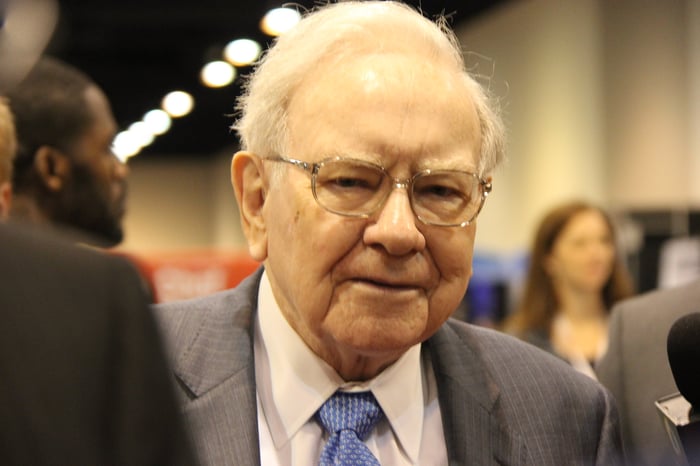
Image source: The Motley Fool.
Second, it's not just the buyback itself -- it's what the buyback represents. Berkshire's buyback policy is unique in the sense that there isn't a formal amount of money authorized for buybacks. Instead, Berkshire is allowed to buy back stock at any time when the CEO (Abel) and chairman of the board (legendary investor Warren Buffett) agree the stock is trading for a substantial discount to the intrinsic value of the shares.
Berkshire Hathaway's stock traded as low as 1.45 times book value in early March, a significant discount to the 1.6x-1.8x multiples it traded for during much of the 21-month period where no buybacks took place. So, the buyback is a clear signal that Abel considers that to be well below Berkshire's true value.
Is Berkshire a strong buy today?
It's also important to note that Berkshire is trading for a lower price-to-book valuation than it was at any point in March -- about 1.44x book, as of this writing. So, it seems reasonable to infer that if Abel's assessment of Berkshire Hathaway stock's intrinsic value is accurate, the stock is even cheaper today than when he was willing to spend some of Berkshire's own cash hoard on it. He was even willing to spend his own money on Berkshire, investing about $15 million to add to his personal stake in the conglomerate.
Of course, these buybacks are based on the analysis and opinions of Greg Abel and Warren Buffett. We don't know the methodology they used, nor do we know what they believe Berkshire's intrinsic value is. But with the stock still trading for more than 10% below the peak before Buffett announced his retirement, it could be an attractive time for long-term investors to take a closer look.
Should you buy stock in Berkshire Hathaway right now?
Before you buy stock in Berkshire Hathaway, consider this:
The Motley Fool Stock Advisor analyst team just identified what they believe are the 10 best stocks for investors to buy now… and Berkshire Hathaway wasn’t one of them. The 10 stocks that made the cut could produce monster returns in the coming years.
Consider when Netflix made this list on December 17, 2004... if you invested $1,000 at the time of our recommendation, you’d have $460,826!* Or when Nvidia made this list on April 15, 2005... if you invested $1,000 at the time of our recommendation, you’d have $1,345,285!*
Now, it’s worth noting Stock Advisor’s total average return is 983% — a market-crushing outperformance compared to 207% for the S&P 500. Don't miss the latest top 10 list, available with Stock Advisor, and join an investing community built by individual investors for individual investors.
See the 10 stocks »
*Stock Advisor returns as of May 13, 2026.
Matt Frankel, CFP has positions in Berkshire Hathaway. The Motley Fool has positions in and recommends Berkshire Hathaway. The Motley Fool has a disclosure policy.
Recommended Articles


