


Up Nearly 60% This Year, Is it Too Late to Buy CoreWeave Stock?
Key Points
CoreWeave is funding its growth with debt.
Nvidia is backing CoreWeave's buildout.
- 10 stocks we like better than CoreWeave ›
CoreWeave (NASDAQ: CRWV) has had a phenomenal 2026. Its stock is up nearly 60% since the start of the year, but nearly all of that rally started once the calendar flipped to April. With returns like that, investors would be forgiven if they thought they had missed the best of CoreWeave's stock, but once you look at its growth rates, it may cause investors to take another look.
The reality is that CoreWeave's business is rapidly expanding, which usually warrants a rapidly increasing stock price. That's exactly what we're seeing, but has the stock run up too far, too fast? Or is the growth driving this rise?
Will AI create the world's first trillionaire? Our team just released a report on the one little-known company, called an "Indispensable Monopoly" providing the critical technology Nvidia and Intel both need. Continue »

Image source: Getty Images.
CoreWeave's business is booming
CoreWeave is a neocloud company and focuses on outfitting its data centers with GPUs from Nvidia. In fact, Nvidia is a major investor in CoreWeave, which is a great backer to have. Nvidia is one of the fastest-growing companies on Earth, if it's using its resources to invest in another company. Nvidia thinks it can do better by owning CoreWeave shares rather than investing that capital back into its own business.
CoreWeave's business model is simple: pack its data centers full of cutting-edge GPUs and rent that excess capacity back to artificial intelligence (AI) hyperscalers, such as Meta Platforms and Microsoft (two of CoreWeave's major clients).
With all of the pent-up AI demand, this is a great business for CoreWeave to be in, and the success is showing up in its finances. In Q1 2026, CoreWeave's revenue rose 112% year over year to $2.1 billion. CoreWeave's revenue backlog soared 284% year over year and now sits at nearly $100 billion. While that's not true revenue, it shows how massive the contracts CoreWeave's clients are signing with it.
With growth like that, it may seem like a no-brainer buy, but there are other considerations. Building data centers and buying Nvidia GPUs isn't cheap, and CoreWeave has no other businesses to fund its build-out. As a result, it's taking on a hefty debt load to fund its growth.
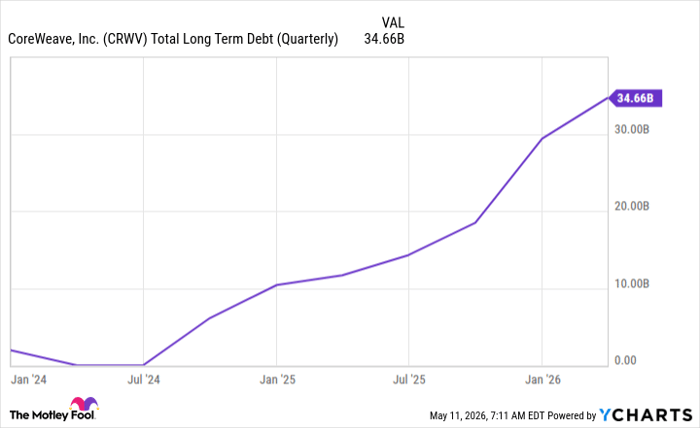
CRWV Total Long Term Debt (Quarterly) data by YCharts
However, if CoreWeave can stabilize as a business and reach the scale it wants, the cloud computing industry is one that produces consistent cash flows and can provide great business economics. CoreWeave will need to balance all-out growth with what the future looks like.
With the AI build-out full steam ahead, it's unlikely that CoreWeave will slow down anytime soon. So these ludicrous growth rates will continue. The jury is still out on whether CoreWeave can be a successful long-term investment, but investors won't know that for many years. This makes CoreWeave a risky investment, but it does have major upside if it can convert all of its contracted work into real business.
Should you buy stock in CoreWeave right now?
Before you buy stock in CoreWeave, consider this:
The Motley Fool Stock Advisor analyst team just identified what they believe are the 10 best stocks for investors to buy now… and CoreWeave wasn’t one of them. The 10 stocks that made the cut could produce monster returns in the coming years.
Consider when Netflix made this list on December 17, 2004... if you invested $1,000 at the time of our recommendation, you’d have $460,826!* Or when Nvidia made this list on April 15, 2005... if you invested $1,000 at the time of our recommendation, you’d have $1,345,285!*
Now, it’s worth noting Stock Advisor’s total average return is 983% — a market-crushing outperformance compared to 207% for the S&P 500. Don't miss the latest top 10 list, available with Stock Advisor, and join an investing community built by individual investors for individual investors.
See the 10 stocks »
*Stock Advisor returns as of May 12, 2026.
Keithen Drury has positions in Meta Platforms, Microsoft, and Nvidia. The Motley Fool has positions in and recommends Meta Platforms, Microsoft, and Nvidia. The Motley Fool has a disclosure policy.
Recommended Articles


