


Prediction: This Unstoppable Vanguard Index Fund Will Crush the S&P 500 (Again) in 2026
Key Points
The S&P 500 index has roared back from a sharp decline to post an 8% gain in 2026 so far.
The S&P 500 Growth index is doing even better, with a return of 10% thanks to high-flying tech stocks.
The Vanguard S&P 500 Growth ETF could end 2026 with a much bigger return than the S&P 500.
- 10 stocks we like better than Vanguard Admiral Funds - Vanguard S&P 500 Growth ETF ›
The stock market had a volatile start to 2026 because of the geopolitical tensions between the U.S. and Iran, which triggered a spike in oil prices that threatened to dent corporate earnings and the broader economy. At its March low point, the S&P 500 (SNPINDEX: ^GSPC) index was down by as much as 9% from its peak.
Fortunately, tensions have eased, and the S&P 500 is now up 8% for 2026. But had investors parked their money in the S&P 500 Growth index at the start of this year instead, they would be sitting on a better return of 10%. The Growth index exclusively holds 143 of the best-performing growth stocks from the regular S&P 500, while maintaining very little exposure to the weaker areas of the market.
Will AI create the world's first trillionaire? Our team just released a report on the one little-known company, called an "Indispensable Monopoly" providing the critical technology Nvidia and Intel both need. Continue »
The Vanguard S&P 500 Growth ETF (NYSEMKT: VOOG) is an exchange-traded fund (ETF) that tracks the performance of the Growth index by holding the same stocks. It has a stellar long-term track record against the S&P 500, and here's why I predict it will continue pulling ahead of the index in 2026.

Image source: Getty Images.
The formula for beating the S&P 500
The S&P 500 Growth index selects stocks based on their momentum and the sales growth of the underlying companies, so it's no surprise that 48.1% of the entire value of its portfolio is parked in stocks from the information technology sector alone. They include Nvidia, Microsoft, Apple, and Broadcom, which are leaders in artificial intelligence (AI), enterprise software, consumer devices, semiconductors, and more.
While those stocks also feature prominently in the regular S&P 500, the index is more diversified, so it assigns a much lower 32.9% weighting to the overall information technology sector.
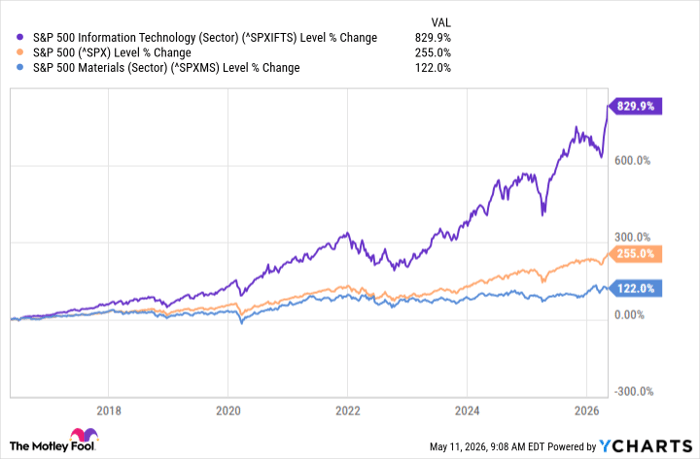
The information technology sector has produced an eye-popping return of 829% over the last 10 years, so any index that assigned it a high weighting over that period almost certainly would have outperformed one that assigned it a more conservative weighting.
However, the outperformance of the Growth index relative to the S&P 500 is also about the sectors in which it invests less aggressively. Its lowest-weighted sector is materials, which accounts for just 0.4% of its portfolio, but it's 2.1% of the S&P 500. It has underperformed the market over the last decade, with a return of just 122%.
^SPXIFTS data by YCharts
The Vanguard ETF looks poised for a strong year
Looking at the long term, the Vanguard S&P 500 Growth ETF has delivered a compound annual return of 16.7% since its inception in 2010. That is much better than the yearly return of 13.5% produced by the S&P 500 over the same period, which highlights the benefits of investing aggressively in growth stocks.
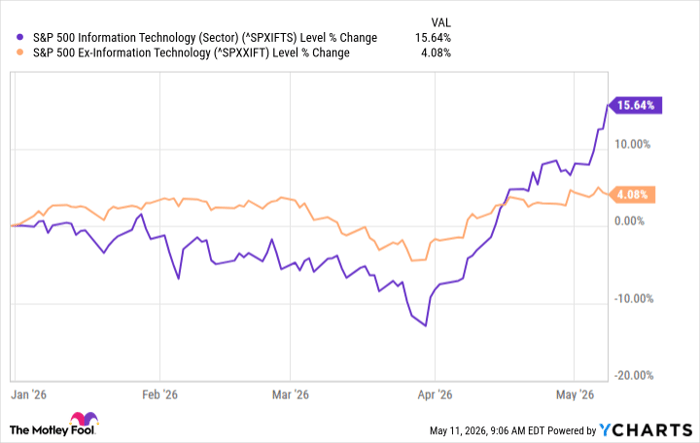
However, growth-oriented areas of the market -- like information technology -- underperform sometimes, particularly when volatility spikes. In fact, the S&P 500 excluding the information technology sector performed significantly better than the information technology sector on its own during the first four months of 2026. When economic shocks arise (like the Iran war), investors often cash in gains from some of their best-performing holdings and flock to the safety of defensive stocks or even cash to ride out the storm.
^SPXIFTS data by YCharts
But as displayed in the above chart, the information technology sector came roaring back in April, which is when the U.S. and Iran reached a ceasefire agreement. Therefore, as long as these conditions hold, I think it will set the stage for further outperformance in the Vanguard ETF relative to the S&P 500.
Plus, the Vanguard ETF will continue benefiting from the incredible growth in the AI industry, thanks to its high degree of exposure to semiconductor companies like Nvidia and Broadcom, which sell advanced data center chips and components. The ETF also has almost twice as much of its portfolio (by weight) parked in other soaring AI infrastructure stocks like Micron Technology and Advanced Micro Devices compared to the S&P 500.
As a result, based on its stellar long-term track record and the currently favorable market conditions, I think the Vanguard S&P 500 Growth ETF will finish 2026 with a higher return than the S&P 500.
Should you buy stock in Vanguard Admiral Funds - Vanguard S&P 500 Growth ETF right now?
Before you buy stock in Vanguard Admiral Funds - Vanguard S&P 500 Growth ETF, consider this:
The Motley Fool Stock Advisor analyst team just identified what they believe are the 10 best stocks for investors to buy now… and Vanguard Admiral Funds - Vanguard S&P 500 Growth ETF wasn’t one of them. The 10 stocks that made the cut could produce monster returns in the coming years.
Consider when Netflix made this list on December 17, 2004... if you invested $1,000 at the time of our recommendation, you’d have $460,826!* Or when Nvidia made this list on April 15, 2005... if you invested $1,000 at the time of our recommendation, you’d have $1,345,285!*
Now, it’s worth noting Stock Advisor’s total average return is 983% — a market-crushing outperformance compared to 207% for the S&P 500. Don't miss the latest top 10 list, available with Stock Advisor, and join an investing community built by individual investors for individual investors.
See the 10 stocks »
*Stock Advisor returns as of May 12, 2026.
Anthony Di Pizio has no position in any of the stocks mentioned. The Motley Fool has positions in and recommends Advanced Micro Devices, Apple, Broadcom, Micron Technology, and Nvidia. The Motley Fool has a disclosure policy.
Recommended Articles


