


Where Are Comcast and Charter's Internet Customers Going? Here.
Key Points
Comcast and Charter both continue to lose broadband customers.
They’re losing these lucrative customers to an unexpected alternative.
There’s still plenty of this customer migration left to suffer, too.
- 10 stocks we like better than Comcast ›
The fact that streaming video is chipping away at cable television's customer base isn't anything new. That's been the case since 2013. But cable providers were able to count on their broadband internet business to offset this attrition.
Now, however, it seems even high-speed internet is no longer a defensible business. Comcast's (NASDAQ: CMCSA) Xfinity lost another 65,000 high-speed internet subscribers last quarter, while Charter Communications' (NASDAQ: CHTR) Spectrum shed 117,000 residential broadband customers in addition to a small handful of business customers. In both cases, this attrition extends what have become well-developed trends, too. Each company's internet customer count peaked in 2023, and each has since suffered losses in excess of 1 million subscribers.
Will AI create the world's first trillionaire? Our team just released a report on the one little-known company, called an "Indispensable Monopoly" providing the critical technology Nvidia and Intel both need. Continue »
But if streaming requires a high-speed connection, where are all these broadband customers going?As it turns out, there's a relatively new option that's getting some serious traction.
A threat now too big to ignore
The top threat to the cable industry's high-speed internet business is no longer a rival cable name. It's wireless telecom names T-Mobile US (NASDAQ: TMUS) and Verizon Communications (NYSE: VZ). Leveraging their 5G mobile broadband networks' high-speed capabilities, consumers can now use this connectivity option -- called fixed wireless access, or FWA -- within their homes just as they would a traditional broadband service.
And they're using this option a lot! The graphic below tells the tale. T-Mobile and Verizon now serve a total of 15.5 million FWA customers after launching these services just a few years ago. It's no coincidence that Comcast's and Charter's high-speed internet customer base began shrinking around that same time.
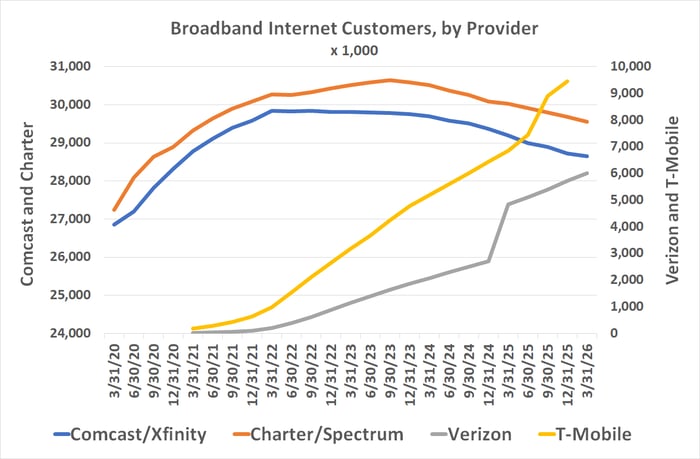
Data sources: Comcast, Charter, Verizon, and T-Mobile quarterly reports. Chart by author. Notes: Acquisitions and reclassifications resulted in a sharp increase in Verizon's 5G FWA broadband customer count in 2025. T-Mobile has not provided a FWA broadband customer count for Q1 of 2026.
Ignore at your own peril
Spectrum and Xfinity are still the nation's two biggest broadband internet service providers, for the record, and their high-speed internet operations are still important cash cows for both. Internet service accounts for roughly 20% of Comcast's revenue and roughly 40% of Charter's.
That's the problem for both outfits, however -- there's still a wide swath of business to lose to competition that's competitive in price and not necessarily limited by a lack of lines extending all the way to peoples' homes.
This evolution is, of course, a solid opportunity for Verizon and T-Mobile. But it's an even bigger risk for Charter and Comcast, both of which saw earnings before interest, taxes, depreciation, and amortization (EBITDA) tumble last quarter. Weak performances from their high-speed internet businesses were a key contributor to these declines.
Shareholders of either provider can't afford to ignore the fact that this customer migration could continue at this pace for a long, long time.
Should you buy stock in Comcast right now?
Before you buy stock in Comcast, consider this:
The Motley Fool Stock Advisor analyst team just identified what they believe are the 10 best stocks for investors to buy now… and Comcast wasn’t one of them. The 10 stocks that made the cut could produce monster returns in the coming years.
Consider when Netflix made this list on December 17, 2004... if you invested $1,000 at the time of our recommendation, you’d have $476,034!* Or when Nvidia made this list on April 15, 2005... if you invested $1,000 at the time of our recommendation, you’d have $1,274,109!*
Now, it’s worth noting Stock Advisor’s total average return is 975% — a market-crushing outperformance compared to 206% for the S&P 500. Don't miss the latest top 10 list, available with Stock Advisor, and join an investing community built by individual investors for individual investors.
See the 10 stocks »
*Stock Advisor returns as of May 7, 2026.
James Brumley has no position in any of the stocks mentioned. The Motley Fool recommends Comcast, T-Mobile US, and Verizon Communications. The Motley Fool has a disclosure policy.
Recommended Articles


