


How Gas Prices and the Iran Conflict Are Shaping Your 2027 Social Security Raise
Key Points
Energy and gasoline prices increased by 11% and 21% in March, respectively.
Higher gas prices can increase the Consumer Price Index, the metric used to calculate the annual Social Security cost-of-living adjustment.
The average gallon of regular gas in the U.S. cost $4.30 at the end of April.
- The $23,760 Social Security bonus most retirees completely overlook ›
The conflict in Iran began on Feb. 28 with the assumption that it would last only a few weeks. Americans began noticing gas prices were rising, but most thought it wouldn't last long. Fast forward to the beginning of May, and the conflict continues, and gas prices haven't seen much relief.
As of the end of April, the average price for a gallon of regular gas was $4.30, $1.12 more than the average in April 2025 -- and prices have increased more since then. Right now, millions of Americans are feeling the effects of the Iran war in their wallets, but it can also have an unintended consequence for current and incoming Social Security recipients.
Will AI create the world's first trillionaire? Our team just released a report on the one little-known company, called an "Indispensable Monopoly" providing the critical technology Nvidia and Intel both need. Continue »

Image source: Getty Images.
How Social Security determines the annual COLA
The annual Social Security cost-of-living adjustment (COLA) is set by looking at changes in the Consumer Price Index for Urban Wage Earners and Clerical Workers (CPI-W), a monthly metric released by the U.S. Bureau of Labor Statistics (BLS) that tracks changes in prices of goods and services like food, housing, transportation, and energy.
Social Security looks at the average CPI-W in the third quarter (Q3) of the current year, compares it to the Q3 average from the previous year, and then sets the COLA to the percentage increase.
For example, the average in 2025 was 2.8% higher than in 2024, which is how we got the 2.8% COLA for 2026. If the average this year is 3% higher than last year, the COLA in 2027 will be 3%.
If the CPI-W average in a given year is the same or less than the previous year, there's no COLA applied, but benefits won't ever decrease.
How gas prices have affected overall inflation in the U.S.
The country's main inflation indicator (the CPI-U) is much broader than the CPI-W used for the Social Security COLA. However, there is a lot of overlap between them, including in energy prices. In March, inflation rose by 3.3% -- up from 2.4% last March -- with much of the increase driven by higher energy prices.
According to the BLS, the gasoline index jumped by 21%. The overall energy index rose 11%. These aren't slight jumps that go relatively unnoticed, either; I'm sure most Americans can tell you they feel every percentage point when they go to the pumps.
We can't say for certain what April's inflation numbers will be until the BLS releases them on May 12, but the thought is that inflation will continue to rise, again led by high energy and gasoline prices.
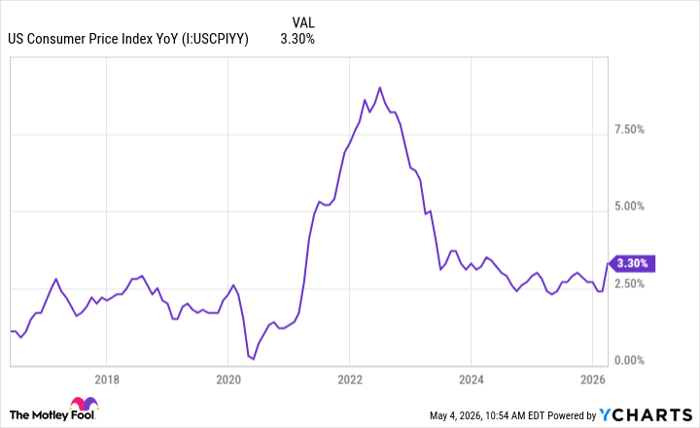
US Consumer Price Index YoY data by YCharts
The CPI-W metric places greater weight on energy and gas prices than the standard CPI-U, so it's likely to come in higher. The World Bank estimates that energy prices will increase by 24%, up to their highest levels since Russia invaded Ukraine in 2022.
How are gas prices likely to affect the 2027 COLA?
The current inflation numbers won't affect the 2027 COLA, because the adjustment is based on the Q3 numbers. Unfortunately, though, there doesn't seem to be any resolution to the Iran war in sight, which means there likely won't be much relief at the gas station either.
If the high gas prices continue through Q3, the CPI-W is likely to see a jump that translates into a higher COLA than in the past three years (2.8%, 2.5%, and 3.2%).
The Senior Citizens League (TSCL) is a non-partisan senior advocacy group that produces COLA estimates. It currently has its 2027 COLA projection at 4%, which would be the fourth-highest COLA since 2007.
On the one hand, I'm sure retirees will appreciate a sizable boost to their benefits. On the other, that means that inflation is higher, and it doesn't help retirees right now. Retirees are seeing more of their Social Security checks go toward gas right now, but unfortunately, benefits can't be adjusted mid-year to help them deal with the rising inflation.
The $23,760 Social Security bonus most retirees completely overlook
If you're like most Americans, you're a few years (or more) behind on your retirement savings. But a handful of little-known "Social Security secrets" could help ensure a boost in your retirement income.
One easy trick could pay you as much as $23,760 more... each year! Once you learn how to maximize your Social Security benefits, we think you could retire confidently with the peace of mind we're all after. Join Stock Advisor to learn more about these strategies.
View the "Social Security secrets" »
The Motley Fool has a disclosure policy.
Recommended Articles


