


Why I'm Losing Patience With Crypto as an Asset Class
Key Points
The last five years have been a rough ride for crypto.
Patient investors did not necessarily come out ahead.
There's a vanishingly small set of crypto assets worth buying now.
- 10 stocks we like better than Bitcoin ›
Suppose you had invested in a basket of the biggest cryptocurrencies five years ago, in early May 2021. You would have bought Bitcoin (CRYPTO: BTC) near $56,000, Ethereum (CRYPTO: ETH) near $3,400, XRP (CRYPTO: XRP) about $1.60, Solana (CRYPTO: SOL) at $45, and Dogecoin (CRYPTO: DOGE) near $0.40. Those were the coins with the most buzz and the most liquidity, and, in some cases, the strongest fundamental arguments, and optimism about their future was widely prevalent, and somewhat reasonable.
Fast-forward five years. Buying the stock market via an S&P 500 index fund returned about 85% in that period, outperforming all of those cryptocurrencies except for Solana. With results like those, it's no wonder investors are losing patience with crypto as an asset class -- and I'm one of them.
Will AI create the world's first trillionaire? Our team just released a report on the one little-known company, called an "Indispensable Monopoly" providing the critical technology Nvidia and Intel both need. Continue »

Image source: Getty Images.
This was five years of mediocrity (and worse)
During the past five years, Bitcoin, the most credible asset in the sector, delivered just a little more than half of the S&P 500's return. Ethereum and Dogecoin lost money outright, whereas XRP was unchanged.
Take a look at this chart:
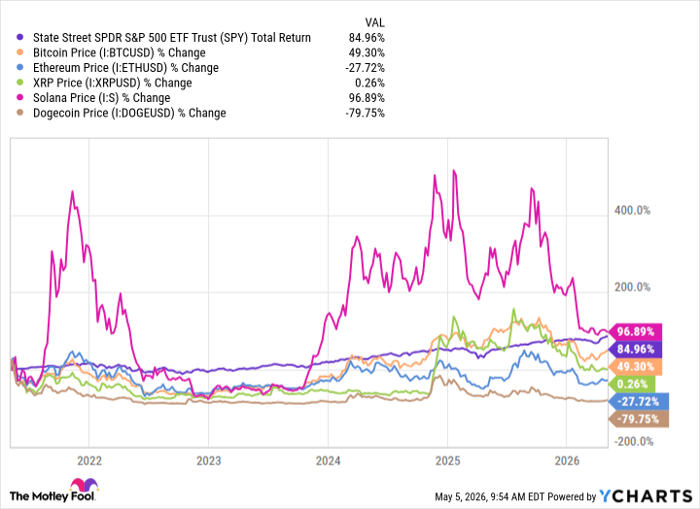
SPY Total Return Level data by YCharts
This isn't cherry-picked timing. May 2021 wasn't a blow-off peak for most of these assets, and Bitcoin didn't hit its high until much later.
Ethereum's story (and its lack of strong returns) should concern investors most, because it's the coin with the strongest claim to driving the future of cryptocurrency's real-world applications. Its decentralized finance ecosystem, which contains the collection of lending, borrowing, and trading protocols built on its chain, today holds $46 billion in total value locked (TVL), a measure of capital deposited in those protocols. Major asset managers are building tokenized products on it. And yet the coin's price has gone backward, not to mention that its TVL exceeded $105 billion for a while in 2021.
One big problem is that there's a widening gap between the degree of activity on the chain and the returns for holders of the chain's native coin. Most blockchains issue their native coins faster than real on-chain usage generates demand for them, and the economic activity on the chain doesn't flow back to holders in any reliable way. Ethereum's gas (user) fees clearly aren't enough to do much for holders even though they've soaked up $2.1 billion in Ether coins during the past three years amid a rising number of weekly transactions.
This isn't unique to Ethereum. A CoinDesk analysis of the eight largest blockchain ecosystems found that chain fees declined across all of them in 2025, even as TVL and activity grew.
Practically every crypto major posted negative returns last year despite improving on-chain fundamentals. And that's quite frustrating for investors because it means one of the core pillars of more than one investment thesis is looking pretty brittle.
There might be relief soon -- or a reckoning
The sector's biggest near-term catalyst is legislative.
The Digital Asset Market Clarity Act (the Clarity Act) is inching through the U.S. Senate, with a recent compromise on stablecoin yield rules potentially clearing a path for a committee markup. If passed, the bill would create a regulatory framework that makes competing in crypto much clearer for institutions.
Even if it passes, the question will be who benefits from it. Regulatory clarity will help exchanges, custodians, and infrastructure companies. It might boost crypto exchange-traded fund inflows. But the structural problem remains: Using a blockchain usually doesn't obligate anyone to own its token in meaningful quantities relative to its supply, and tokens don't confer ownership rights the way shares of a stock do.
I'm not walking away from crypto. Bitcoin's investment thesis is distinct from the rest because its value proposition is that it's scarce, not that it needs to be used so as to generate fees for its holders.
But for the broader sector, five years of data is telling me something that enthusiasm alone can't override, which is that this is an industry where the financial returns overwhelmingly flow to the developers rather than to the investors in a project or chain's coins. That will need to change for crypto be a competitive asset class from here on out.
If you're allocating capital, the case for a diversified portfolio tilted toward equities has been stronger than the case for crypto for a half-decade now. Until the industry solves the disconnect between on-chain activity and token returns, I plan to be quite cautious with any new investments.
Should you buy stock in Bitcoin right now?
Before you buy stock in Bitcoin, consider this:
The Motley Fool Stock Advisor analyst team just identified what they believe are the 10 best stocks for investors to buy now… and Bitcoin wasn’t one of them. The 10 stocks that made the cut could produce monster returns in the coming years.
Consider when Netflix made this list on December 17, 2004... if you invested $1,000 at the time of our recommendation, you’d have $490,864!* Or when Nvidia made this list on April 15, 2005... if you invested $1,000 at the time of our recommendation, you’d have $1,216,789!*
Now, it’s worth noting Stock Advisor’s total average return is 963% — a market-crushing outperformance compared to 201% for the S&P 500. Don't miss the latest top 10 list, available with Stock Advisor, and join an investing community built by individual investors for individual investors.
See the 10 stocks »
*Stock Advisor returns as of May 6, 2026.
Alex Carchidi has positions in Bitcoin, Ethereum, and Solana. The Motley Fool has positions in and recommends Bitcoin, Ethereum, Solana, and XRP. The Motley Fool has a disclosure policy.
Recommended Articles


