


Is This Millionaire-Maker Biotech Stock a Buy Right Now?
Key Points
Vertex Pharmaceuticals' core business isn't the growth driver it once was.
The company has also found it hard to expand into new areas.
However, things could improve for Vertex Pharmaceuticals in the coming years.
- 10 stocks we like better than Vertex Pharmaceuticals ›
If you had invested $20,000 in Vertex Pharmaceuticals (NASDAQ: VRTX) in its IPO in 1991 and held onto its shares, you'd have over $1 million today, considering the company's strong 14% compound annual growth rate since then, much better than the S&P 500's 11% over the same period. Maintaining this pace over more than three decades is commendable. However, can Vertex Pharmaceuticals still perform well from here on out?
Image source: The Motley Fool.
Will AI create the world's first trillionaire? Our team just released a report on the one little-known company, called an "Indispensable Monopoly" providing the critical technology Nvidia and Intel both need. Continue »
The past few years haven't been great
Vertex Pharmaceuticals has made quite a name for itself, given the company's dominance in its core market. It develops medicines for a rare disease called cystic fibrosis (CF), characterized by the accumulation of thick, sticky mucus in the lungs, which leads to a range of problems, including respiratory issues. Vertex Pharmaceuticals is the only notable player in this niche. Its portfolio of CF medicines has improved over time, enabling it to treat about 95% of CF patients in the U.S.
However, as the biotech leader has made progress in this field, its top-line growth rates have declined. In the first quarter, Vertex's revenue increased by 8% year over year to $2.99 billion. That's not terrible, but Vertex Pharmaceuticals has seen a general downward trend on this front in recent years.
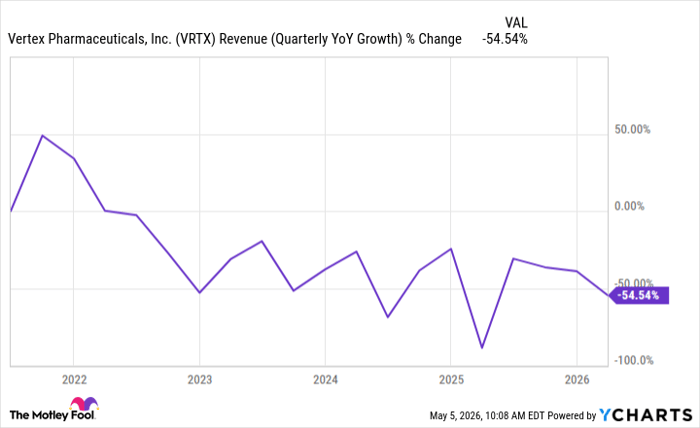
VRTX Revenue (Quarterly YoY Growth) data by YCharts
What's more, although the drugmaker is trying to diversify its lineup and reduce its exposure to its core therapeutic area, its efforts in that regard have thus far been somewhat unsuccessful. That's why Vertex Pharmaceuticals has lagged broader equities over the past three years.
Reasons to be optimistic
Despite its struggles in non-CF markets, things may be about to pick up for Vertex Pharmaceuticals. The company expects at least $500 million in non-CF revenue this year. That's significant for Vertex Pharmaceuticals, since in 2024 it reported $10 million in revenue from products outside CF, which grew to $175.4 million last year.
Things will likely improve further in 2027. Vertex Pharmaceuticals is now seeking approval for Casgevy, a gene editing medicine for sickle cell disease (SCD) and transfusion-dependent beta-thalassemia (TDT), for patients between the ages of five and 11; Vertex Pharmaceuticals co-markets Casgevy with CRISPR Therapeutics. The median age of death for SCD and TDT patients is 45 and 37, respectively, hence the importance of treating them as early as possible. That's why this label expansion is important for Vertex Pharmaceuticals.
Meanwhile, the company is racing toward approval of povetacicept, a therapy for IgA nephropathy (IgAN), a kidney disease. Povetacicept could become a major growth driver, especially if it earns indications beyond IgAN. Even in CF, Vertex Pharmaceuticals will likely seek to develop new products, as it has in the past, including some to treat the remaining 5% of patients it can't reach with its current medicines. My view is that, within a few years, Vertex Pharmaceuticals will have a much deeper, more diversified portfolio, helping it post stronger revenue and earnings growth.
And the company's core CF business that can still perform relatively well, along with a deep pipeline, makes its long-term prospects bright. For all those reasons, Vertex Pharmaceuticals looks attractive at current levels.
Should you buy stock in Vertex Pharmaceuticals right now?
Before you buy stock in Vertex Pharmaceuticals, consider this:
The Motley Fool Stock Advisor analyst team just identified what they believe are the 10 best stocks for investors to buy now… and Vertex Pharmaceuticals wasn’t one of them. The 10 stocks that made the cut could produce monster returns in the coming years.
Consider when Netflix made this list on December 17, 2004... if you invested $1,000 at the time of our recommendation, you’d have $490,864!* Or when Nvidia made this list on April 15, 2005... if you invested $1,000 at the time of our recommendation, you’d have $1,216,789!*
Now, it’s worth noting Stock Advisor’s total average return is 963% — a market-crushing outperformance compared to 201% for the S&P 500. Don't miss the latest top 10 list, available with Stock Advisor, and join an investing community built by individual investors for individual investors.
See the 10 stocks »
*Stock Advisor returns as of May 6, 2026.
Prosper Junior Bakiny has positions in Vertex Pharmaceuticals. The Motley Fool has positions in and recommends CRISPR Therapeutics and Vertex Pharmaceuticals. The Motley Fool has a disclosure policy.
Recommended Articles


